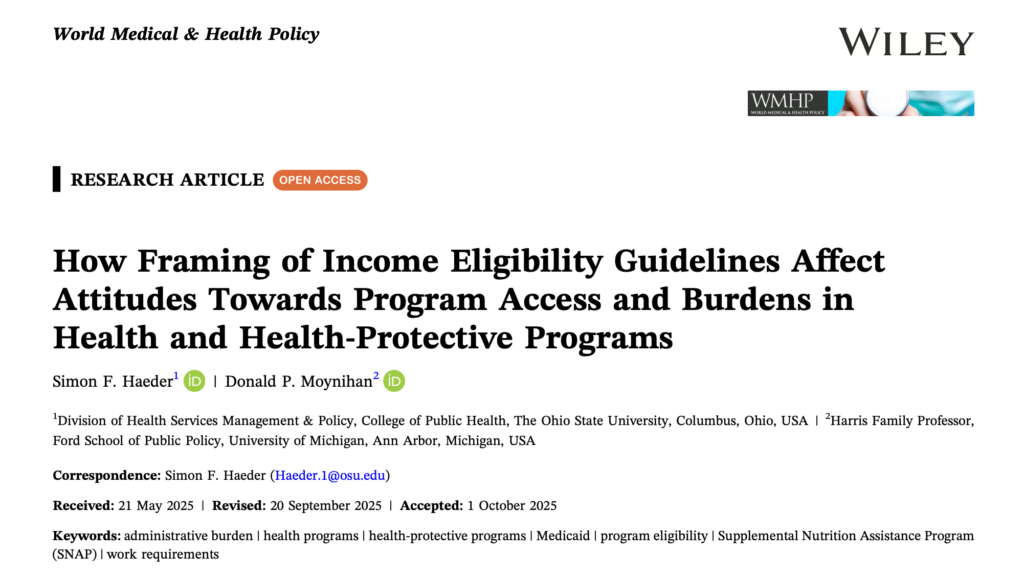
How Framing of Income Eligibility Guidelines Affect Attitudes Towards Program Access and Burdens in Health and Health-Protective Programs
This research article explores how framing income eligibility guidelines in either dollar amounts or as a percentage of the Federal Poverty Line (FPL) affects public attitudes toward program access and administrative burdens in Medicaid and SNAP.
The study utilized a national survey experiment featuring vignettes with racially identifiable names to test preferences regarding eligibility and work requirements.
Researchers found that when Medicaid eligibility was presented in FPL terms rather than dollars, public support for benefits decreased, likely because FPL categories feel more abstract or bureaucratic compared to tangible dollar values. Interestingly, these framing effects did not hold for evaluations of SNAP or for work requirements, and the study found no significant differences in attitudes based on the race or ethnicity of the potential beneficiaries. However, consistent differences in support were identified based on the respondents’ own partisanship, ideology, and knowledge of the disparate effects of administrative burdens.
Share this Resource: