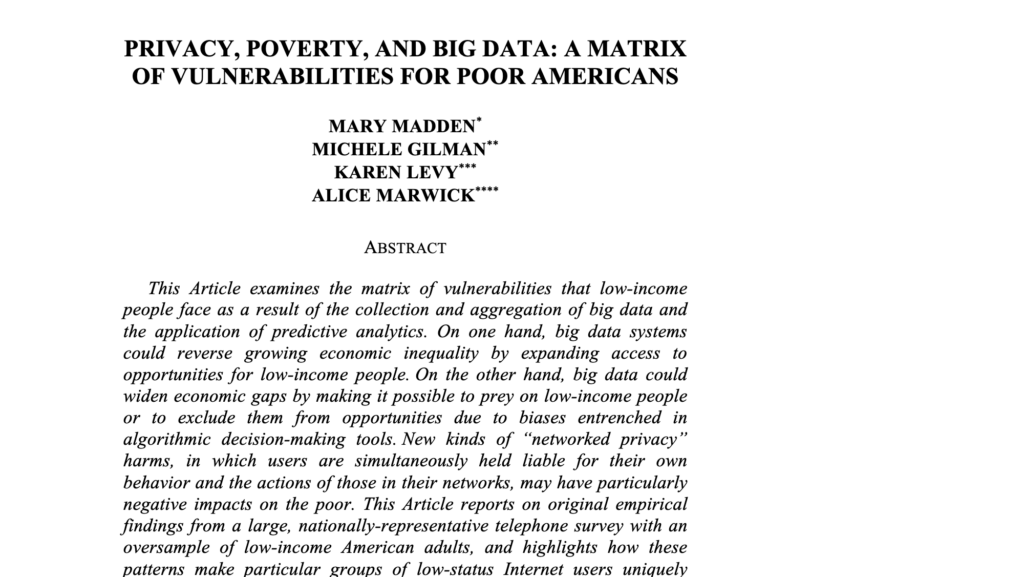
The authors report on original empirical survey findings to show that a greater reliance on mobile connectivity—combined with fewer privacy-protective strategies—leaves low-income internet users uniquely exposed to severe surveillance harms and “networked privacy” risks, where individuals are penalized for the actions of those in their networks.
The resource provides targeted legal analyses across three real-world case studies: employment screening algorithms that reflect preexisting structural disadvantages, predictive analytics in higher education admissions, and algorithmic threat scores used in predictive policing.
Share this Resource: