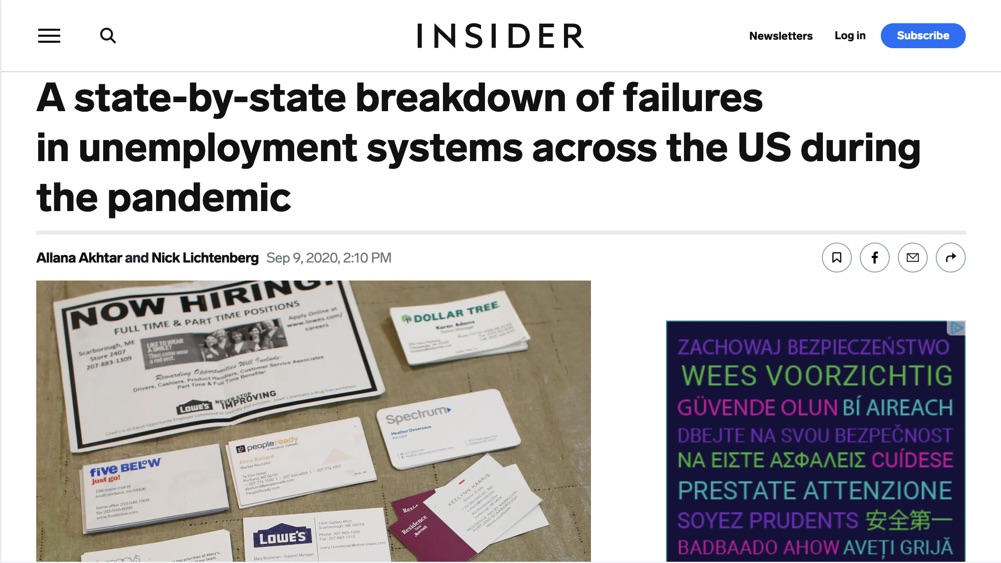
This article examines how outdated state unemployment insurance (UI) systems struggled during the COVID-19 pandemic, leading to delays, technical failures, and widespread frustration for job seekers.
Ad Hoc has found that product operations can help scale impact by putting objective indicators at the center of product decision-making. The team has seen success in supporting product thinking at agencies like the Department of Veterans Affairs (VA), where they made it easier for Veterans to access employment and education assistance and for caregivers to receive needed support.
In this panel conversation from Better Identity Coalition’s 2022 policy forum “Identity, Authentication, and the Road Ahead” presenters from the General Services Administration, the Transportation Security Administration, the Consumer First Coalition, and the congressional branch, discuss government’s role in digital identity.
This presentation explores the balance between security and user experience in digital benefit account creation and authentication, highlighting insights from a forthcoming playbook focused on SNAP and Medicaid portals.
The team developed an AI solution to assist benefit navigators with in-the-moment program information, finding that while LLMs are useful for summarizing and interpreting text, they are not ideal for implementing strict formulas like benefit calculations, but can accelerate the eligibility process by leveraging their strengths in general tasks.
The team developed an application to simplify Medicaid and CHIP applications through LLM APIs while addressing limitations such as hallucinations and outdated information by implementing a selective input process for clean and current data.
Public procurement in state governments can be slow and inefficient, but artificial intelligence (AI) offers a solution by automating tasks, improving decision-making, and addressing workforce gaps, as highlighted in a joint brief by NASCIO and NASPO.
National Association of State Chief Information Officers (NASCIO)
This toolkit provides guidance to protect participant confidentiality in human services research and evaluation, including legal frameworks, risk assessment strategies, and best practices.
U.S. Department of Health and Human Services (HHS)
EBT theft has deeply damaged the lives of the lowest-income Americans. The following insights reveal a system that leaves people in the dark and fails to protect a crucial lifeline.