The Digital Service Network (DSN) spoke with Chief Digital Officer (CDO) Julia Gutiérrez of the Digital Services (DS) Team in the Department of Innovation and Technology (DoIT) and Chief Mariangely Solís Cervera of Boston’s Equity and Inclusion Cabinet.
Through analyzing hundreds of research studies and surveying thousands of Americans this report identifies 28 life experiences that drive lifetime income, called mobility experiences.
This Urban Institute report examines how public investments in children's health, education, and welfare yield significant short- and long-term benefits for both individuals and society.
This Urban Institute report highlights how immigrant and mixed-status families continued to avoid safety net programs in 2023 due to lingering fears around the public charge rule.
These principles and best practices for AI developers and employers to center the well-being of workers in the development and deployment of AI in the workplace and to value workers as the essential resources they are.
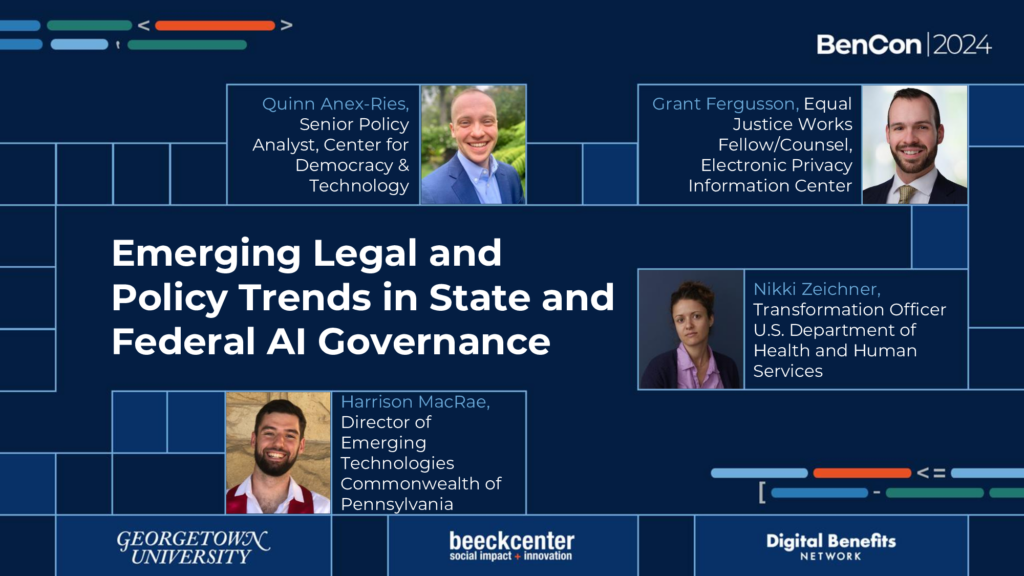
BenCon 2024 explored state and federal AI governance, highlighting the rapid increase in AI-related legislation and executive orders. Panelists emphasized the importance of experimentation, learning, and collaboration between government levels, teams, agencies, and external partners.
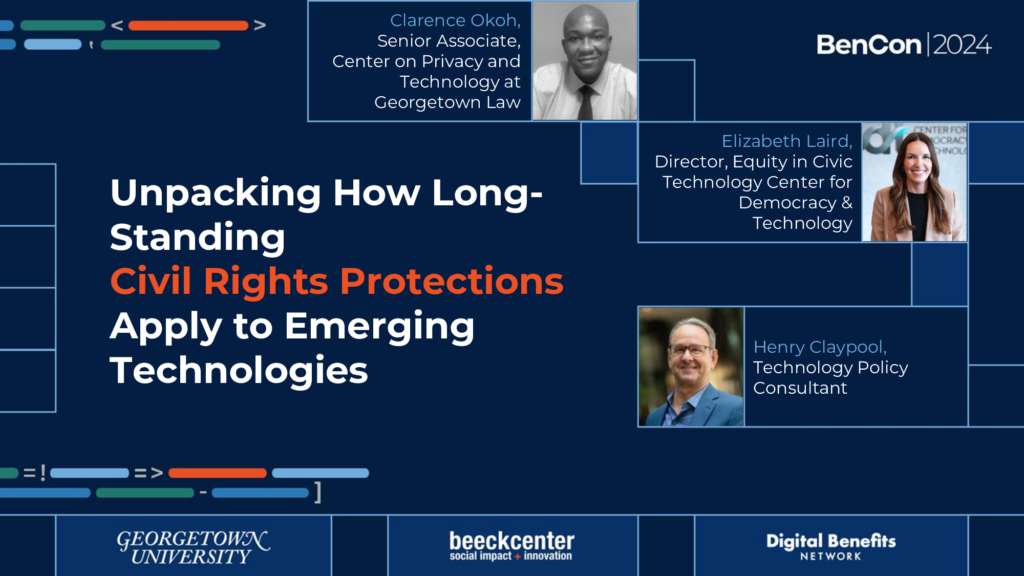
A panel of experts discuss the application of civil rights protections to emerging AI technologies, highlighting potential harms, the need for inclusive teams, and the importance of avoiding technology-centric solutions to social problems.
This article explores how AI and Rules as Code are turning law into automated systems, including how governance focused on transparency, explainability, and risk management can ensure these digital legal frameworks stay reliable and fair.
Presentation covering the findings of a research study analyzing the structural and budgetary layout of of eleven US-based Digital Service Teams (DSTs) at the municipal, county, and state levels.
The Policy2Code Prototyping Challenge explored utilizing generative AI technology to translate U.S. government policies for public benefits into plain language and code, culminating in a Demo Day where twelve teams showcased their projects for feedback and evaluation.