This report investigates how D.C. government agencies use automated decision-making (ADM) systems and highlights their risks to privacy, fairness, and accountability in public services.
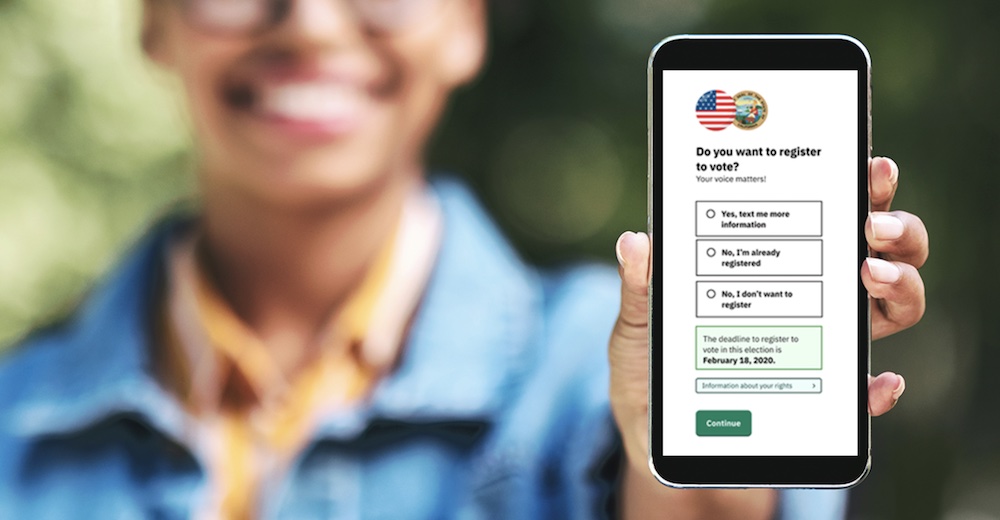
The GetCalFresh team, the California Department of Social Services, and the California Secretary of State’s office worked together to create a simplified, accessible voter registration experience with clients. When people come to GetCalFresh.org, they are looking to apply for food assistance, so the state of California did not want voter registration to become an obstacle to the goal of getting food assistance. Thus, rather than directing clients to anther website, they offered to text clients a link to the CA Secretary of State’s voter website with directions on how to register.
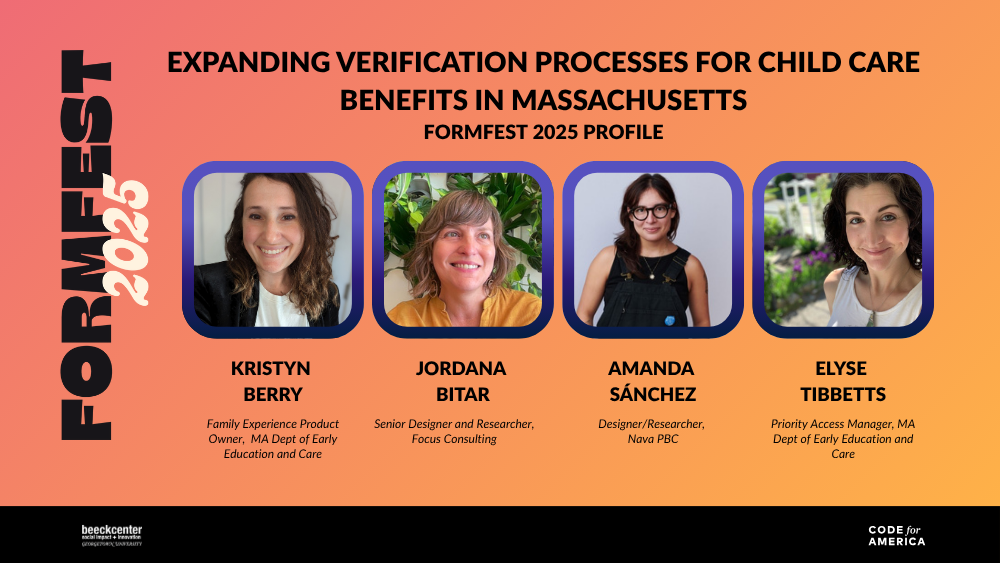
This FormFest profile examines how Massachusetts’ Department of Early Education and Care is modernizing its child care benefits system through human-centered design, making verification and application processes simpler, more compassionate, and more efficient for families and staff.
This piece highlights promising design patterns for account creation and identity proofing in public benefits applications. The publication also identifies areas where additional evidence, resources, and coordinated federal guidance may help support equitable implementations of authentication and identity proofing, enabling agencies to balance access and security.
This publication shares ten ways states can improve start-to-finish customer experience for unemployment insurance claimants. These approaches can increase overall equitable access and system integrity for UI administration.
Digital service (DS) teams across the public sector are working to improve how services are delivered to residents. These teams exist at all levels of government and are iteratively using data, technology, and human-centered design to reframe how residents interact with government.
Blog post authored by U.S. Digital Response discussing best practices for creating inclusive, accessible, and affirming government services for LGBTQ+ populations gleaned from their recent work in the City of Boston.