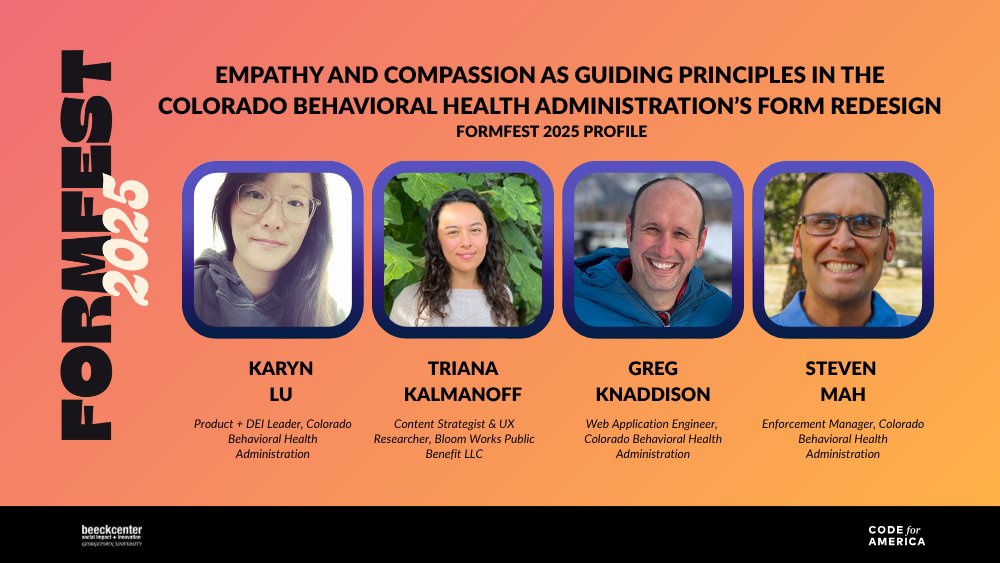
This FormFest profile highlights how the Colorado Behavioral Health Administration redesigned its complaint submission form using empathy, human-centered design, and trauma-informed research methods to make the process more accessible, compassionate, and secure for all users.
An event recap from one of FormFest 2024's breakout sessions featuring speakers from the state of Maryland's Department of Social Services and the U.S. Department of Health and Human Services (HHS).
An event recap from one of FormFest 2024's breakout sessions featuring speakers from Digital Service Teams across the United States and the Department of Veteran Affairs.
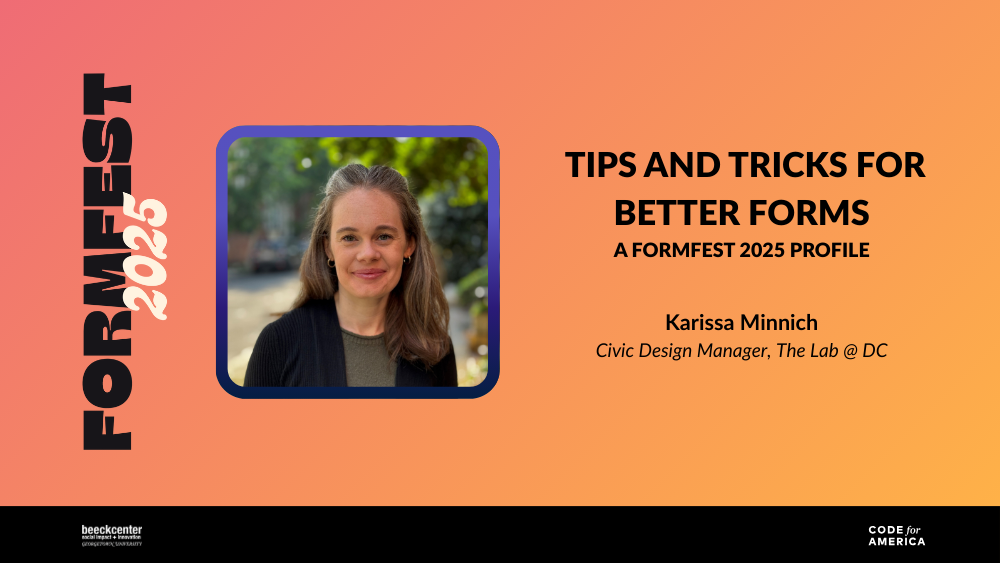
A profile on FormFest speaker Karissa Minnich, a civic design manager with The Lab @ DC, whose innovative approach to redesigning government forms has transformed paperwork into a model of human-centered design.
The Digital Service Network (DSN) spoke with three staff members from the Digital Transformation Team in Montgomery County Public LIbraries—Maddie Schellhardt, Raymond Bryson, and Emily Lamancusa, to learn more about the county's efforts to advance digital service delivery and inclusion
This paper describes results from fieldwork conducted at a social services site where the workers evaluate citizens' applications for food and medical assistance submitted via an e-government system. These results suggest value tensions that result - not from different stakeholders with different values - but from differences among how stakeholders enact the same shared value in practice.
CHI '14: Proceedings of the SIGCHI Conference on Human Factors in Computing Systems
This case study explores how the City of Akron developed a community tree map to engage residents in urban forestry efforts, enabling them to identify, grow, and care for trees in their neighborhoods.
Errors in administrative processes are costly and burdensome for clients but are understudied. Using U.S. Unemployment Insurance data, this study finds that while automation improves accuracy in simpler programs, it can increase errors in more complex ones.
DSN Spotlights are short-form project profiles that feature exciting work happening across our network of digital government practitioners. Spotlights celebrate our members’ stories, lift up actionable takeaways for other practitioners, and put the resources + examples we host in the Digital Government Hub in context.
DSN Spotlights are short-form project profiles that feature exciting work happening across our network of digital government practitioners. Spotlights celebrate our members’ stories, lift up actionable takeaways for other practitioners, and put the resources + examples we host in the Digital Government Hub in context.