The article examines the impact of digital interfaces on welfare state administration, focusing on the UK's Universal Credit system and the design elements that shape user interactions and behavior in an "interface first" bureaucracy.
This foundational article develops the concept of administrative burden, defining it as the learning, psychological, and compliance costs individuals face when interacting with government, and argues that these burdens are often shaped by political choices.
Journal of Public Administration Research and Theory
This study examines public attitudes toward balancing equity and efficiency in algorithmic resource allocation, using online advertising for SNAP enrollment as a case study.
This paper argues that a human rights framework could help orient the research on artificial intelligence away from machines and the risks of their biases, and towards humans and the risks to their rights, helping to center the conversation around who is harmed, what harms they face, and how those harms may be mitigated.
This article explores how anticipatory logics—drawing from foresight, futures thinking, and design—are shaping the future of government by creating space for innovative policy approaches, public participation, and proactive governance.
This study investigates how administrative burdens influence differential receipt of income transfers after a family member loses a job, looking at Unemployment Insurance, Temporary Assistance for Needy Families, and the Supplemental Nutrition Assistance Program.
Recent studies demonstrate that machine learning algorithms can discriminate based on classes like race and gender. This academic study presents an approach to evaluate bias present in automated facial analysis algorithms and datasets.
This article examines how administrative burdens in U.S. social safety net programs have changed over the past 30 years, showing that while average burdens have declined, inequality in who faces these burdens has grown.
The ANNALS of the American Academy of Political and Social Science
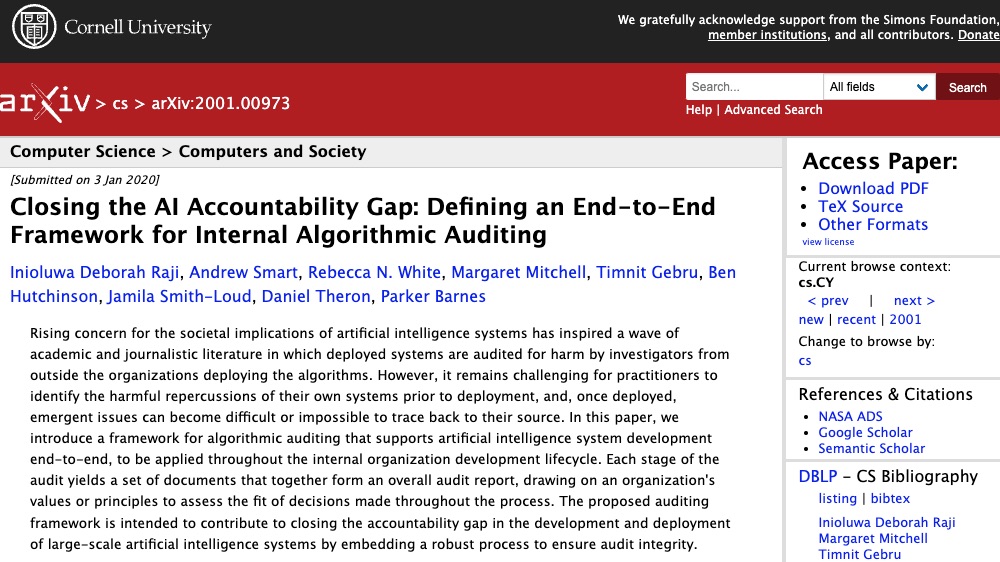
This paper introduces a framework for algorithmic auditing that supports artificial intelligence system development end-to-end, to be applied throughout the internal organization development lifecycle.
ACM Conference on Fairness, Accountability, and Transparency (ACM FAccT)