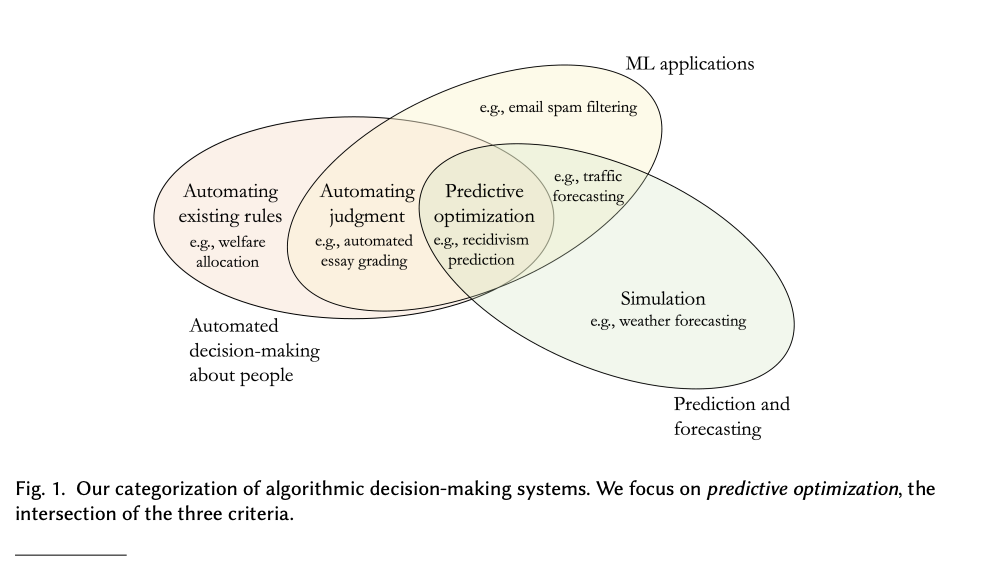
This academic paper examines predictive optimization, a category of decision-making algorithms that use machine learning (ML) to predict future outcomes of interest about individuals. Through this examination, the authors explore how predictive optimization can raise concerns that make its use illegitimate and challenge claims about predictive optimization's accuracy, efficiency, and fairness.
This academic article develops a framework for evaluating whether and how automated decision-making welfare systems introduce new harms and burdens for claimants, focusing on an example case from Germany.
This paper explores how legacy procurement processes in U.S. cities shape the acquisition and governance of AI tools, based on interviews with local government employees.
This article explores how integrating behavioral science into public administration can improve government effectiveness, equity, and trust by redesigning public services with human behavior in mind.
A unified taxonomy and tooling suite that consolidates AI risks across frameworks and links them to datasets, benchmarks, and mitigation strategies to support practical AI governance.
A national survey of low-wage workers showing that administrative burdens in SNAP and Medicaid are common and strongly linked to food hardship, healthcare hardship, and chronic illness.
This foundational article develops the concept of administrative burden, defining it as the learning, psychological, and compliance costs individuals face when interacting with government, and argues that these burdens are often shaped by political choices.
Journal of Public Administration Research and Theory
This study examines public attitudes toward balancing equity and efficiency in algorithmic resource allocation, using online advertising for SNAP enrollment as a case study.
This paper argues that a human rights framework could help orient the research on artificial intelligence away from machines and the risks of their biases, and towards humans and the risks to their rights, helping to center the conversation around who is harmed, what harms they face, and how those harms may be mitigated.
This article explores how anticipatory logics—drawing from foresight, futures thinking, and design—are shaping the future of government by creating space for innovative policy approaches, public participation, and proactive governance.