This site contains resources explaining the 2025 Working Families Tax Cut Act (WFTC) — formally Public Law 119-21, which changes eligibility, financing, and community-engagement requirements for Medicaid and Children’s Health Insurance Program (CHIP).
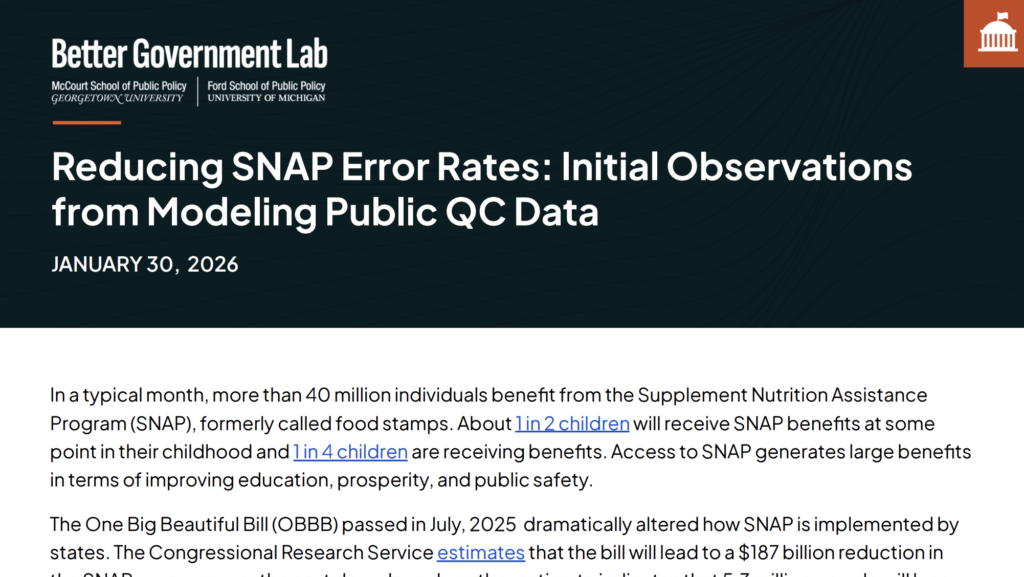
A blog post outlining key strategies states can use to lower SNAP payment error rates, a priority given new fiscal penalties tied to error rates under recent federal law.
A technical guide that outlines policy and system design strategies states can use to reduce procedural terminations when implementing Medicaid work reporting requirements.
This article examines the historic structural changes to the Supplemental Nutrition Assistance Program (SNAP) enacted through H.R. 1 and their potential consequences for public health and food security.
This communications workplan provides a strategic framework for state Medicaid agencies to manage outreach and engagement ahead of the January 2027 implementation of Medicaid work reporting requirements.
This workshop summary synthesizes key takeaways from a convening of nearly 40 research and data analytics staff from 15 states focused on SNAP Quality Control (QC) data modeling.
This report analyzes the critical role of SNAP’s "broad-based categorical eligibility" (BBCE) policy and the widespread consequences of its potential elimination by the Trump Administration.
This presentation focuses on data-driven and analytic strategies for identifying and verifying medical frailty exemptions within Medicaid work requirements.
This technical brief uses predictive analytics to identify the primary drivers of SNAP payment error rates (PER) following the implementation of the One Big Beautiful Bill (OBBB).
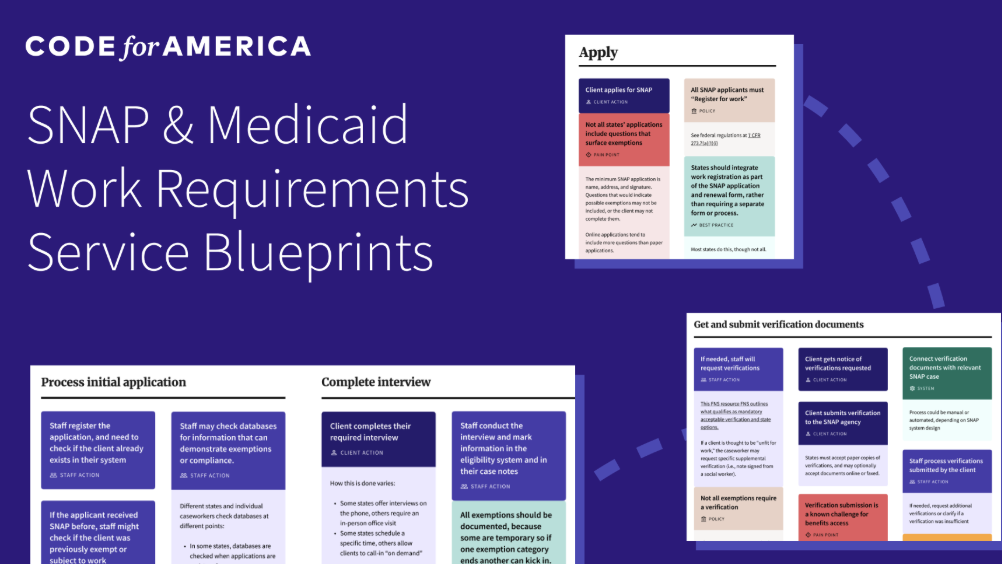
This file contains two, state-agnostic service blueprints that visualize how the new work requirements policy passed as part of H.R. 1 impacts the process of applying for, determining, and maintaining eligibility for SNAP and Medicaid benefits.