As a part of Benefit Data Trust (BDT)’s Medicaid Churn Learning Collaborative, BDT has created a memo describing policy options and state examples for Medicaid administrators to reduce churn for non-MAGI Medicaid enrollees when the federal public health emergency ends.
In this video, Susan S. Gibson, chair of the Pandemic Response Accountability Committee's (PRAC) Identity Fraud and Redress Working Group, speaks with Jeremy Grant of the Better Identity Coalition, about the challenges of identity fraud for benefits program during the COVID-19 pandemic.
Based on state agency survey responses, this report summarizes key findings from the first calendar year of pandemic response and provides policy considerations for the future of SNAP.
American Public Human Services Association (APHSA)
This article analyzes the strategic use of public policy as a tool for reshaping public opinion. Though progressive revisionists in the 1990s argued that reforming welfare could produce a public more willing to invest in anti-poverty efforts, welfare reform in the 1990s did little to shift public opinion. This study investigates the general conditions under which mass feedback effects should be viewed as more or less likely.
This book is an in-depth exploration of federal programs and controversial legislation demonstrating that administrative burden has long existed in policy design, preventing citizens from accessing fundamental rights. Further discussion of how policymakers can minimize administrative burden to reduce inequality, boost civic engagement, and build an efficient state.
Hear perspectives on topics including centering beneficiaries and workers in new ways, digital service delivery, digital identity, and automation.This video was recorded at the Digital Benefits Conference (BenCon) on June 14, 2023.
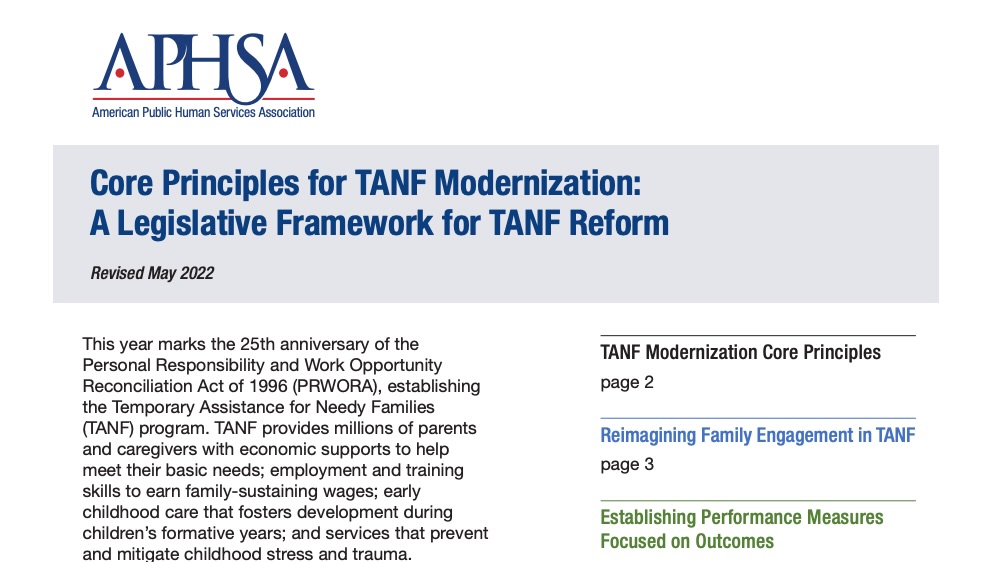
Working with TANF administrators and human services leaders across the country, the American Public Human Services Association (APHSA) embraces the call to reimagine how TANF can work in support of the families it serves and has established a set of TANF Modernization Core Principles to guide our vision for the future of TANF. Grounded in these Core Principles, APHSA’s members have laid out a legislative framework to unlock the potential of TANF. We call upon Congress to use this framework as a starting point to build common ground to achieve a TANF reauthorization that promotes a more equitable and prosperous future for all Americans.
American Public Human Services Association (APHSA)
A training course on using artificial intelligence (AI) tools to de-jargonize government language, with a tutorial on turning a complex piece of government writing into simpler and easier-to-understand language for government employees and residents alike.