In response to exploding demand for social services during COVID-19, the Louisiana Department of children and Family services implemented text-message alerts and reminders for the state’s entire SNAP caseload, launched a text-based public campaign to help people understand and apply for SNAP benefits, and hired SNAP recipients to provide client feedback on communications and policy decisions.
This report details findings and lessons from a project to develop a calculator to help people anticipate how a change in earnings from employment would affect their net income and information on their estimated effective marginal tax rate.
U.S. Department of Health and Human Services (HHS)
The Performance.gov team hosted a webinar featuring federal customer experience (CX) changemakers from across government and focused on the nine CX projects that aim to address pain points learned about through human-centered design research.
This case study highlights Michigan’s integrated, data-driven approach to reducing food insecurity through cross-agency collaboration, referral tracking, and targeted outreach.
American Public Human Services Association (APHSA)
Applicants to federal aid programs face numerous barriers in accessing benefits they are eligible for. The Centers for Medicaid and Medicare conducted an extensive qualitative user research study to better understand applicant experience in enrolling in public assistance programs. Based on the results, the study emphasizes the need for simplified, streamlined and less burdensome application processes.
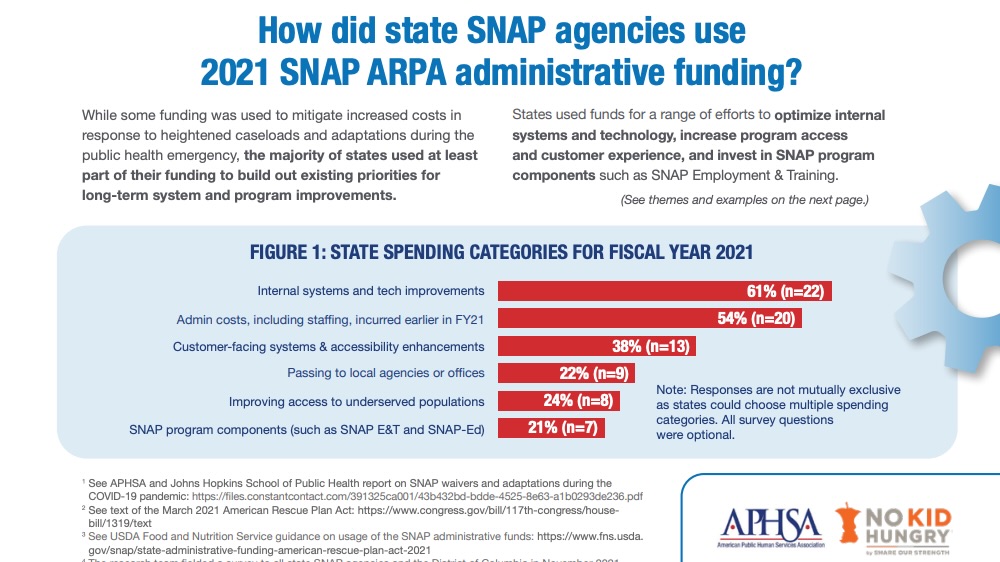
This brief shares findings from a November 2021 survey of state SNAP agencies about their use of the SNAP ARPA funds in fiscal year 2021, and their initial planned activities for fiscal year 2022 and 2023.
American Public Human Services Association (APHSA)
This report describes C-Stat 2.0, an updated version of the the Colorado Department of Human Services’ performance-based analysis strategy that allows them to better focus on and improve performance outcomes that enhance people’s lives.
In this webinar, the Center on Budget and Policy Priorities and the Digital Benefits Network explored key terms related to digital identity, and provided ecosystem-level context on how authentication and identity proofing may show up in the online benefits experience and impact clients.