The Center on Budget and Policy Priorities (CBPP) report discusses how reducing administrative burdens in Medicaid can enhance health outcomes and promote racial equity.
This resource describes how different agencies have updated their systems to increase online and mobile access to benefits information and applications, including using text messages to share benefits information with residents.
This research summary presents findings from a randomized controlled trial demonstrating how mRelief’s simplified SNAP application significantly increases application rates among eligible individuals.
This article reviews two examples of how Nava has used open-source technologies to bring human-centered testing practices to government services software.
Government agencies at all levels collect administrative data in the course of their day-to-day operations. While such information has been used to determine effectiveness through program evaluations for many years, program administrators view it increasingly as a valuable resource that can also be used to improve program performance. For example, administrative data from employment and public benefits programs such as Temporary Assistance for Needy Families (TANF) can offer insights into families’ unmet needs and ways to improve services.
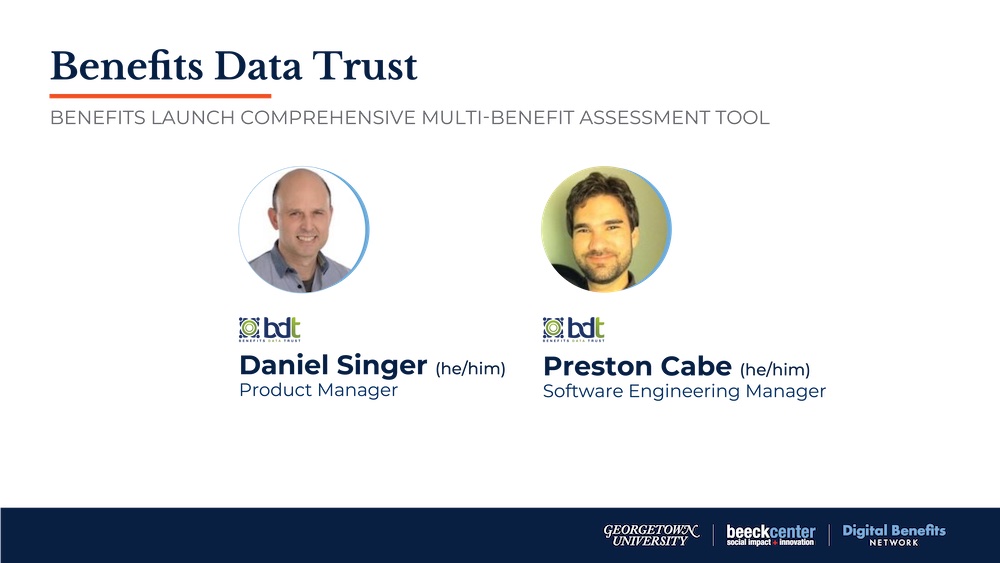
We continued Rules as Code Demo Day with Daniel Singer and Preston Cabe from Benefits Data Trust. Benefits Data Trust provides benefit outreach and application assistance services in seven states. Using Benefits Launch, their in-house interview and rules engine, they support two hundred contact center employees as they screen and apply thousands of clients each year. They also offer a self-service screener, Benefits Launch Express. Additionally, they offer an eligibility API to integrate with other services.
This paper introduces the problem of semi-automatically building decision models from eligibility policies for social services, and presents an initial emerging approach to shorten the route from policy documents to executable, interpretable and standardised decision models using AI, NLP and Knowledge Graphs. There is enormous potential of AI to assist government agencies and policy experts in scaling the production of both human-readable and machine executable policy rules, while improving transparency, interpretability, traceability and accountability of the decision making.