This blog summarizes an event exploring how the City of Boston and Washington State are designing and implementing Single Sign-On (SSO) systems to simplify access to government services.
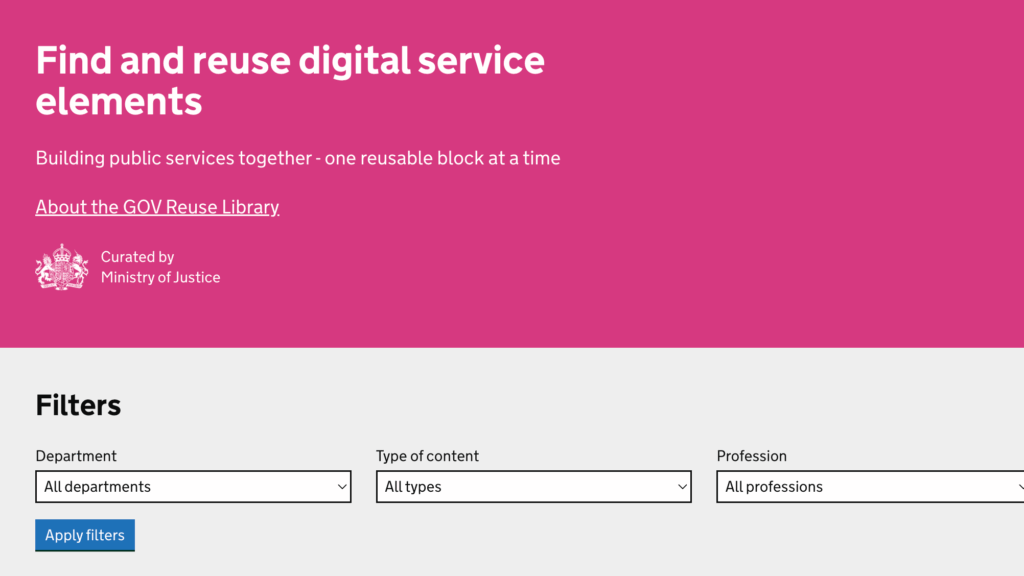
This is a government catalog of reusable digital service components, templates, and patterns designed to help public sector teams build services more efficiently and consistently.
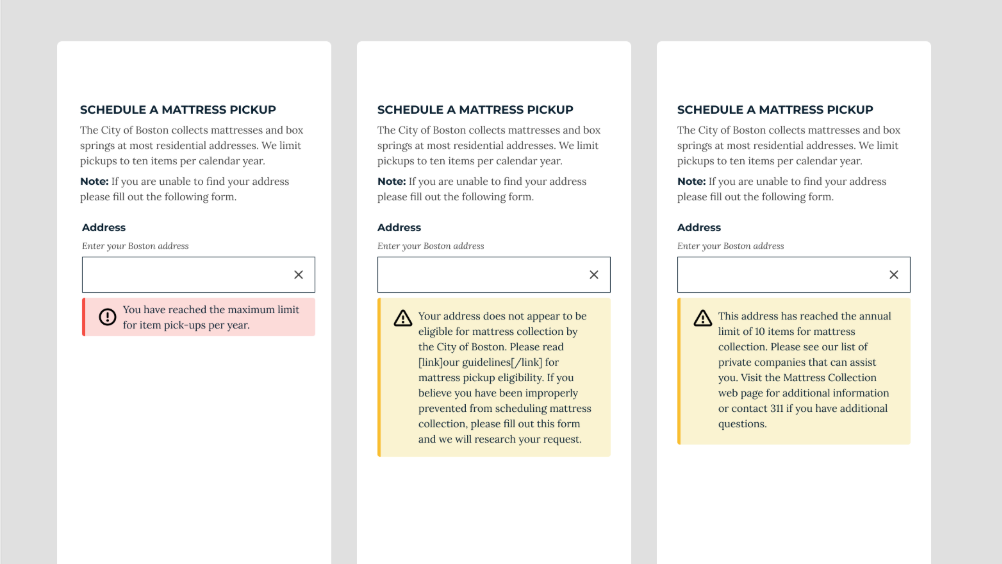
These Figma artifacts illustrate the end-to-end design of Boston’s digital mattress recycling service, including resident scheduling flows, mobile interfaces, alerts, and design system components.
The New York State WIC program website provides access to nutritious foods, nutrition education, breastfeeding/chestfeeding support, and referrals to eligible pregnant, breastfeeding, and postpartum individuals, infants, and children up to age five.
The GSA’s Service Design program implemented a data-driven evaluation process to enhance digital experiences, improve compliance, and streamline its website portfolio, achieving significant cost savings and customer-centric digital transformation.
This case study highlights a collaborative effort to enhance Nevada’s unemployment insurance (UI) program by simplifying claimant-facing communications and improving user experiences through behavioral science and human-centered design.
National Association of State Workforce Agencies (NASWA)
This factsheet outlines the Administration for Children and Families’ (ACF) 2024 initiatives to promote health equity across its programs by embedding equity into funding, service delivery, and community engagement.
U.S. Department of Health and Human Services (HHS)
This blog recaps a conversation with Richard Pope, author of Platformland, on how public sector digital services must evolve to reduce administrative burden, enable easier service creation, and foster transparency and democratic participation.
This report explores how public benefit systems can better support young adults by addressing the barriers they face in accessing and maintaining vital services like SNAP, Medicaid, and WIC.
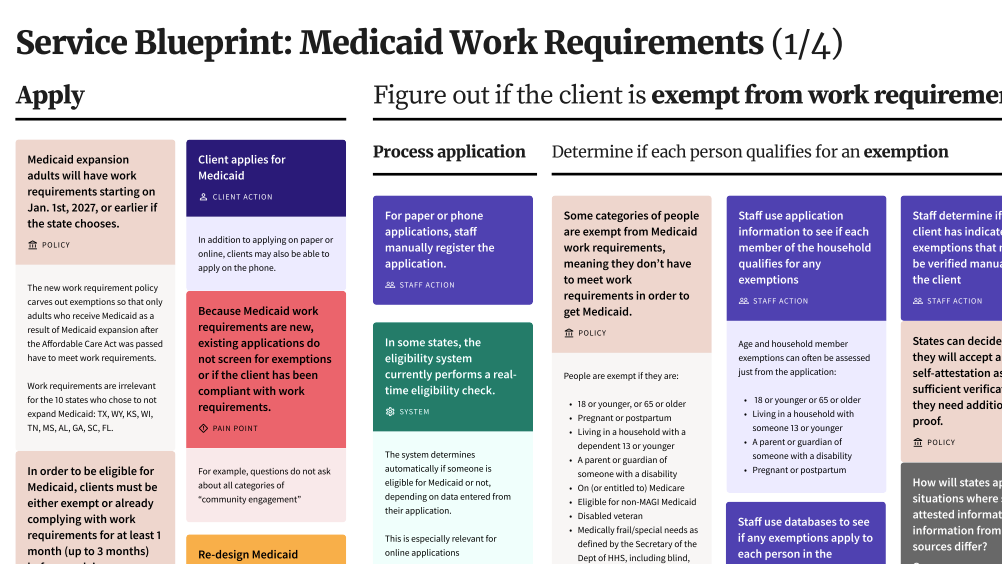
This 8.5x11 service blueprint visually maps how Medicaid work requirements will function once implemented in 2027, detailing each policy step, system interaction, and client experience to help states identify administrative challenges and opportunities for human-centered redesign.
Applicants to federal aid programs face numerous barriers in accessing benefits they are eligible for. The Centers for Medicaid and Medicare conducted an extensive qualitative user research study to better understand applicant experience in enrolling in public assistance programs. Based on the results, the study emphasizes the need for simplified, streamlined and less burdensome application processes.