Building on our February 2022 report Benefit Eligibility Rules as Code: Reducing the Gap Between Policy and Service Delivery for the Safety Net, the Beeck Center’s Digital Benefits Network (DBN) recently held a convening to share progress and potential in digitizing benefits eligibility and to begin addressing how a national approach could be started.
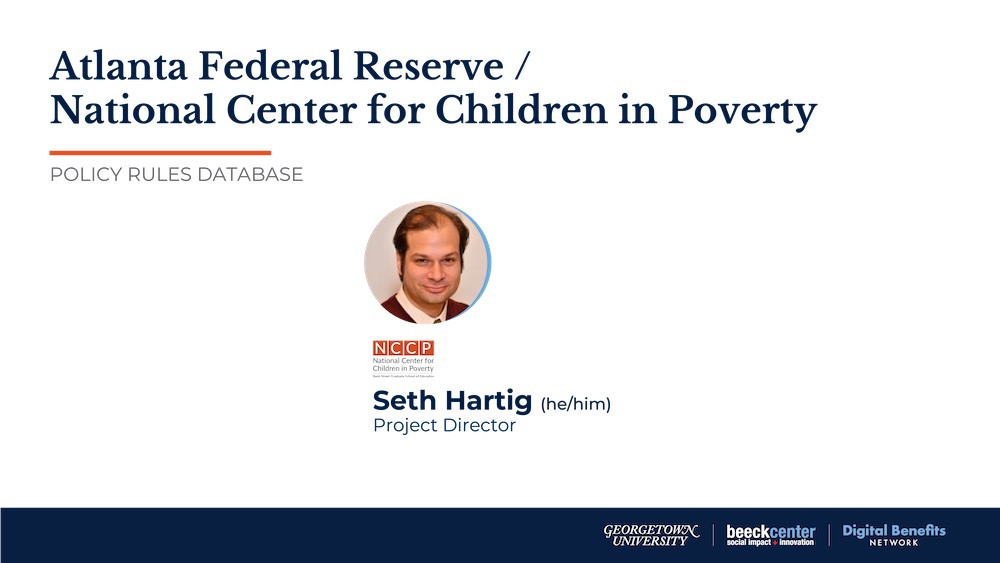
At Rules as Code Demo Day Seth Hartig from the National Center for Children in Poverty (NCCP) and Bank Street College demoed the Policy Rules Database (PRD), a collaborative effort between the Federal Reserve Bank of Atlanta and the NCCP. The primary purpose of the PRD is to simplify the interpretation of all programs by creating a common structure and a common terminology. The repository allows for research on public assistance programs and tax policies, and helps users model benefits cliffs on career pathways. The PRD is supported by a technical manual with pseudocode that helps guide integration and usage in other platforms.
This mainstage session from FormFest 2024 included conversations about form design, accessibility, user experience, and data collection to show how good forms can build trust and confidence in government.
This session from FormFest 2024 focuses on accessibility, featuring British Columbia’s work to improve legal form usability and tips from the Wisconsin Department of Public Instruction on making forms more accessible overall.
This session from FormFest 2024 features the South Carolina Early Childhood Advisory Council’s work developing a single portal to integrate applications for publicly funded programs and services, and the office of Federal Student Aid’s work on the FAFSA form.
This example examines Miami-Dade County's initiative to streamline digital applications for LIHEAP, aiming to improve accessibility and efficiency for residents seeking energy assistance.
A collaborative resource document detailing the civic tech support offerings, state and local government resources, and civic tech organizational support.
An event recap from one of FormFest 2024's breakout sessions featuring speakers from Digital Service Teams across the United States and the Department of Veteran Affairs.