The strategic plan outlines intentions to responsibly leverage artificial intelligence (AI) to enhance health, human services, and public health by promoting innovation, ethical use, and equitable access across various sectors, while managing associated risks.
U.S. Department of Health and Human Services (HHS)
Executed on March 28, 2024, this memorandum establishes new agency requirements and guidance for AI governance, innovation, and risk management, including through specific minimum risk management practices for uses of AI that impact the rights and safety of the public.
Executed on September 24, 2024, a memorandum for the heads of executive departments and agencies on advancing the responsible acquisition of artificial intelligence in government.
This hub introduces the UK government's Algorithmic Transparency Recording Standard (ATRS), a structured framework for public sector bodies to disclose how they use algorithmic tools in decision-making.
This framework provides practical guidance, detailed reference designs, and example solutions to help organizations securely adopt and operationalize Zero Trust principles across diverse IT environments.
National Institute of Standards and Technology (NIST)
This profile provides a cross-sectoral profile of the AI Risk Management Framework specifically for Generative AI (GAI), outlining risks unique to or exacerbated by GAI and offering detailed guidance for organizations to govern, map, measure, and manage those risks responsibly.
National Institute of Standards and Technology (NIST)
The Maryland Information Technology Master Plan 2025 lays out the state’s strategy to modernize IT, expand digital services, and strengthen infrastructure to better serve residents and government agencies.
A comprehensive guide to help government agencies establish, implement, and oversee responsible artificial intelligence (AI) governance policies and review processes.
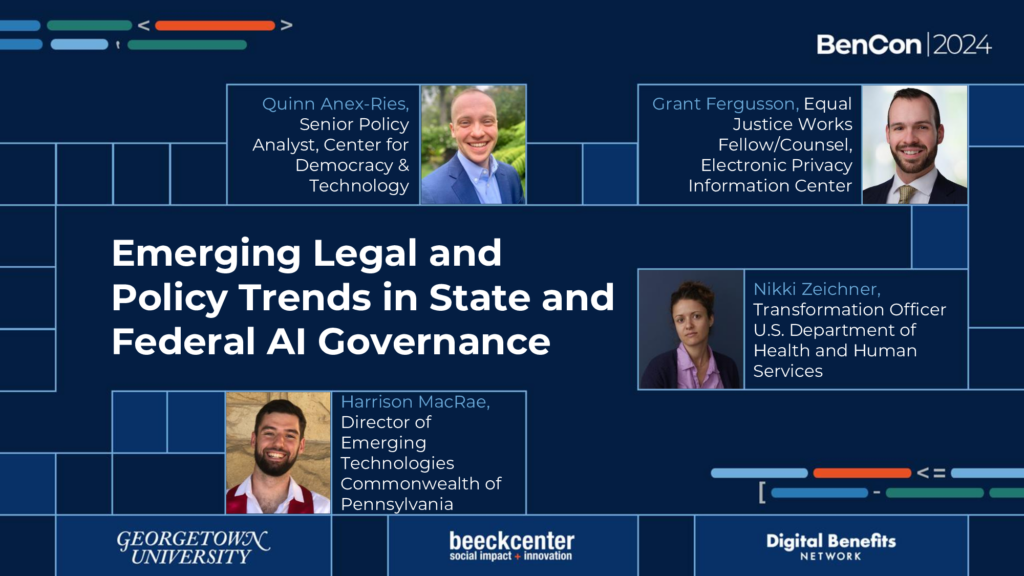
BenCon 2024 explored state and federal AI governance, highlighting the rapid increase in AI-related legislation and executive orders. Panelists emphasized the importance of experimentation, learning, and collaboration between government levels, teams, agencies, and external partners.