This report explores how AI is currently used, and how it might be used in the future, to support administrative actions that agency staff complete when processing customers’ SNAP cases. In addition to desk and primary research, this brief was informed by input from APHSA’s wide network of state, county, and city members and national partners in the human services and related sectors.
American Public Human Services Association (APHSA)
This analysis explores the potential reduction in poverty rates across all U.S. states if every eligible individual received full benefits from seven key safety net programs, highlighting significant decreases in overall and child poverty.
This report explores how state and local agencies can enhance customer service in health and human services by implementing technologies such as web-based tools, mobile applications, and call center innovations, aiming to streamline processes and improve client interactions.
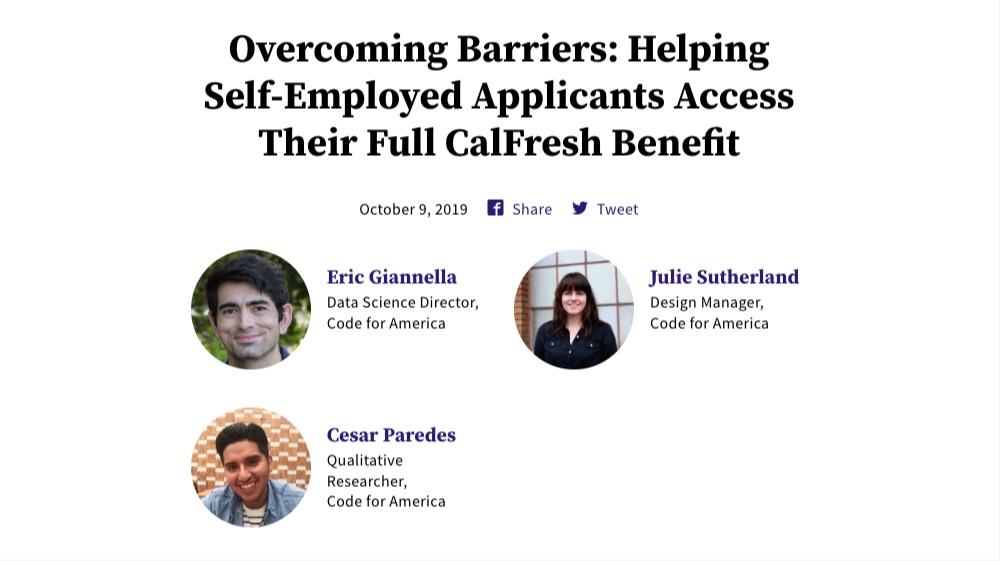
This article discusses how Code for America enhanced the CalFresh application process to better assist self-employed individuals in accessing their full benefits by clarifying self-employment definitions and simplifying income verification.
Benefits Data Trust (BDT), in collaboration with the Center for Health Care Strategies (CHCS), conducted a nationwide analysis of how states coordinate across Medicaid and SNAP programs to streamline access to benefits.
This Urban Institute article argues that poverty is driven by structural barriers rather than individual choices and advocates for safety net programs that address systemic inequities.
This piece highlights promising design patterns for account creation and identity proofing in public benefits applications. The publication also identifies areas where additional evidence, resources, and coordinated federal guidance may help support equitable implementations of authentication and identity proofing, enabling agencies to balance access and security.
In this webinar, a panel of experts discuss what states can do right now to improve EBT security, how to use data to analyze theft patterns, and how EBT payment technology needs to evolve to ensure efficiency, security, and dignity for beneficiaries.
This resource allows policymakers, employers, benefits providers, and researchers assess benefits performance for constituents and identify opportunities in market and policy innovation to ensure equitable benefits distribution.
This visualized report is a first first-of-its-kind view of the state of benefits applications across the nation from a client perspective, including information on application availability online, combined benefit applications, application completion times, as well as login and identity proofing requirements.
This study examines public attitudes toward balancing equity and efficiency in algorithmic resource allocation, using online advertising for SNAP enrollment as a case study.