This report examines how implementing Asset Verification Systems (AVS) can streamline Medicaid eligibility determinations for seniors and individuals with disabilities by automating the verification of applicants' financial assets.
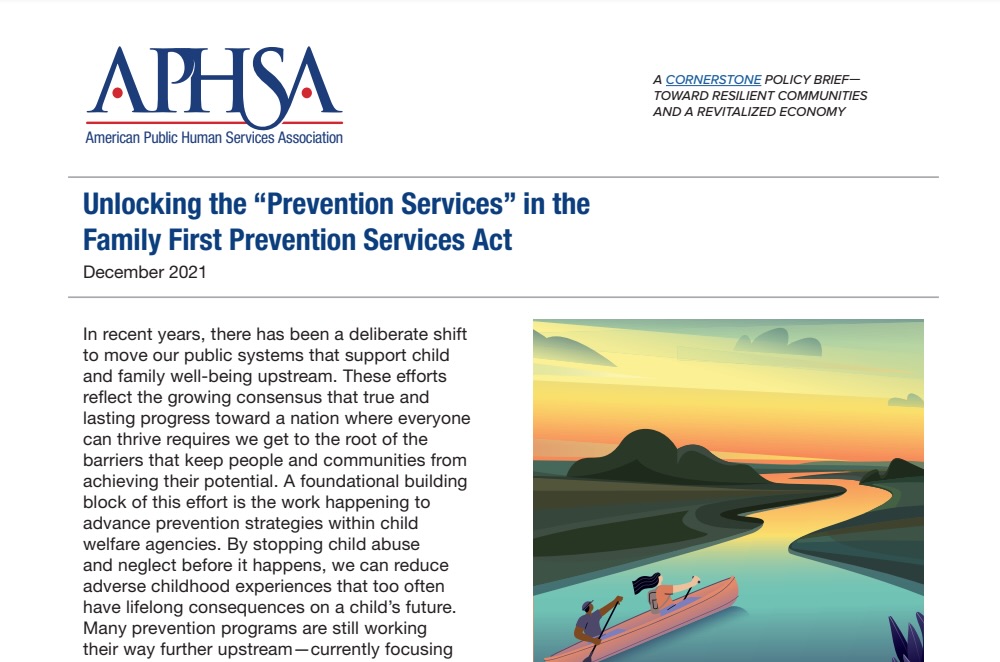
In recent years, there has been a deliberate shift to move our public systems that support child and family well-being upstream. These efforts reflect the growing consensus that true and lasting progress toward a nation where everyone can thrive requires we get to the root of the barriers that keep people and communities from achieving their potential. A foundational building block of this effort is the work happening to advance prevention strategies within child welfare agencies. In this brief, we focus on the challenges and opportunities that the Family First Prevention Services Act (Family First) offers to accelerate the shift toward a prevention-oriented child well-being system.
American Public Human Services Association (APHSA)
APHSA's President and CEO reflects on lessons and opportunities the COVID-19 pandemic highlighted and constructs a national narrative around the moment.
American Public Human Services Association (APHSA)
This brief highlights key takeaways from APHSA’s work on young families, starting with an overview of the young families work and its early years, followed by key takeaways and highlights from its final year, ending with opportunities for future work in the young families space.
American Public Human Services Association (APHSA)
This toolkit provides links to a multitude of resources to help health and human services leaders evaluate and intentionally design programs to meet the unique needs of young families.
American Public Human Services Association (APHSA)
This report outlines critical actions states should take to maintain Medicaid coverage as the COVID-19 Public Health Emergency (PHE) concludes, aiming to prevent widespread loss of health insurance among eligible individuals.
The report discusses how state Medicaid agencies can enhance efficiency and maintain coverage for eligible individuals by implementing ex parte renewals, which automatically renew beneficiaries' coverage using existing data without requiring action from enrollees.
The article discusses how state agencies can effectively use text messaging to communicate with Medicaid and SNAP enrollees, especially following a 2021 FCC ruling that permits automated texts for informational purposes.
SNAP Waivers and Adaptations During the COVID-19 Pandemic: A Survey of State Agency Perspectives in 2020 is a study conducted by the Johns Hopkins Institute for Health and Social Policy (IHSP) based at Johns Hopkins Bloomberg School of Public Health and the American Public Human Services Association (APHSA). This research seeks to understand perspectives from state SNAP administrators on the successes, challenges, and lessons learned from waivers and flexibilities used to preserve equitable access to SNAP during the COVID-19 pandemic. Based on state agency survey responses, this report summarizes key findings from the first calendar year of pandemic response and provides policy considerations for the future of SNAP. This research was supported by Healthy Eating Research, a national program of the Robert Wood Johnson Foundation.
Johns Hopkins Institute for Health and Social Policy
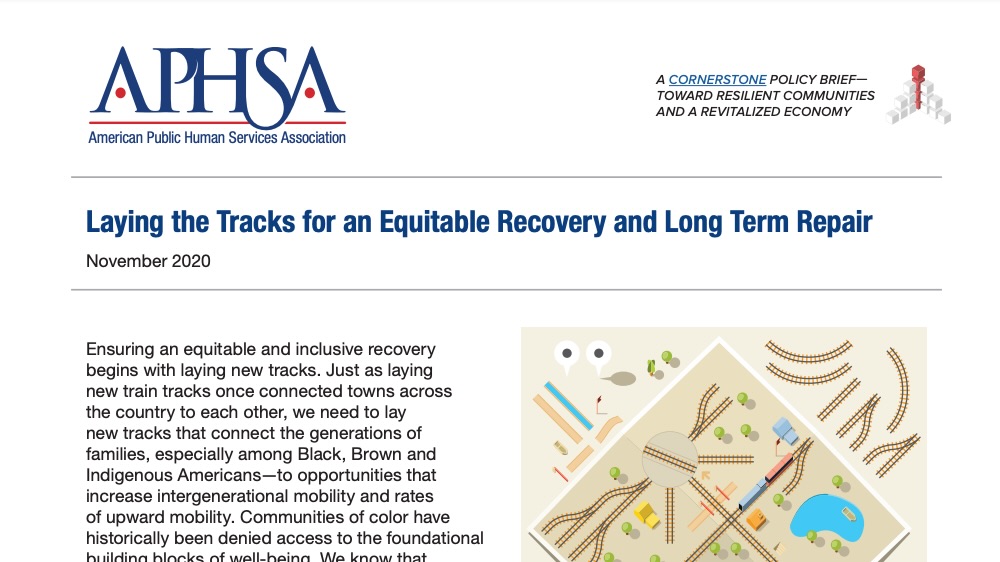
In this brief, APHSA outlines its commitment to addressing the causes of structural inequities by first illuminating structural root causes of race inequity within the context of human services. The brief outlines approaches to doing the intentional and systematic work that is required to counteract the structural barriers human services systems have fostered.
American Public Human Services Association (APHSA)