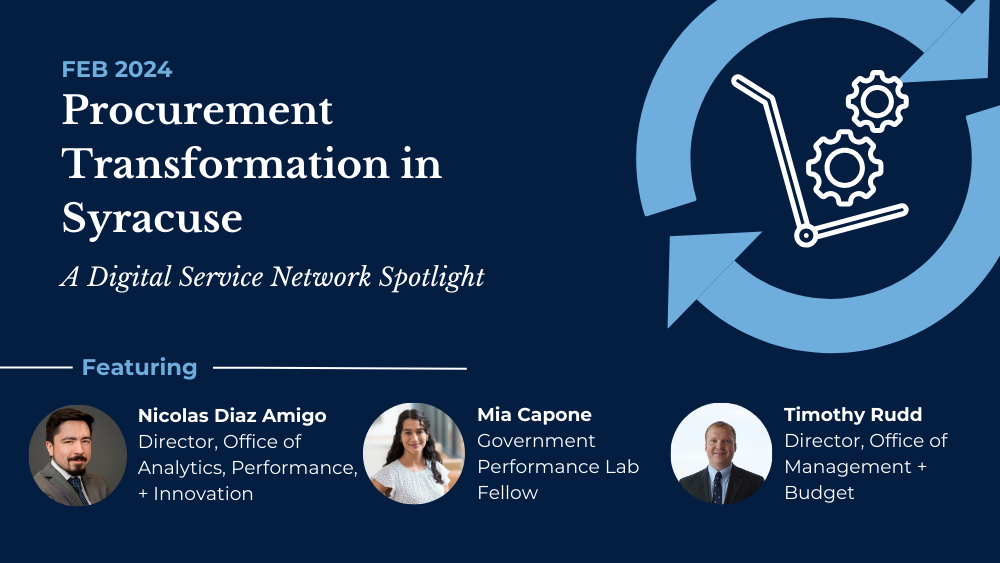
The Digital Service Network (DSN) spoke with API Director Nicolas Diaz Amigo, GPL Fellow Mia Capone, and OMB Director Timothy Rudd to learn more about the City of Syracuse's multi-year procurement transformation initiative.
This guiding framework supports thoughtful evaluation of how new digital technology-based proposals can affect the U.S. public sector, with a particular focus on their impacts on human rights, social and economic justice, and democratic values. It will benefit funders, procurement officers, and advocates evaluating proposed projects that are often framed as “tech for good,” “justice tech,” or public interest technologies.
18F describes modular contracting, the process of breaking up large, custom software procurements into a small constellation of smaller contracts. Modular procurement requires agile, product thinking, user-centered design, DevSecOps, and loosely-coupled architecture.
Public procurement in state governments can be slow and inefficient, but artificial intelligence (AI) offers a solution by automating tasks, improving decision-making, and addressing workforce gaps, as highlighted in a joint brief by NASCIO and NASPO.
National Association of State Chief Information Officers (NASCIO)
This guide provides practical financing strategies for governments to build, maintain, and expand integrated data systems (IDS) and evaluation capacity using federal and non-federal funding sources.
This paper explores how legacy procurement processes in U.S. cities shape the acquisition and governance of AI tools, based on interviews with local government employees.