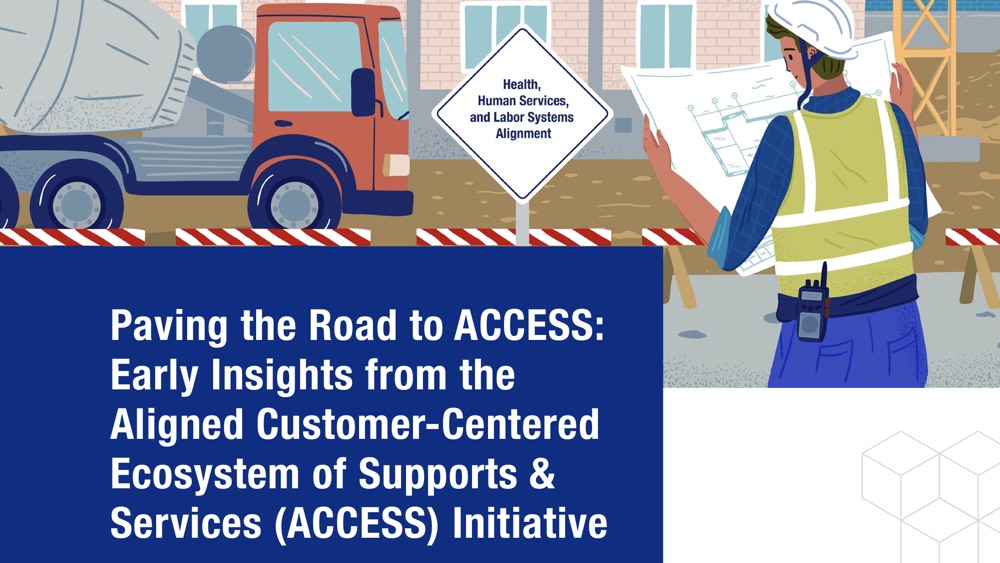
Through the ACCESS project, key collaborators have shared insights into current and future opportunities for alignment within their agencies, including potential enablers for and barriers to alignment activities.
American Public Human Services Association (APHSA)
Differing federal requirements for public benefit applications create significant barriers for applicants and complicate state efforts to integrate services.
This guide explores intersectionality and why it is essential for advancing equity. It explores strategies for planning and conducting research with an intersectional lens, describes quantitative measures and methods to examine differences across groups of people with intersecting identities, and provides key considerations for using qualitative data to better understand intersectionality.
Office of the Assistant Secretary for Planning and Evaluation (ASPE)
Policymakers, program administrators, federal leaders, researchers, and advocates are increasingly focused on using administrative data to build evidence for improving government programs. Achieving this goal requires accessible data sources and the capacity to use them, yet stakeholders have little information about the baseline level of state capacity in these areas. How does one measure concepts such as “effective data use” and “analytic capacity?” This brief reports findings from a pioneering and comprehensive needs assessment that examined the capacity of Temporary Assistance for Needy Families (TANF) programs in 54 U.S. states and territories to analyze data used for program improvement, monitoring, and evidence-building. The needs assessment provides a foundation for technical assistance and continued improvement for the TANF program and may also provide valuable insights and frameworks for other state-administered human services programs.
There were over 25 million Medicaid disenrollments in 2023, but national enrollment remained significantly above pre-pandemic levels at over 56 million, with notable state-level variations and near-recovery of child enrollment.
This article explores how integrating behavioral science into public administration can improve government effectiveness, equity, and trust by redesigning public services with human behavior in mind.
A data report providing updated statistics on key federal programs that support the well-being of women, LGBTQI+ individuals, and their families, highlighting trends, coverage gaps, and areas for policy improvement.
An analysis showing that a proposed plan to shift some cost of SNAP benefits to states could push nearly 900,000 additional people into poverty during a recession.
This article offers three human‑centered strategies to help state agencies implement expanded work reporting requirements in SNAP and Medicaid under H.R. 1 with minimal burden on clients and staff.
This report highlights 5 key takeaways from the Aspen Institute Financial Security Program's 2022 Benefits Forum, where 55 experts from various sectors discussed solutions for improving public and private benefits to better support workers and their families.