The State of California government published guidelines for the safe and effective use of Generative Artificial (GenAI) within state agencies, in accordance with Governor Newsom's Executive Order N-12-23 on Generative Artificial Intelligence.
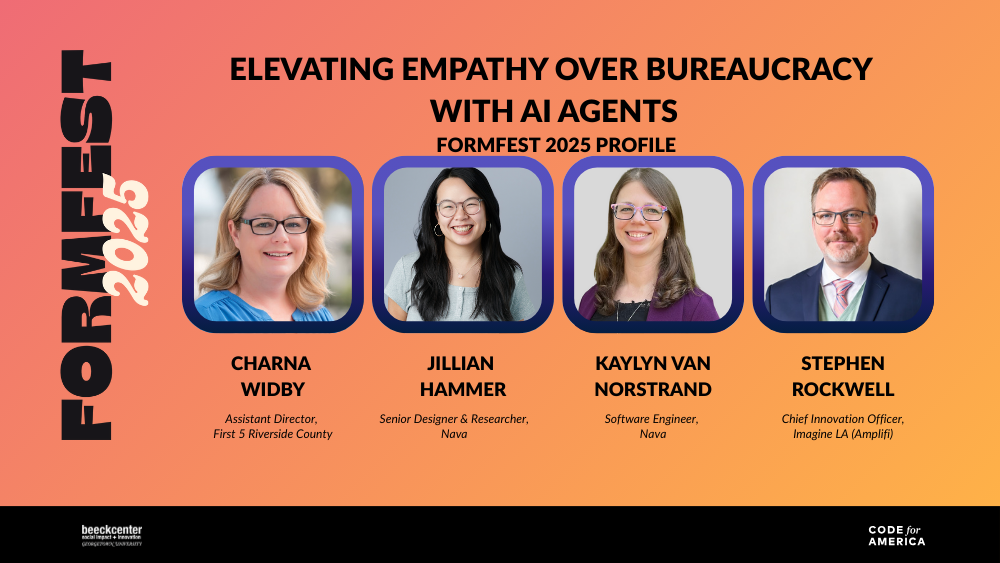
This FormFest profile highlights Riverside County’s pilot of AI-powered interviews that streamline benefit applications, reducing bureaucratic burden on families in crisis while freeing caseworkers to focus on human connection.
A report that defines what effective “human oversight” of AI looks like in public benefits delivery and offers practical guidance for ensuring accountability, equity, and trust in algorithmic systems.
This session from FormFest 2024 walked attendees through some of the major changes AI is bringing to form design. Learn about the National Head Start Association’s use of AI to reduce administrative burden and the Canadian Digital Service’s tips for protecting government applications systems from AI.
A growing observatory of examples of how open data from official sources and generative artificial intelligence (AI) are intersecting across domains and geographies.
Learn how to use generative AI to quickly create unemployment insurance translations that are accurate, easy to understand, and tailored to your state.
This report documents four experiments exploring if AI can be used to expedite the translation of SNAP and Medicaid policies into software code for implementation in public benefits eligibility and enrollment systems under a Rules as Code approach.
This resource page provides comprehensive information on the state's initiatives, policies, training, and governance related to the adoption and implementation of generative AI technologies in government operations.
This report on the use of Generative AI in State government presents an initial analysis of the potential benefits to individuals, communities, government and State government workers, while also exploring potential risks.
Concerns over risks from generative artificial intelligence systems have increased significantly over the past year, driven in large part by the advent of increasingly capable large language models. But, how do AI developers attempt to control the outputs of these models? This primer outlines four commonly used techniques and explains why this objective is so challenging.
Center for Security and Emerging Technology (CSET)
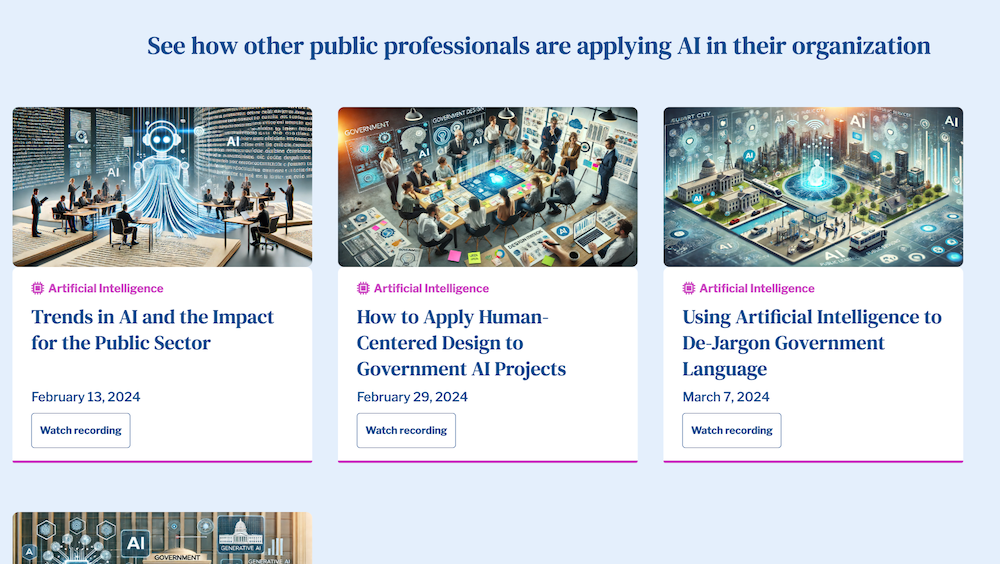
AI resources for public professionals on responsible AI use, including a course showcasing real-world applications of generative AI in public sector organizations.