A research report that defines different local early childhood governance models and explains how communities can choose and design governance structures to support effective early care and education systems.
In this brief, APHSA outlines its commitment to addressing the causes of structural inequities by first illuminating structural root causes of race inequity within the context of human services. The brief outlines approaches to doing the intentional and systematic work that is required to counteract the structural barriers human services systems have fostered.
American Public Human Services Association (APHSA)
This webpage links to materials ASPE has prepared as it leads work on how federal agencies and programs can meaningfully and effectively engage people with lived experience.
Office of the Assistant Secretary for Planning and Evaluation (ASPE)
Initially created to inform federal staff at the U.S. Department of Health and Human Services, this tool describes how to conduct intensive equity assessments of existing programs, policies, and processes. It may be useful for state and local governments, tribal governments, and other private or non-profit organizations focused on programs and policies relating to health and human services.
Office of the Assistant Secretary for Planning and Evaluation (ASPE)
An America where no one experiences poverty is possible. Already, the U.S. has programs with the potential to make this vision a reality, including programs that provide cash assistance, like Temporary Assistance for Needy Families (TANF). The current TANF program provides very little cash assistance and is marked by stark racial disparities, but it has the potential to reduce child poverty, increase economic security, and advance racial equity. This report offers a vision for an anti-racist approach to the TANF program, with new statutory goals and policy recommendations to advance racial justice.
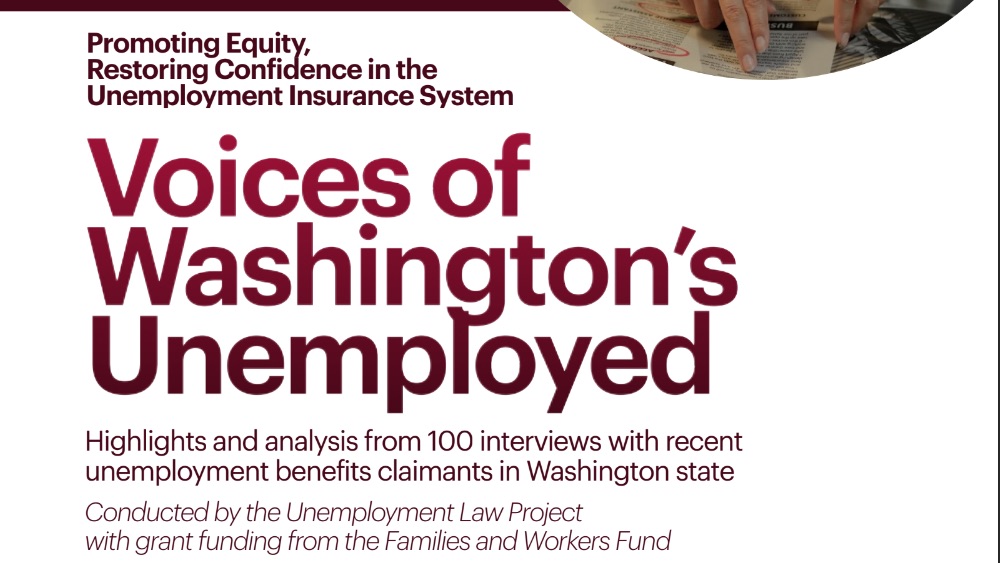
Through the interviews, ULP sought to capture details of claimant experience, see how and why system failures occurred, and make recommendations for reform now—before another financial or public health crisis suddenly causes state unemployment rates to spike.
The guidelines for bias-free language contain both general guidelines for writing about people without bias across a range of topics and specific guidelines that address the individual characteristics of age, disability, gender, participation in research, racial and ethnic identity, sexual orientation, socioeconomic status, and intersectionality.
The Playbook’s purpose is to guide researchers while supporting and lending authority to community organizations as they advocate for partnerships that will benefit their constituencies. The Playbook aims to provide some answers to such questions as: How can technologists and scientists engage communities in a spirit of partnership, without such extractive practices? How can community organizations work with researchers in ways that benefit their communities and expand their capacity, rather than burdening their staff?
The Unemployment Insurance Equitable Access Toolkit contains common equity recommendations, promising practices, and insights, represented visually as a different floor of an agency office building, compiled in one interactive document.
In order to create for all, we have to employ processes that authentically engage misrepresented communities. People tend to think of diversity, equity, and inclusion (DEI) efforts in terms of implicit bias workshops, employee resource groups, and hiring processes. These efforts are all important, but it is also necessary to focus on DEI as it relates to the creation of products, services, and content, and use a design-thinking approach to tackle these tricky issues.
Executive Order 13985, titled "Advancing Racial Equity and Support for Underserved Communities Through the Federal Government," was issued by President Joe Biden on January 20, 2021, to promote equity across federal agencies.