This article investigates how users' "metamemory"—specifically their anxiety regarding their own memory capabilities—drives insecure password behaviors.
This report examines federal efforts to connect eligible college students with Supplemental Nutrition Assistance Program (SNAP) benefits and identifies actions needed to improve outreach and program access.
Drawing on interviews and convenings with experts and practitioners from the field of public interest technology, this report contains recommendations across five core priority action areas for cross-sector innovation and collaboration to improve state benefits systems through procurement practices.
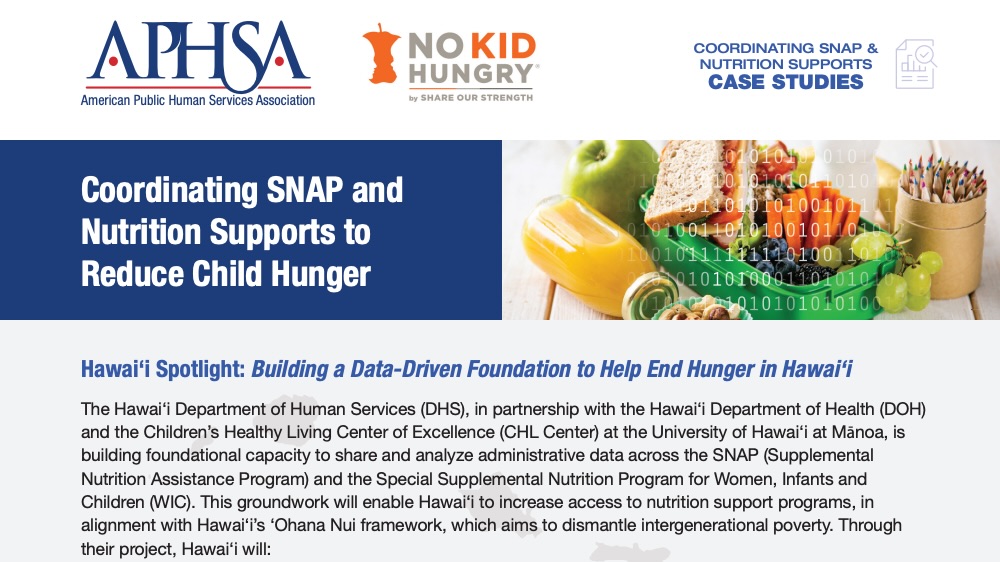
The Hawai‘i Department of Human Services (DHS), in partnership with the Hawai‘i Department of Health (DOH) and the Children’s Healthy Living Center of Excellence (CHL Center) at the University of Hawai‘i at Mānoa, is building foundational capacity to share and analyze administrative data across the SNAP (Supplemental Nutrition Assistance Program) and the Special Supplemental Nutrition Program for Women, Infants and Children (WIC). This groundwork will enable Hawai‘i to increase access to nutrition support programs, in alignment with Hawai‘i’s ‘Ohana Nui framework, which aims to dismantle intergenerational poverty.
American Public Human Services Association (APHSA)
This toolkit provides practical guidance for agencies, researchers, and community partners to embed racial equity throughout every stage of data integration and use.
This resource outlines strategies for cross-enrollment outreach, which can break down silos between programs and reach applicants who may be eligible for under-enrolled benefits programs.
Blog post authored by U.S. Digital Response discussing best practices for creating inclusive, accessible, and affirming government services for LGBTQ+ populations gleaned from their recent work in the City of Boston.
Together, the Kansas Department for Children and Families (DCF) and Department of Health and Environment (KDHE) are working to design and build a sustainable process to improve cross-enrollment for families eligible for both the Supplemental Nutrition Assistance Program (SNAP) and the Special Supplemental Nutrition Program for Women, Infants, and Children (WIC). This report outlines how Kansas will integrate data matches between SNAP and WIC—as well as targeted outreach— within the ongoing business processes of the agencies to help streamline the experience of accessing nutrition supports for clients. These functions will contribute to the agencies’ shared goal of reducing rates of food insecurity in Kansas.
American Public Human Services Association (APHSA)