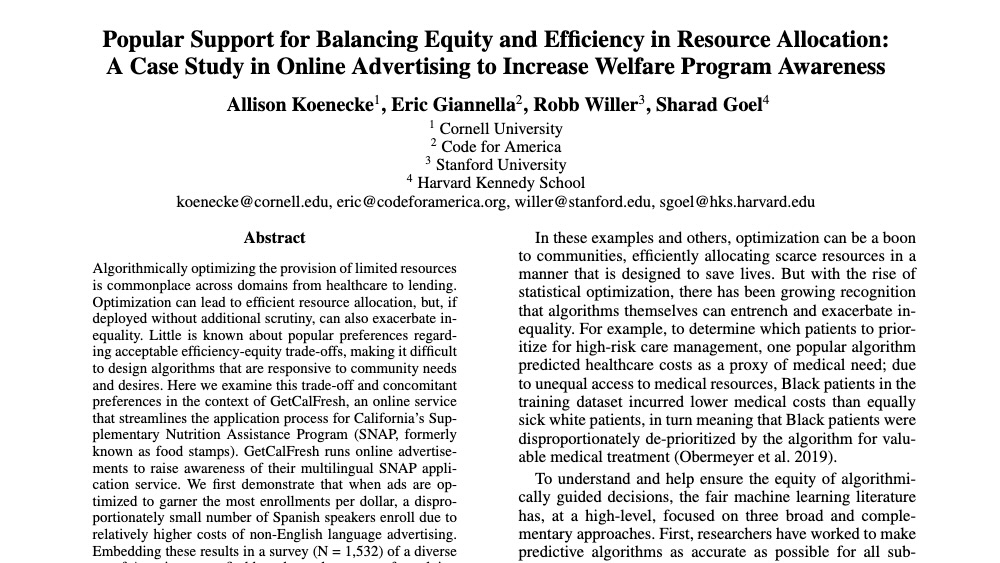
This study examines public attitudes toward balancing equity and efficiency in algorithmic resource allocation, using online advertising for SNAP enrollment as a case study.
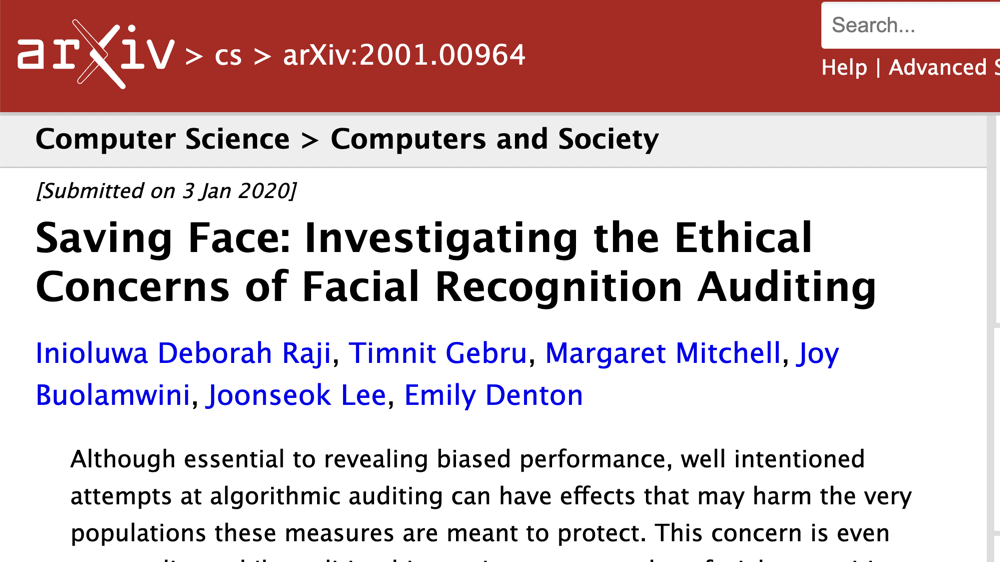
Through a field scan, this paper identifies emerging best practices as well as methods and tools that are becoming commonplace, and enumerates common barriers to leveraging algorithmic audits as effective accountability mechanisms.
ACM Conference on Fairness, Accountability, and Transparency (ACM FAccT)
The State of California government published guidelines for the safe and effective use of Generative Artificial (GenAI) within state agencies, in accordance with Governor Newsom's Executive Order N-12-23 on Generative Artificial Intelligence.
A training course on using artificial intelligence (AI) tools to de-jargonize government language, with a tutorial on turning a complex piece of government writing into simpler and easier-to-understand language for government employees and residents alike.
The primer–originally prepared for the Progressive Congressional Caucus’ Tech Algorithm Briefing–explores the trade-offs and debates about algorithms and accountability across several key ethical dimensions, including fairness and bias; opacity and transparency; and lack of standards for auditing.
The New York State Office of Information Technology established guidelines for the acceptable and responsible use of Artificial Intelligence technologies by state entities.
New York State Office of Information Technology Services
The team aimed to automate applying rules efficiently by creating computable policies, recognizing the need for AI tools to convert legacy policy content into automated business rules using Decision Model Notation (DMN) for effective processing and monitoring.