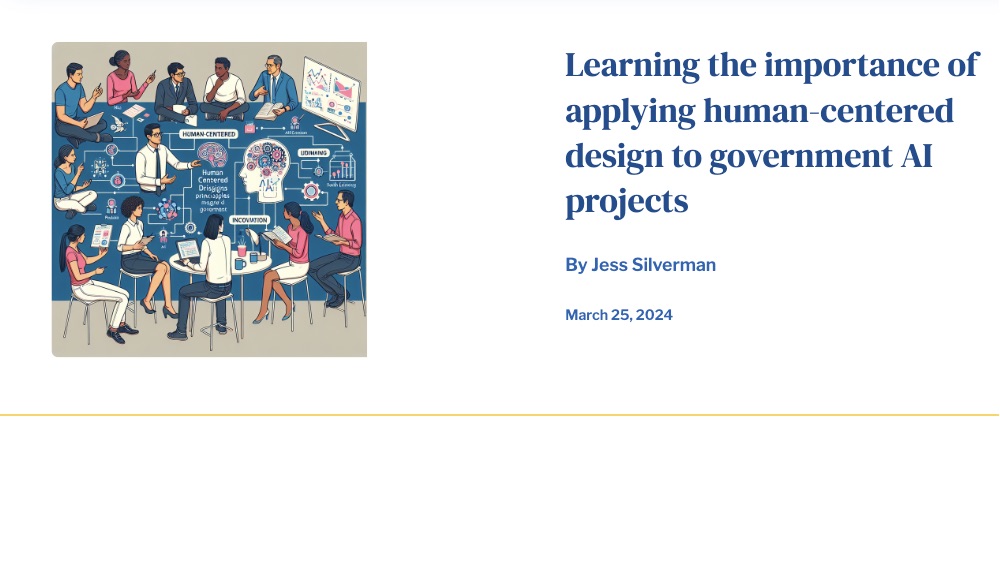
Takeaways from a workshop focusing on applying human-centered design to government artificial intelligence (AI) projects, led by Elham Ali, Researcher from the Beeck Center for Social Impact and Innovation.
A guide from the General Service Administration to help government decision makers clearly see what AI means for their agencies and how to invest and build AI capabilities.
This primer is written for a non-technical audience to increase understanding of the terminology, applications, and difficulties of evaluating facial recognition technologies.
Hear perspectives on topics including centering beneficiaries and workers in new ways, digital service delivery, digital identity, and automation.This video was recorded at the Digital Benefits Conference (BenCon) on June 14, 2023.
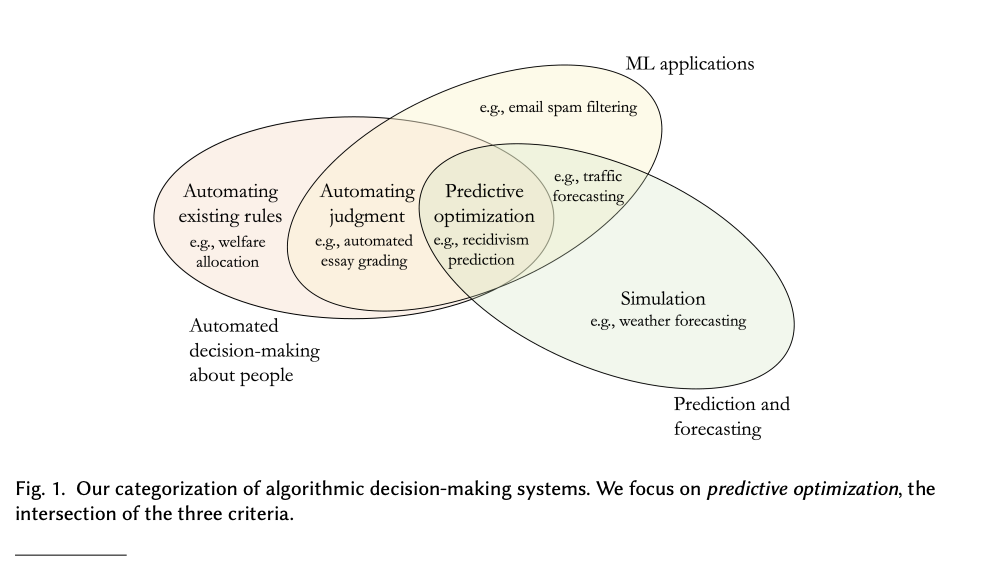
This academic paper examines predictive optimization, a category of decision-making algorithms that use machine learning (ML) to predict future outcomes of interest about individuals. Through this examination, the authors explore how predictive optimization can raise concerns that make its use illegitimate and challenge claims about predictive optimization's accuracy, efficiency, and fairness.
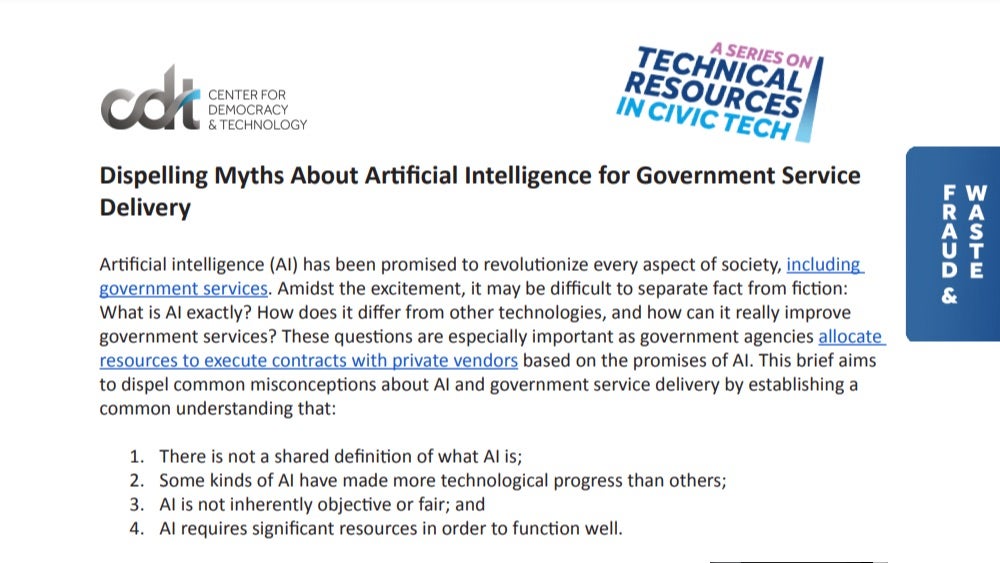
The Center for Democracy and Technology's brief clarifies misconceptions about artificial intelligence (AI) in government services, emphasizing the need for precise definitions, awareness of AI's limitations, recognition of inherent biases, and acknowledgment of the significant resources required for effective implementation.
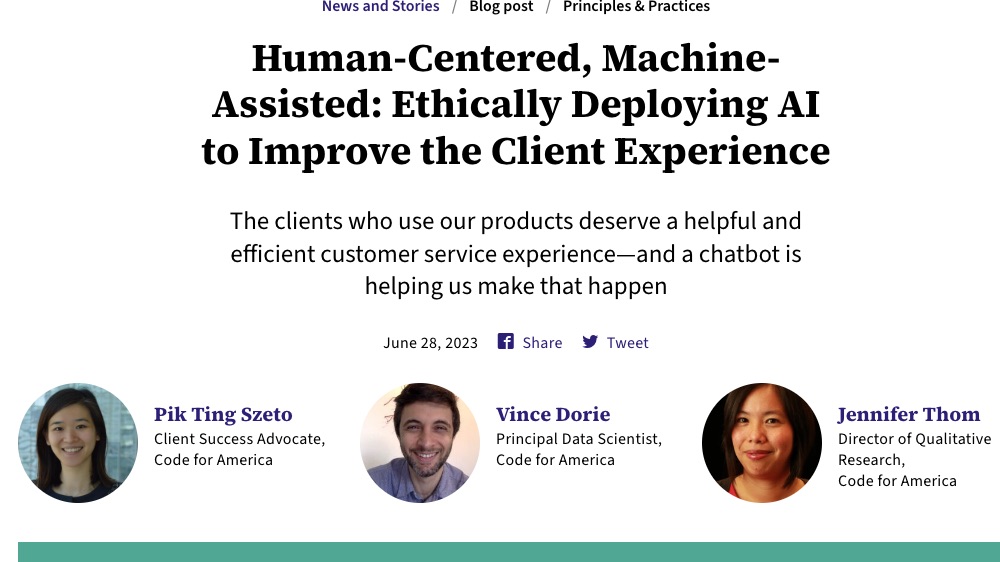
In this interview, Code for America staff members share how client success, data science, and qualitative research teams work together to consider the responsible deployment of artificial intelligence (AI) in responding to clients who seek assistance with three products.
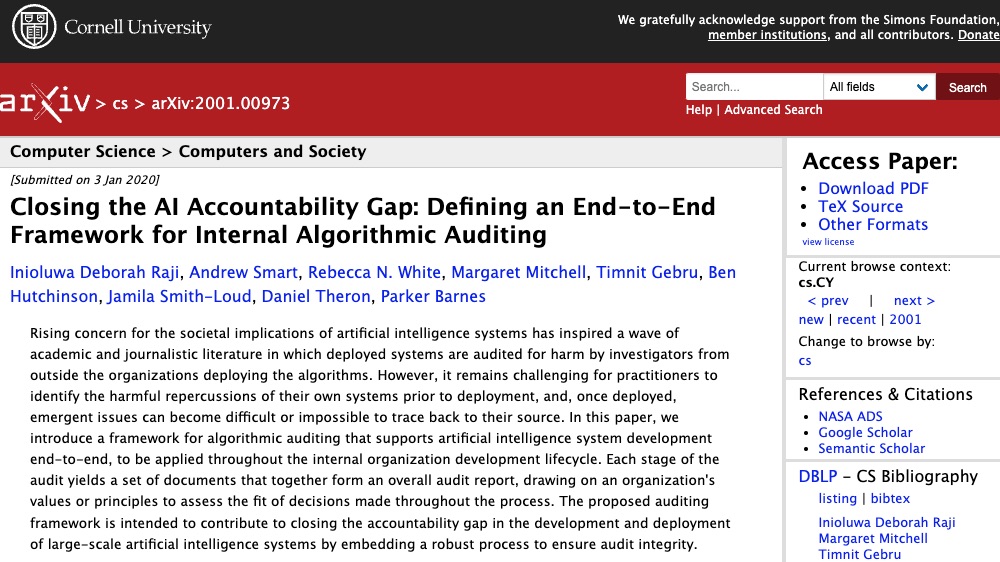
This paper introduces a framework for algorithmic auditing that supports artificial intelligence system development end-to-end, to be applied throughout the internal organization development lifecycle.
ACM Conference on Fairness, Accountability, and Transparency (ACM FAccT)
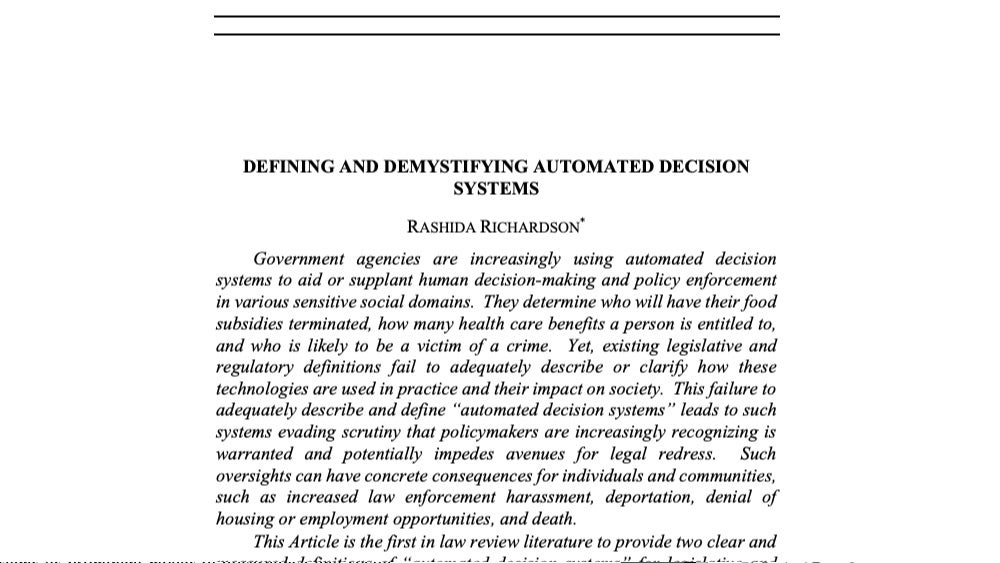
Automated decision systems (ADS) are increasingly used in government decision-making but lack clear definitions, oversight, and accountability mechanisms.
This guidebook offers an introduction to the risks of discrimination when using automated decision-making systems. This report also includes helpful definitions related to automation.