A training course on using artificial intelligence (AI) tools to de-jargonize government language, with a tutorial on turning a complex piece of government writing into simpler and easier-to-understand language for government employees and residents alike.
This article explores how legal documents can be treated like software programs, using methods like software testing and mutation analysis to enhance AI-driven statutory analysis, aiding legal decision-making and error detection.
A growing observatory of examples of how open data from official sources and generative artificial intelligence (AI) are intersecting across domains and geographies.
This article examines how Chile’s SUSESO is balancing cost-focused procurement criteria with ethical AI concerns in its medical claims automation process.
This guide helps UK public bodies understand how to responsibly procure, develop, and use AI while meeting their legal duties to prevent discrimination and promote equality under the Public Sector Equality Duty (PSED).
This is a searchable tool that compiles and categorizes over 4,700 policy recommendations submitted in response to the U.S. government's 2025 Request for Information on artificial intelligence policy.
An in-depth report that examines how states use automated eligibility algorithms for home and community-based services (HCBS) under Medicaid and assesses their implications for access and fairness.
A critical landscape report examining how the AI industry concentrates corporate power, reshapes public institutions, and advances economic and political interests that undermine democracy, labor, and shared prosperity.
A central hub of guidance, standards, and supporting documentation explaining how UK public sector bodies should record and publish information about algorithmic systems to ensure transparency and accountability.
A comprehensive assessment that maps how artificial intelligence is currently being used, governed, and managed across local, state, and federal governments in the United States.
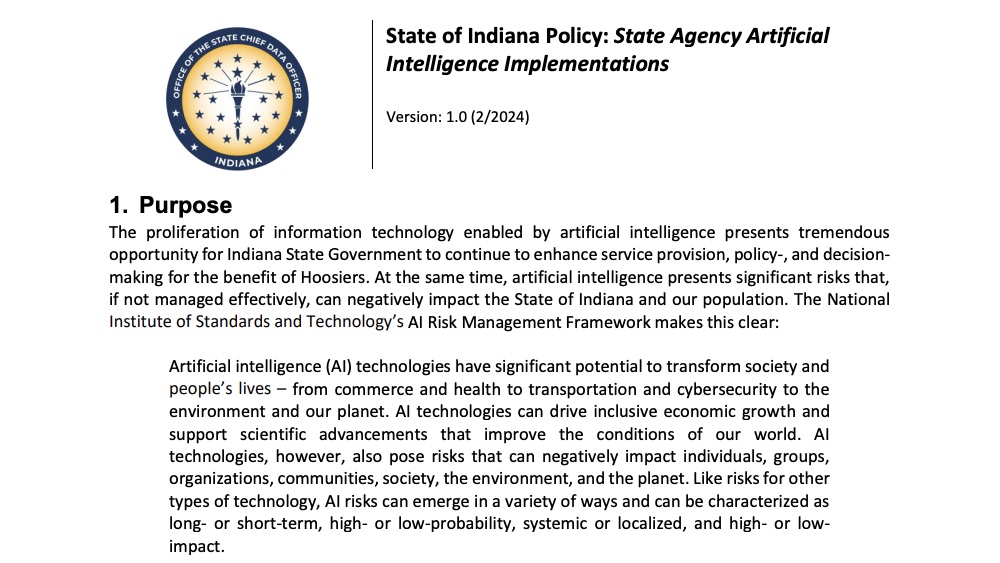
The state of Indiana developed a policy framework for the ethical and efficient use of artificial intelligence (AI) within state agencies. The policy adopts the National Institute of Standards and Technology’s AI Risk Management Framework to manage potential risks effectively. It also details the applicability of the actions undertaken by the Office of the Chief Data Officer (OCDO) to enable the deployment of trustworthy AI systems.