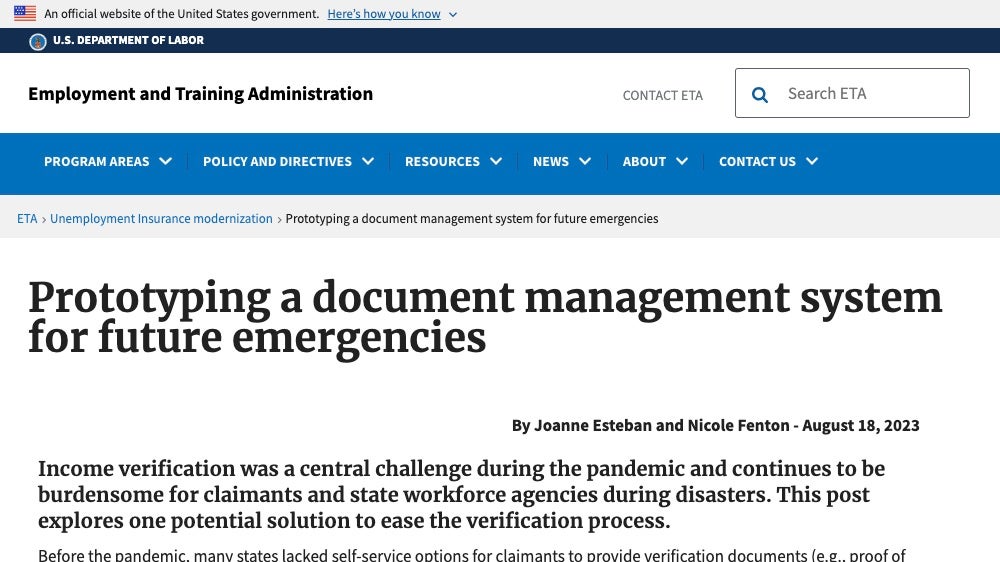
Research from the Department of Labor shows that document management systems reduce barriers for claimants and help states be more efficient. With additional improvements and investment, these systems can be even more effective in serving the public and reducing backlogs in times of crisis.
Sharing lessons learned via the Medicaid Churn Learning Collaborative, which is working to reduce Medicaid churn, improve renewal processes for administrators, and protect health insurance coverage for children and families.
This toolkit offers strategies and tools to help agencies build the culture and infrastructure needed to apply data analysis routinely, effectively, and accurately – referred to in this publication as “sustainable data use.”
This brief examines how state Temporary Assistance for Needy Families (TANF) programs adapted policies during the early stages of the COVID-19 pandemic to address emerging challenges.
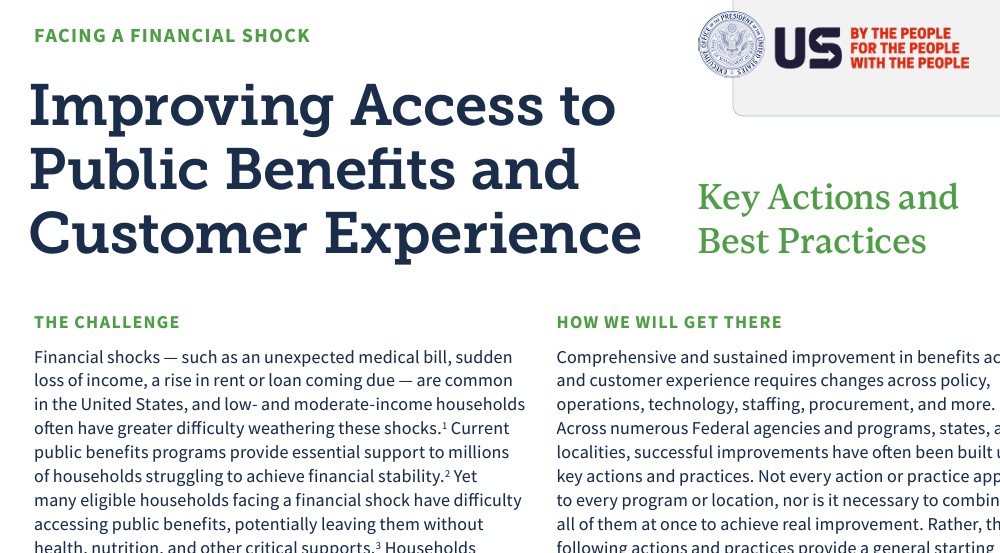
Comprehensive and sustained improvement in benefits access and customer experience requires changes across policy, operations, technology, staffing, procurement, and more. This guide offers a collection of actions and best practices for states to apply.
This paper argues that a human rights framework could help orient the research on artificial intelligence away from machines and the risks of their biases, and towards humans and the risks to their rights, helping to center the conversation around who is harmed, what harms they face, and how those harms may be mitigated.
This report examines how the U.S. federal government can enhance the efficiency and equity of benefit delivery by simplifying eligibility rules and using a Rules as Code approach for digital systems.
A study shows that Benefits Data Trust’s outreach and application assistance significantly increased SNAP enrollment among North Carolina seniors, improving health outcomes and reducing Medicaid costs.
This report highlights lessons learned from improving economic stability and well-being outcomes for young parent families, focusing on interagency collaboration, community engagement, data-driven improvement, and aligned services to guide future efforts.
This paper introduces the problem of semi-automatically building decision models from eligibility policies for social services, and presents an initial emerging approach to shorten the route from policy documents to executable, interpretable and standardised decision models using AI, NLP and Knowledge Graphs. There is enormous potential of AI to assist government agencies and policy experts in scaling the production of both human-readable and machine executable policy rules, while improving transparency, interpretability, traceability and accountability of the decision making.
The Guide to Robotic Process Automation, including the RPA Playbook provides detailed guidance for federal agencies starting a new RPA program or evolving an existing one.