This playbook offers a comprehensive guide to enhancing unemployment benefits systems, focusing on claimant-centric approaches, equitable access, and actionable steps for state agencies.
The Enterprise Single Sign-On (SSO) Playbook is a practical guide to help federal agencies implement or modernize an SSO service for federal employee access to government applications.
Initially created to inform federal staff at the U.S. Department of Health and Human Services, this guide explores opportunities to advance equity in quantitative analysis, including by recognizing common biases (e.g., research and measurement bias).
Office of the Assistant Secretary for Planning and Evaluation (ASPE)
This framework is a logical structure for classifying, organizing, and communicating complex activities involved in making decisions about and taking action on enterprise data.
Learn how to use generative AI to quickly create unemployment insurance translations that are accurate, easy to understand, and tailored to your state.
This toolkit is designed to support government agencies in evaluating the effectiveness of their public participation and community engagement (PPCE) activities.
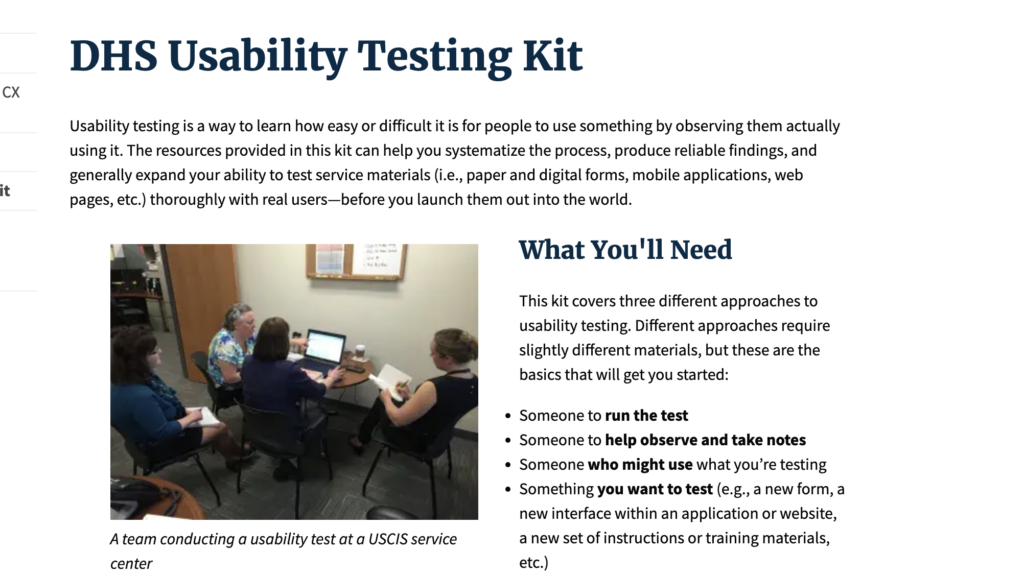
This is a toolkit designed to help Department of Homeland Security teams conduct usability testing for digital services, with templates, guidance, and best practices.
Guidance outlining how Australian government agencies can train staff on artificial intelligence, covering key concepts, responsible use, and alignment with national AI ethics and policy frameworks.