The Digital Service Network (DSN) recently sat down with the Maryland Family and Medical Leave Insurance (FAMLI) team to learn more about an exciting role they’re hiring for.
An event recap from one of FormFest 2024's opening main stage featuring speakers from the Commonwealth of Pennsylvania, State of Maryland, Beeck Center for Social Impact + Innovation, and Code for America.
This article offers three human‑centered strategies to help state agencies implement expanded work reporting requirements in SNAP and Medicaid under H.R. 1 with minimal burden on clients and staff.
Technology enables governments to engage in “pilot” projects to see where they are headed and course-correct along the way, as opposed to evaluating the results over the course of multiple years. Delivery-driven government utilizes technology and “pilot” projects to see institutions and processes through the eyes of users, allowing for more effective service delivery.
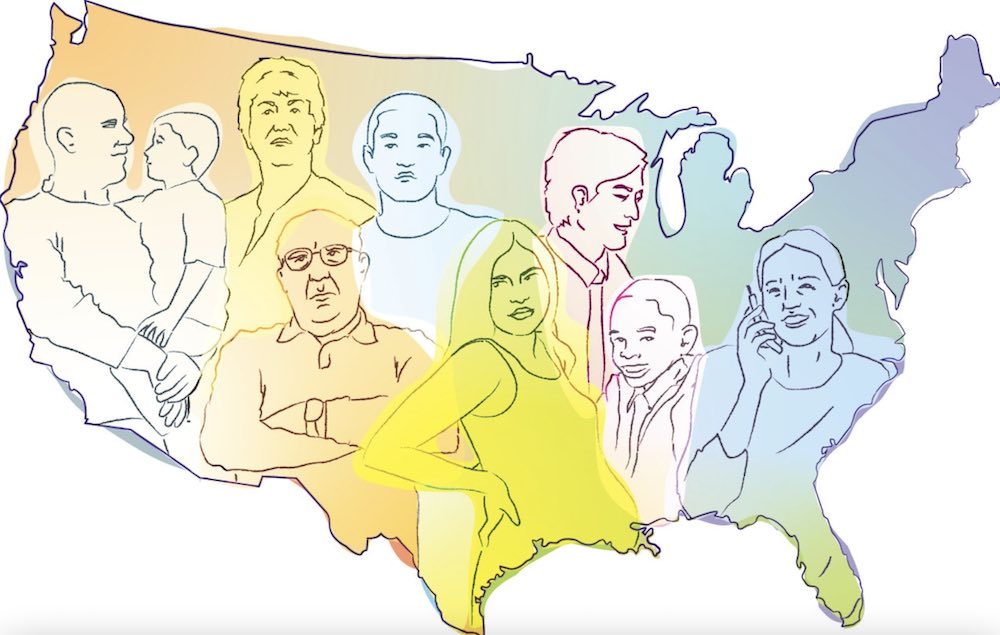
This article discusses Code for America’s research into the user experience of applying or Medicaid, SNAP, TANF, WIC, and LIHEAP in the United States. They found that user experience applying for benefits programs varies greatly by (and often within) each state.
County workers typically spend most of their time trying to get income information right during eligibility interviews. This article provides several recommendations for asking about income, accounting for cognitive biases, under-reporting, and complexities in reporting income.
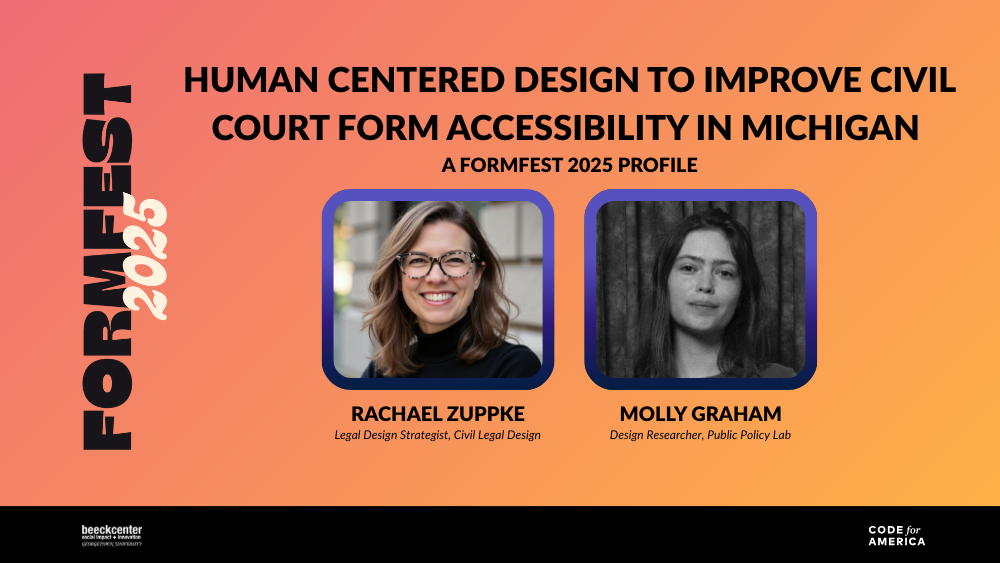
This FormFest profile highlights Rachael Zuppke and Molly Graham’s work to redesign Michigan’s civil court forms using human-centered design, making them more accessible for people who must represent themselves in critical cases like eviction, family law, and guardianship.
This blog recaps a conversation with Richard Pope, author of Platformland, on how public sector digital services must evolve to reduce administrative burden, enable easier service creation, and foster transparency and democratic participation.