Designing with Youth in Seattle: A Digital Government Network Spotlight
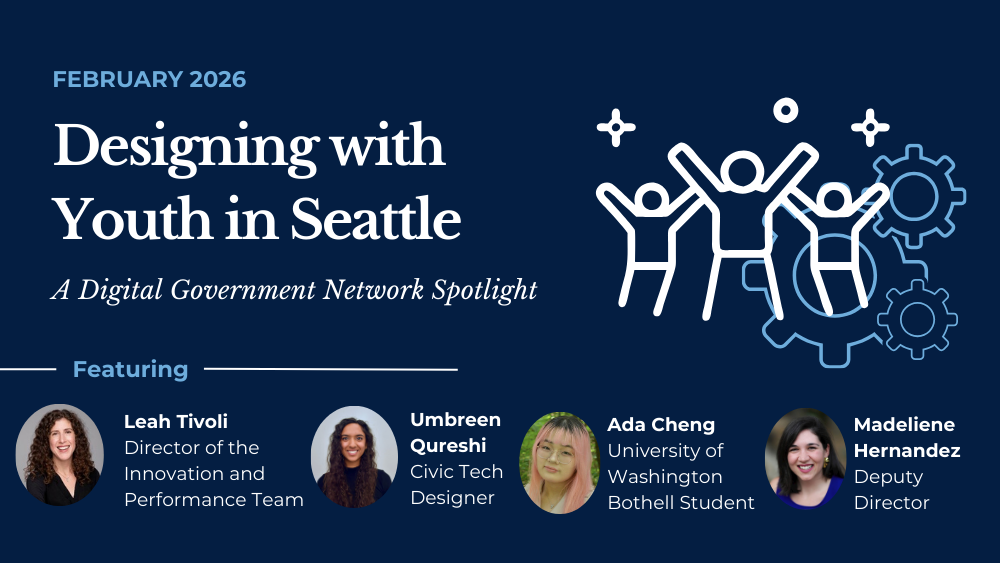
DGN Spotlights highlight innovative digital initiatives transforming how government connects with the public. This story explores Seattle’s Youth Connector—a youth-informed digital platform and outreach strategy that aims to make youth programs easier to find, access, and trust.
Across the United States, cities are investing millions of dollars into youth mental health and enrichment programs. Yet despite the funding, participation often lags. Many teens never hear about opportunities until they’ve passed—not because they lack interest, but because the information is scattered, outdated, or hidden behind institutional language.
The City of Seattle’s Innovation and Performance Team (IPT) saw this gap firsthand. This civic innovation team focuses on helping government work more effectively, equitably, and transparently. In 2024, their attention turned to a challenge voiced directly by Seattle’s youth: Why is it so hard to find programs that already exist for us?
That question sparked the creation of Youth Connector, a two-part initiative that combines a digital platform with a coordinated social media strategy to make city-funded programs easier for young people to discover.
To learn more, the Digital Service Network spoke with Leah Tivoli, director of the Innovation and Performance Team; Madeliene Hernandez, the deputy director leading Youth Connector’s strategy and implementation; Umbreen Qureshi, a civic tech designer specializing in equitable access and human-centered design; and Ada Cheng, a University of Washington Bothell student who interned with the team to conduct peer research.
Focusing on Youth Mental Health
Youth Connector grew out of A Student-Led Approach to Mental Health Services, a 2024 report on youth mental health that revealed a deep sense of disconnection among Seattle teens. Youth shared stories of stress, loneliness, and burnout—all feelings that intensified during and after the pandemic. Director Leah Tivoli noted that while the city had allocated over $20 million toward youth mental health initiatives and hundreds of millions toward youth programs, utilization plateaued around 60–70 percent.
This figure helped them reframe the problem. Seattle didn’t need to create more programs, it needed to help youth learn about what was already there. The barrier was communication, not capacity. “When we looked at the data, we realized the issue wasn’t supply,” explained Deputy Director Madeliene Hernandez. “It was visibility.”
Through their initial research, the IPT found that youth learned about programs primarily through parents, teachers, and friends, which meant missing disconnected or out-of-school teens who lacked those networks. The solution, then, was to meet these teens where they were: online.
That insight laid the groundwork for Youth Connector’s two-pillar strategy: a digital hub for discovering programs, and a social media campaign designed to reach youth across platforms they already use. As Tivoli put it, the project “bridges an awareness gap—connecting youth to opportunities that already exist, so they can grow, connect, and thrive.”
“[Youth Connector] bridges an awareness gap—connecting youth to opportunities that already exist, so they can grow, connect, and thrive.”
Leah Tivoli Director, Innovation and Performance Team
Seattle’s Two-Pillar Solution
Web Design
At the heart of Youth Connector is a digital platform designed to make discovery intuitive, inclusive, and familiar. Rather than build a typical government website filled with dropdown menus and departmental jargon, the team prioritized a design strategy and language youth already understand. “Governments don’t need to reinvent the wheel,” Qureshi said. “We borrowed patterns from platforms like Peloton or Stitch Fix—interfaces people already know how to navigate.”
The result is the design for a mobile-friendly site that allows youth to browse programs based on what they want to feel, like “have fun,” “get outside,” or “learn new skills,”, rather than by administrative categories like “sports” or “volunteering.” Filters allow users to search by cost, transportation access, timing, and language support.
The simple interface belies a complex web of cross-functional collaboration. The city’s youth programs are scattered across 15 different departments, each using its own registration system and terminology. Coordination of that data requires cross-departmental relationships, standardization, and persistence. As Hernandez described, “Getting everyone aligned takes as much diplomacy as it does technology.”
Social Media
The second pillar, a citywide social media campaign, was born from the same user research. Youth consistently said they weren’t seeing program information in their feeds because the city primarily used Facebook, a platform most teens don’t use.
Instead, they pointed to YouTube, TikTok, and Instagram as their main sources of information. Recognizing this, the IPT team sought to rethink outreach entirely. “Youth don’t care if something is run by Parks and Rec or Education,” Hernandez said. “They just want to know when and where it happens.”
To execute this, the team partnered with a creative agency that helped the city develop a cohesive visual identity, from typography and iconography to tone and storytelling—ensuring the campaign felt relatable, not institutional. However, using social media as a civic outreach tool wasn’t without controversy. “Social media has been vilified,” Tivoli noted, “but it’s where youth communicate. Our approach is to use it responsibly as a bridge, not a distraction.”
Together, the website and campaign form a loop of engagement: discover online, explore offline, and reconnect digitally—all shaped by the requests of young people.
A Youth-Centered, Cross-Functional Development Process
From the earliest research to the latest prototypes, youth have shaped every major decision of the Youth Connector. Their voices were a critical part of the research in the Student-Led report that justified the funding. Not only did they define what “access” really means, they designed the features that made the platform intuitive. “This project wouldn’t exist without youth,” said Tivoli. “They were the ones who catalyzed funding, research, and participation.”
This was made possible due to the team’s meticulous approach to engagement. During her internship, student Ada Cheng led interviews and focus groups across south Seattle schools and community centers—areas where access to programs tends to be lowest. Young people were invited to review early designs, react to mockups, and share honest critiques. “One-on-one interviews were the most helpful,” Cheng said. “Once youth saw an example or visual, they opened up and gave thoughtful feedback.”
That process surfaced insights that often go overlooked: transportation barriers, caregiving responsibilities, and language access. Young people wanted to know if they could bring siblings, whether food was offered, or if staff spoke their language. These seemingly small requests revealed the broader inequities that shape participation. The team incorporated all of the feedback, recognizing that even small considerations could determine whether a teen participates or opts out.
Qureshi saw these insights as transformative. “Youth don’t want to be marketed to, they want to be respected and informed,” she said. The internet already had a plethora of information, but simplicity, clarity, and intentionality was missing, Qureshi said. “They showed us how good design can make government feel human.”
“Youth don’t want to be marketed to, they want to be respected and informed. […] They showed us how good design can make government feel human.”
Umbreen Qureshi Civic Tech Designer
The team also learned that youth engagement requires more than outreach—it requires trust. Cheng noticed that youth initially hesitated to join interviews until they saw an example of the interface or app mockups. Once they realized their input would directly shape something real, their enthusiasm skyrocketed. “That’s when I realized,” Cheng said, “the problem isn’t that youth don’t care—it’s that we haven’t done a good job helping them find or shape these opportunities.” By embedding youth voices in every stage, Youth Connector turned a program goal into a living system that reflects the realities of the community it serves.
When it came time to test and iterate on the web platform, the team sought out feedback through hackathons, prototype workshops, and user interviews.
The Youth Connector hackathon proved to be a particularly interesting experiment. To Hernandez, the hackathon was less about coding and more about understanding what collaboration would take. “It helped us see which data points were essential—things like location, accessibility, and cost—and what could be automated later, ” she said. The hackathon didn’t just produce prototypes; it created a shared sense of ownership, while simultaneously giving youth participants a tangible role in shaping the city’s digital infrastructure.
In the early design phase, the team also explored whether artificial intelligence (AI) could serve as a “digital guide”—a kind of trusted companion that could recommend programs based on interests or constraints. Many teens already use AI tools for emotional support or advice, and the idea of using those same technologies for civic engagement was tempting.
But the team decided to hold back, considering the complicated nature of the AI landscape. ”Youth data privacy comes first,” Qureshi said. “We’ll revisit it once we have a secure foundation.” For now, the focus remains on building trust through design and human relationships— not algorithms—a process that can be done without AI.
Youth Connector’s Future Outlook
In late 2025, the team is preparing for a soft launch of its social media campaign, starting with a pro-social-focused campaign during the holidays, a time when loneliness often spikes. In 2026, Youth Connector will expand to a full rollout of the website and social campaign.
One of the biggest ongoing challenges has been bridging generational perspectives inside government. Many decision-makers remain skeptical about the role of social media in public engagement, though this work is helping shift that narrative.
Moreover, the long-term vision extends beyond program discovery. The team hopes to integrate “social prescriptions,” where therapists, counselors, or community leaders can directly recommend youth programs, as part of broader mental health care. Hernandez described it as “connecting wellness to community,” positioning Youth Connector as a civic tool for both prevention and connection. As Qureshi emphasized, “The goal isn’t to launch and leave, it’s to validate, learn, and grow. Once youth start using it, that’s when the real iteration begins.”
Lessons Learned
Digital tools can have a force multiplying effect for proven programs. Rather than inventing something entirely new, the team focused on improving access to proven programs using digital tools and communications. The innovation wasn’t the technology itself, but the digital strategy: repackaging public information in ways that felt intuitive and relevant to young people. Modernization in government doesn’t always mean building from scratch; sometimes it’s about removing barriers or paving new paths to good services.
Good user engagement is a good in and of itself. Effective digital delivery starts with the people it aims to serve. Young voices weren’t a box to check, they were the foundation for every decision, from data modeling to color palettes. But involving youth at every stage didn’t just improve the final outcome. The process became an outcome in and of itself—building trust with young people.
Explore the resources
To see how this work was put into practice, explore the following assets in the Digital Government Hub:
An interactive prototype that illustrates a user interface concept for the Seattle Next Move service, showcasing screen flows and interactions for mobile/web user journeys.
A reusable UI design template showcasing key interface patterns, components, and layout structures for the Seattle Next Move digital service to support consistent, user-centered design across screens.
A comprehensive report outlining a student-led strategy to improve access to mental health supports through prevention, early intervention, and treatment across schools and community partners.
A blog post describing Seattle’s Youth Connector initiative, a city effort to make it easier for young people to discover, access, and connect with youth programs and supports that promote mental health, enrichment, and opportunity.
A recap of a community innovation hackathon in Seattle where technologists and students used AI to prototype solutions that help youth discover and access local programs and services.
A blog post highlighting how youth employment interns contributed to shaping and co-designing the Youth Connector project by leading research, feedback sessions, and design testing to ensure the platform reflects youth needs.