Advancing Data Interoperability for Public Benefits Delivery: Practice and Literature Review
This publication offers a starting point into the current research and practice landscape on data interoperability for public benefits administration. It identifies key takeaways for those looking to advance such efforts in their jurisdiction. In particular, it pinpoints what the research reveals about key challenges benefits agencies face, as well as recommendations for addressing those challenges and examples of states and localities that have done so.
Motivation
Benefits-administering agencies at the federal, state, and local levels are increasingly interested in sharing and using cross-program data for efforts like connecting beneficiaries to multiple programs and monitoring program outcomes. Currently, to benefit from available research on the subject and identify promising ethical practices, practitioners must comb through resources from governments, think tanks, academic journals, and public interest groups.
Since the July 2025 passage of H.R. 1, the One Big Beautiful Bill, the accessibility of data interoperability research has become all the more salient, as states endeavor to advance such efforts to comply with the bill’s intensive reporting requirements while also protecting beneficiary data. Some have identified this moment as a critical opportunity for states to modernize their approach to data sharing, integration, and use.
This publication offers a starting point into the current research and practice landscape on data interoperability for public benefits administration. It identifies key takeaways for those looking to advance such efforts in their jurisdiction. In particular, it pinpoints what the research reveals about key challenges benefits agencies face, as well as recommendations for addressing those challenges and examples of states and localities that have done so.
This publication focuses specifically on research and practice documentation related to data sharing, integration, and subsequent use in public benefits administration, including the Supplemental Nutrition Assistance Program (SNAP), the Women, Infants, and Children (WIC) program, Medicaid, the Temporary Assistance for Needy Families (TANF) program, child care, and housing programs. It therefore does not delve deeply into research or practice on data sharing in government writ large (for example, the body of work on data sharing for evidence-based policymaking, exemplified by Actionable Intelligence for Social Policy (AISP) and Urban Institute reports). However, where relevant, some broader concepts, insights, and recommendations are referenced when their translation to the benefits space is particularly relevant, or when benefits-specific resources are sparse.
Concepts and Definitions
This publication uses the term “data interoperability” to describe the work of bringing together disparate data sources to inform benefits administration, drawing from the U.S. Department of Health and Human Services’ Administration for Children & Families’ definition of interoperability as “the ability of different information systems, devices, or applications to connect, in a coordinated way, within and beyond organizational boundaries to access, exchange, and use data in a cooperative way between stakeholders.”
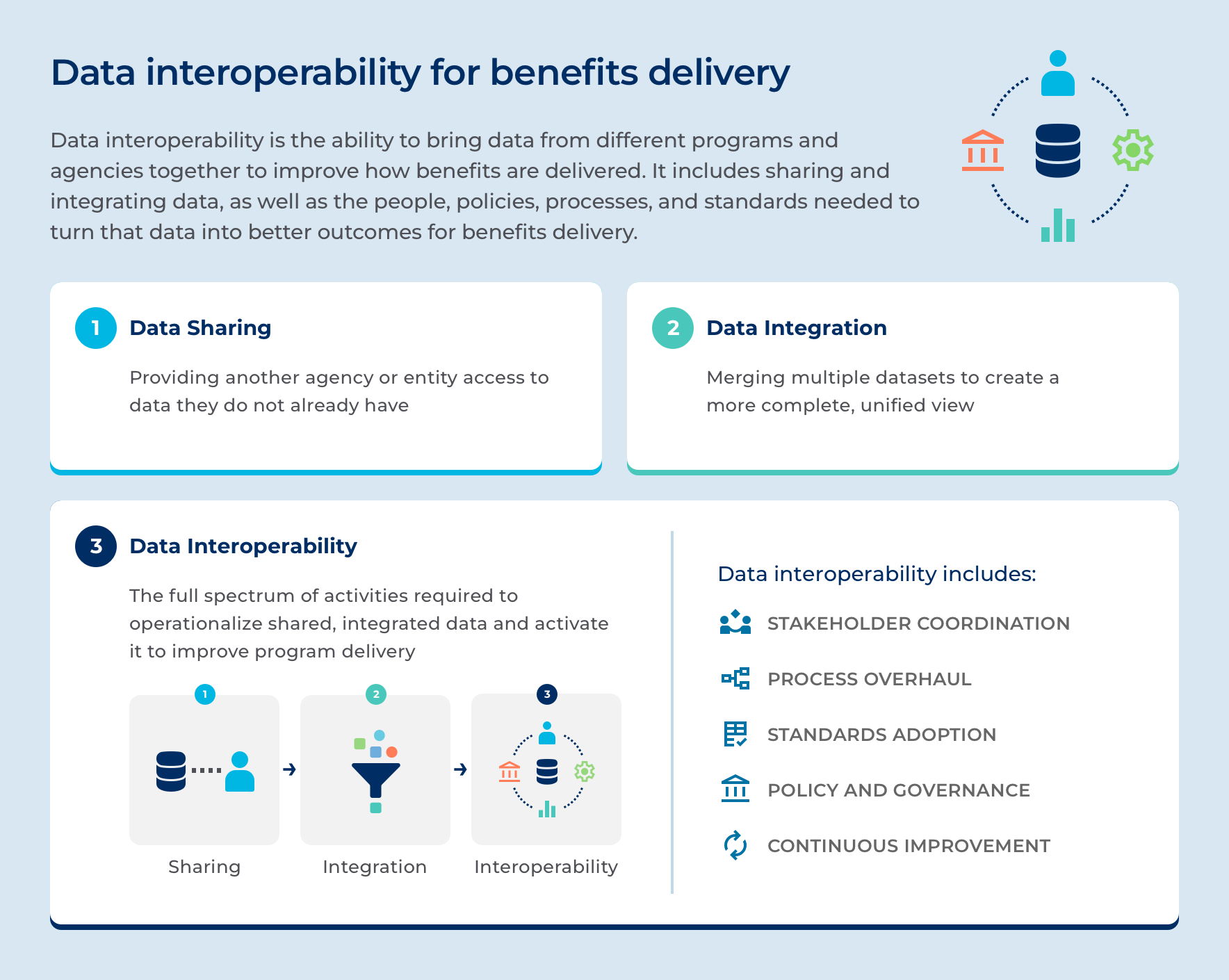
“Data interoperability” is not the most common term used across existing research and discourse surrounding the exchange and leveraging of data for program delivery. The terms “data sharing” and “data integration” are more commonly used. ”Data sharing” refers to providing another agency or entity access to data that they do not already have, for example as used in Urban Institute, Benefits Data Trust, and Bipartisan Policy Center reports. “Data integration” refers to the merging of multiple datasets to provide a richer information landscape, for example as used in Actionable Intelligence for Social Policy’s Introduction to Data Sharing and Integration. But it has been noted that these terms insufficiently describe the spectrum of work called for and required to bring about the programmatic gains promised by data sharing and integration.
In response to this need for more nuanced terminology, this publication opts to use “data interoperability” to capture the wide range of activities necessary to operationalize shared, integrated data to inform program delivery. These activities include data sharing and integration, but extend further to include others, such as stakeholder coordination, process overhaul, standards adoption, and policymaking. Because many efforts stall at just data sharing or integration, this publication uses “data interoperability” to capture these essential activities that promote the activation of shared, integrated data.
In short:
- Data sharing: Accessing data (e.g., providing privileges to a previously inaccessible database)
- Data integration: Merging data (e.g., cleaning, reformatting, matching)
- Data interoperability: Using shared, integrated data to support program delivery efforts
Potential gains from data interoperability for benefits delivery
Key Insights
An estimated $80 billion to $140 billion worth of benefits go unused each year as staggering numbers of people eligible for benefits remain unenrolled. Recent studies suggest 43 percent of parents and children who are eligible for WIC are not receiving benefits, while 26 percent of people eligible for SNAP and millions of seniors eligible for Medicare are also without coverage.
Research suggests that data interoperability can play a significant role in reducing the administrative burden for staff and beneficiaries alike, thereby supporting both program integrity and uptake. In particular, studies suggest interoperability can:
- Help agencies better understand and monitor program uptake and integrity, for example, by bringing down error rates
- Increase referrals and support targeted outreach strategies
- Remove duplicate processes and burdens for administrators, making it easier to enroll families in multiple programs for which they’re eligible (such as using income data from SNAP to automatically renew Medicaid)
- Increase accuracy of data and determinations by providing multiple sources to confirm beneficiary information and eligibility factors
As interest in the gains from data interoperability grows, researchers have sought to understand the core risks and challenges that agencies must consider when undertaking such efforts. Across this research, three broad categories emerge:
- Establishing sound technical foundations
- Managing legal and ethical risks
- Sustaining and funding data interoperability efforts
The following sections explore key sources and insights across each of these challenge areas.
Key Sources
- “Opportunities to Streamline Enrollment Across Public Benefit Programs”, Center on Budget and Policy Priorities, 2017.
- “Data Sharing to Build Effective and Efficient Benefits Systems”, Benefits Data Trust, 2023.
- “States Can Reduce Medicaid’s Administrative Burdens to Advance Health and Racial Equity”, Center on Budget and Policy Priorities, 2022.
- “Tackling the Time Tax: How the Federal Government Is Reducing Burdens to Accessing Critical Benefits and Services”, U.S. Office of Information and Regulatory Affairs, 2023.
- “Leveraging Cross-Program Data to Modernize Outreach & Enrollment in SNAP & Connected Benefits”, American Public Human Services Association, 2024.
- “WIC Coordination With Medicaid and SNAP”, Center on Budget and Policy Priorities, 2024.
- “How to Streamline Verification of Eligibility for Medicaid and SNAP”, Center on Budget and Policy Priorities, 2024.
- “Data Source Integration Strategy for Work Requirements: A Prioritization Guide for State Medicaid Programs”, 17A, 2026.
- “Program Integrity Through Data Infrastructure: Policy Brief”, Data Foundation, 2026.
Challenge Area: Establishing Sound Technical Foundations
Key Insights
Successful data interoperability can be the product of complex technical processes that are dependent on multilayered technological infrastructure. However, as discussed below, complex technological infrastructure is not necessarily required for successful data interoperability, and many of the challenges that practitioners face are technical in nature—from reconciling inconsistent data standards to resolving poor data quality.
Data Standards
For data to be meaningfully leveraged by multiple systems, shared data standards are critical. Data.gov defines a data standard as “a technical specification that describes how data should be stored or exchanged for the consistent collection and interoperability of that data across different systems, sources, and users.” Some agencies do use common standards to manage their benefits data systems, such as the National Information Exchange Model (NIEM) developed by the federal government, which provides “reusable data terms and definitions, and repeatable processes” that entities can use to document, format, and exchange data, and the community navigation standards managed by Inform USA (formerly AIRS, the Alliance of Information and Referral Systems), which provide standardized data structures and elements to community navigators across the U.S.
When agencies do not follow or document data standards, discrepancies in datasets can complicate exchange between agencies. Currently, data sharing entities are often formatting, defining, and processing data using different standards, and pulling from varied—often aging—systems that were not designed to interact.
These variations have implications for how a dataset that lacks certain attributes, like unique identifiers or Social Security numbers (required by some programs but not others), can be incorporated into a data system that requires them, and the human effort needed to reconcile differences.
“[T]rue interoperability requires establishing common standards and designing infrastructure, so that different databases, tools, and applications can consistently recognize, trust, and interpret one another. It requires structuring data fields and metadata that align across systems and agencies. Most critically, it means viewing data and systems not as a collection of isolated parts, but as a cohesive blueprint that is continually refined.”
Sydney Saubestre and Comfort Sampong., “The Power of Shared Data: Building Blocks for Interoperability” (2025)
Data Documentation
New America acknowledges that “there is a lack of standardization for data documentation across government, as well as gaps in updating shifting data definitions and other important data changes over time. Sharing data can thus require significant time investment from personnel.” The TANF Data Collaborative also notes that “gaps in data documentation make it harder to use data effectively”—even when agencies have access to it.
The Benefits Data Trust (BDT)—which formally sunset as an organization in 2024—notes that documentation tools like data dictionaries can make it much easier to assess data quality and put data to use. This is especially true in the case of staff turnover; currently, much institutional data knowledge is passed down informally from person to person and lost when staff members leave the agency.
Data Quality
Poor or untested data quality can add to this difficulty. This is particularly true for data elements that are “collected or verified inconsistently because they are not essential for agencies’ frontline practice, such as reasons for case closures.” Poor data quality can also have serious implications for beneficiaries if used to determine eligibility, with the potential for people to be denied for programs they qualify for.
Data quality is particularly relevant for programs that use reasonable compatibility to determine eligibility. This method is used by some programs to ensure that self-reported income is sufficiently consistent with trusted data sources to verify eligibility without additional proof. Medicaid uses reasonable compatibility to streamline verifications, with federal regulations requiring agencies to “use all available and useful data sources and only request information from the client if they are unable to verify needed information through a data source.” If data is not reasonably compatible with an attestation due to inaccurate data sources, the administrative burden of proving eligibility falls to the beneficiary, who will need to share additional documentation. Research has demonstrated that an increase in such “compliance costs” can lead directly to program dropoff and detrimental health impacts.
Data Infrastructure
Researchers offer less consensus regarding data infrastructure—the technical systems agencies use to house and process data. Some speak of the costs of outdated and fragmented legacy infrastructure that cannot meet current data demands, and a lack of resources or political will for investments in what are likely to be costly modernization efforts. And yet, other researchers emphasize that effective data interoperability between benefits agencies does not require significant investment.
BDT states that “[a]gencies do not need to have perfect data or the most modern data infrastructure to develop secure data sharing initiatives that benefit residents and frontline workers,” though acknowledges that “proven approaches are underutilized due to … operational hurdles related to using administrative data from siloed programs and aging infrastructure.” Code for America reports that “states don’t need high data maturity to make big changes to their systems.” A report on the characteristics of high-quality data users within TANF agencies found no correlation between technical characteristics of a state’s data system and its quality of data use.
“It may strike some as counterintuitive to think that data infrastructure is not associated with data use, but the innovative thinking necessary to overcome technical challenges may also be what is needed to practice good data use.”
TANF Data Collaborative, “Exemplary Data Use by State TANF Agencies” (2022)
Indeed, many case studies cited by researchers center on the relatively low-tech activity of sharing enrollee lists between agencies and departments to identify beneficiaries likely eligible for programs under one another’s purview. Examples include the South Carolina Department of Social Services, where staff compare lists of Medicaid and SNAP enrollees to identify Medicaid beneficiaries who are not enrolled in SNAP, and the Minnesota Department of Health, which shares lists of new Medicaid recipients likely to be eligible for WIC with Minnesota WIC, which matches them against a list of current recipients. Both efforts inform targeted outreach to assist beneficiaries in applying for eligible programs.
In their Quality Framework for IDS (Integrated Data Systems), AISP notes that states would be remiss to approach this work solely as a technical project, stating “the technical approach should not be the end goal, but a means to get there,” and emphasizing that it should be iterative; it “can and should change as data sharing and integration needs develop and technological advances shift best practices … we encourage starting small, and initially investing in relationships and human capacity more than in large IT infrastructure.”
Recommendations from the Research
- Leverage government data standards and open-source data standards.
- Use documentation, including tools like data dictionaries, to align on, define, and document data formatting and structure, including elements like unique identifiers, variable names.
- Run quality control on data prior to using it.
- Explore simple, low-cost, and low-tech opportunities for innovation.
- “Data Standards”, Data.gov, n.d.
- “Moving to 21st-Century Public Benefits”, Center for Law and Social Policy, 2012.
- “Unpacking Data Use in State TANF Agencies: Insights from TANF Data Innovation Needs Assessment”, TANF Data Collaborative, 2021.
- “Quality Framework for Integrated Data Systems,” Actionable Intelligence for Social Policy, 2021.
- “Better Data Sharing for Benefits Delivery”, New America, 2022.
- “Integration and Coordination Across Public Benefit Programs: Insights from State and Local Government Leaders in the United States”, Preventive Medicine Reports, 2022.
- “Exemplary Data Use by State TANF Agencies”, TANF Data Collaborative, 2022.
- “Data Sharing to Build Effective and Efficient Benefits Systems”, Benefits Data Trust, 2023.
- “How to Streamline Verification of Eligibility for Medicaid and SNAP”, Center on Budget and Policy Priorities, 2024.
- “Working with the Data You Already Have to Improve Benefits Delivery”, Code for America, 2025.
- “The Power of Shared Data: Building Blocks for Interoperability”, New America, 2025.
Challenge Area: Managing Legal and Ethical Risks
Key Insights
While technical challenges may be expensive and time-intensive, research consistently points to concerns surrounding legality, privacy, security, and ethics as the biggest impediments to data interoperability for public benefits. This seems partly due to legitimate complexities surrounding these issues, and partly due to the widespread fear of those complexities.
Data Privacy Concerns
Researchers agree that the efficiencies of data interoperability cannot come at the expense of data privacy. While this is true in all contexts, it is particularly important in the context of public benefits, where beneficiaries—who often represent vulnerable populations like low-income individuals, immigrants, and older adults—are disproportionately harmed by breaches and have historically suffered from institutional misuse of data. For these reasons, vulnerable beneficiaries themselves might be particularly wary of data interoperability efforts.
The general population increasingly shares this view. In 2023, Pew Research Center reported 71 percent of U.S. adults are worried about how the government uses their data, an increase from 2019, while a 2026 study by the Center for Democracy & Technology, motivated by the Trump administration’s efforts to expand federal access to states’ program data, showed 74 percent of U.S. adults worry about their personal data held by the government and want public agencies accountable for protecting it. Recent developments in the use of artificial intelligence (AI) to automate benefits administration are likely to exacerbate such concerns, particularly when agencies lack federally-mandated guidelines for safely integrating AI into operations.
In a study conducted by Nava to uncover opportunities to bring AI to public benefits processes, beneficiaries and case workers reported being “concerned about how their information would be used and shared. However, everyone with those concerns said they would be open to using AI if organizations can clearly explain how their data is protected.”
Data Privacy Laws
The laws governing how beneficiary data can be shared are varied and complex, often leaving agencies unsure of how to comply with privacy laws while pursuing data interoperability efforts. Agencies must consider federal privacy laws, like the Privacy Act of 1974, Section 1137 of the Social Security Act, as well as the Health Insurance Portability and Accountability Act (HIPAA), Family Educational Rights and Privacy Act (FERPA), and Title 42 of the Code of Federal Regulations, which vary in their applicability to program data and requirements for de-identification and data exchange protocols. There are also state-specific privacy laws, federal and state-specific benefits laws, as well as laws related to specific modes of communication, such as text messaging. On top of this, agencies and specific divisions may have their own policies regarding how data is shared across offices and agencies.
Additionally, due to variations in program policies and laws, only some benefits programs collect beneficiary data with consent to share it later with other agencies. For example, while WIC agencies are “fairly limited” in how they can use or disclose confidential information without the beneficiary’s consent, SNAP administrators have “significant leeway” in disclosing data to support the delivery of other programs. BDT notes that “more robust data sharing options—across programs and/or for different purposes—may be possible if consent is collected by the administering agencies.”
Data Sharing Agreements
Data sharing agreements are the primary legal mechanism for establishing an official relationship and terms of data exchange between agencies. These agreements formalize the process by which government agencies exchange records, typically through instruments like Memoranda of Understanding (MOUs) or computer/data matching agreements, and can connect agencies more formally than caseworker-to-caseworker relationships allow.
“[Well-executed data sharing agreements provide the foundation to facilitate a secure exchange of information that provides meaningful data through an interoperable information network … Foundational requirements are as follows: (a) data sharing must protect confidentiality and security, and operate within the principles established by governing laws and regulations; and (b) data sharing requires participants to operate within a set of clear protocols that govern who, when, how, and why individuals and entities can access and use data, as well as ensure compliance with regulatory and oversight structures.”
AISP, “Legal Issues for IDS Use: Finding a Way Forward” (2017)
With many state benefits systems being designed, built, or managed by vendors, researchers also note that third parties must be addressed when crafting agreements. (Particularly in light of research showing that considerable use of private vendors can influence public trust, making it “harder for the public to understand how public benefits programs work and how recipients’ data are used.”) It is recommended to include terms about contractors’ ability to access and modify confidential data, to require their compliance with agreement protocols, and to confirm they have proper privacy and security training.
Despite their centrality to successful data interoperability efforts, data sharing agreements are not always used—the National Neighborhood Indicators Partnership (NIPP) reports that “the [data sharing] process is frequently ad hoc,” and other researchers note that government administrators can be wary of developing data sharing agreements due to legal concerns or privacy issues.
Data Security
Data interoperability, by design, expands the set of systems and parties that can access a dataset beyond its original owner—and each additional party and interaction offers a new opportunity for data to be mishandled or breached. Strong security practices are thus a precondition for safe interoperability. Data security plans can help agencies handle data with care, protect confidentiality and privacy, and reduce risk of exposure or misuse.
The NIPP’s Resource Guide to Data Governance and Security notes that data security plans are typically a required part of data sharing agreements, and should identify the following: 1) Data use and handling procedures, (2) Vulnerability assessment and risk management, and (3) Data security incidents and breaches, and should account for various stages of the data life cycle, including acquisition, processing, dissemination, and destruction. AISP notes that data security is composed of multiple layers, including legal (such as data agreements), physical (e.g., locked hardware), procedural (e.g., regular staff training), and technical (e.g., secure servers) components.
Different projects demand different security measures across these layers. For example, a data agreement for a project with confidential data should include greater security conditions than for a project using non-confidential data. If a project integrates data that is covered by HIPAA, it requires a secure method of transfer (outlined in federal HIPAA guidance and/or existing data sharing agreements), while data that is already publicly available does not.
Risk-Aversion and Data Interoperability
Researchers also speak of the fear of issues related to laws, privacy, and data security (how agencies assess threats, and the tools and protocols they use to protect beneficiary data from breaches or loss). This fear is fueled by a lack of clear federal guidance on these subjects, often leading administrators to avoid data interoperability efforts altogether rather than risk inadvertent noncompliance or legal breaches. This avoidance can delay the development of data sharing agreements between agencies and lead to underutilization of proven approaches.
“[A]mbiguity [of existing policies] gives rise to a culture that is risk averse beyond the actual risks posed by legal rules, leaving a status quo of ad hoc data sharing and lengthy sharing agreement processes. There is a need for clear legal and organizational policies that create a foundation to support the sharing of data while protecting privacy.”
New America, “Better Data Sharing for Benefits Delivery” (2022)
Privacy-Enhancing Technologies
Privacy-enhancing technologies (PETs) are proving a crucial area of development for data interoperability, and for addressing some of the concerns held by both agencies and the public.
While there is growing research on PETs for government operations and delivery broadly, there is less data on how these tools are being used specifically for benefits delivery. What is clear is that PETs present a promising opportunity space for helping agencies advance data interoperability while protecting beneficiary data, by decentralizing access to sensitive data, enabling responsible data sharing, expanding trust and participation, and meeting privacy regulatory requirements.
Some PETs include:
- Hashing: The process of converting a data input—such as a password, name, or Social Security number—into a fixed-length string of characters (a “hash”) using a mathematical function. The same input always produces the same hash, but cannot be converted back to reveal the original data. It’s used widely for secure storage and exchange of sensitive data. (New America)
- Trusted Execution Environment (TEE): A TEE is a secure area within a processor that runs code in isolation from the rest of the system, ensuring that sensitive data is processed in a trusted and confidential manner. New America suggests that these environments can be used in benefits delivery to evaluate “claims without exposing the full databases of all individuals receiving [the benefit].” (New America)
- Federated data science: “Federated data science is a collaborative approach to data analysis where multiple parties work together to analyze decentralized data without transferring or sharing sensitive information.” (New America)
- Differential privacy: Differential privacy adds “noise” to data. This makes it impossible to identify individuals but retains the usefulness of the database for data analysis. (NIST) (See also: NIST Guidelines for Evaluating Differential Privacy Guarantees)
- Privacy-enhancing cryptography: The use of cryptographic tools to enhance privacy goals. These include methodologies like zero-knowledge proofs, secure multi-party computation, homomorphic encryption, private set intersection, and others. (NIST)
- Zero-knowledge proof: “A cryptographic method that allows one party to prove to another party that they know a piece of information (e.g., a password or secret) without revealing the information itself.” For example, enabling “users to prove they meet age requirements without revealing their exact age or identity.” (New America)
Recommendations from the Research
Data Laws, Privacy, and Security
- Engage with legal teams early to understand the relevant legal considerations.
- Restrict data collection and sharing to only what is critical for enrollment objectives.
- Clarify for beneficiaries how data is being used via targeted communications and outreach.
- Include beneficiaries in data interoperability efforts, such as through participant advisory boards.
- Establish clear legal guidance at state and federal levels.
- Use tools like data masking, aggregation, and obfuscation for keeping data both private and secure.
- Use PETs in combination and proper sequence to protect privacy at every step of data exchange and use.
- Include data security plans in data sharing agreements, accounting for legal, physical, procedural, and technical security.
Data Sharing Agreements
- Leverage shared infrastructure to reduce the need for multiple individual data sharing agreements across agencies, such as the Federal Data Services Hub.
- Standardize data use and sharing agreements.
- Leverage template resources, such as the Administration for Children and Families’ example Memorandums of Understanding and data security agreements.
- “Moving to 21st-Century Public Benefits”, CLASP, 2012.
- “Technology for Civic Data Integration”, Actionable Intelligence for Social Policy, MetroLab Network, and National Neighborhood Indicators Partnership, 2018.
- “Nothing to Hide: Tools for Talking (and Listening) About Data Privacy for Integrated Data Systems”, Actionable Intelligence for Social Policy and Future of Privacy Forum, 2018.
- “From Siloes to Solutions: Getting to Interoperability in Health and Human Services”, National Interoperability Collaborative, 2018.
- “Maximizing Linkages: A Policymaker’s Guide to Data Sharing”, Social Interest Solutions, 2019.
- “Better Data Sharing for Benefits Delivery”, New America, 2022.
- “A Community-Centered Approach to Data Sharing and Policy Change: Lessons for Advancing Health Equity”, Center for Health Care Strategies, 2022.
- “Data Sharing to Build Effective and Efficient Benefits Systems”, Benefits Data Trust, 2023.
- “Data Coordination at SNAP and Medicaid Agencies”, Center for Health Care Strategies, 2023.
- “How Americans View Data Privacy: Tech Companies, AI, Regulation, Passwords and Policies”, Pew Research Center, 2023.
- “Unlocking the Power of Data Sharing in Tax and Benefits Administration”, Bipartisan Policy Center, 2024.
- “Conducting User Research to Jumpstart Human-Centered Experimentation with Artificial Intelligence”, Nava, 2024.
- “How to Streamline Verification of Eligibility for Medicaid and SNAP”, Center on Budget and Policy Priorities, 2024.
- “Introduction to Data Sharing and Integration Vol. 2”, Actionable Intelligence for Social Policy, 2025.
- “Field Guide for Financing Public-Sector Integrated Data Systems and Evaluation”, U.S. Digital Response and National Academy of Public Administration, 2025.
- “Data Sharing Guidebook”, North Carolina Department of Health and Human Services, 2025.
- “A governance and legal framework for getting to “yes” with enterprise-level data integration”, Actionable Intelligence for Social Policy and North Carolina Department of Health and Human Services, 2025.
- “Introduction to Privacy-Enhancing Technologies (PETs): How to Protect Government Data with Privacy-Enhancing Technology”, New America, 2025.
- “Privacy-Enhancing Cryptography (PEC)”, National Institute of Standards and Technology, 2026.
- “Overwhelming Majority of Americans Worried About Personal Data Held by Public Agencies and Want Government Accountability”, Center for Democracy and Technology, 2026.
- ”Data Security: Considerations for Data Sharing,” Actionable Intelligence for Social Policy, 2025.
- NNIP’s Resource Guide to Data Governance and Security, National Neighborhood Indicators Partnership, 2018.
- “Measuring Performance: A Guidance Document for Promise Neighborhoods on Collecting Data and Reporting Results,” Urban Institute, 2019.
Challenge Area: Implementation and Sustainability
Key Insights
Once agencies address technical, ethical, and legal considerations, they face another challenge: implementing and sustaining their data interoperability efforts across multiple benefits agencies, each with their own culture, priorities, and resource constraints. Existing research speaks to several core areas that influence this phase’s success: stakeholder alignment; agency culture, legislation and policy; and financing.
Stakeholder Alignment
The success of data interoperability efforts for public benefits is directly tied to agencies’ capacities for collaboration. These entities must agree on terms and policies, coordinate access to and exchange of data, and share documentation. This collaboration requires strong relationships between agencies—and the public—built on trust, transparency, and clear communication.
“TANF agencies that stood out for exemplary data use relied on strong collaboration and communication among teams, with other state agencies, and with external partners.”
TANF Data Collaborative, “Exemplary Data Use by State TANF Agencies” (2022)
But research also tells us that these strong working relationships are not necessarily the norm—benefits agencies are historically siloed, and lack shared priorities or preexisting working relationships, leaving them unprepared for the complex collaboration data interoperability requires.
Agency Culture and Capacity
Challenges will vary depending on the agencies involved. In some cases, the complex architecture of a relevant entity, such as housing agencies operated through multiple local housing authorities, poses a unique challenge by requiring relationship-building across a large number of distinct offices. In others, the preexisting agency culture can present a hurdle—researchers report that a “data-driven and collaborative culture” is crucial, and that a “[r]isk-averse office culture” driven by concerns of unintentionally violating laws can significantly slow or prohibit data interoperability initiatives.
On the other hand, leadership that embraces data interoperability and cross-program coordination can drive the formation of clear policy and protocol, giving staff the guidance they need to confidently move ahead with data sharing agreements. But research also supports that leadership buy-in itself is not enough. Agency staff must have the requisite data literacy and privacy and security training to realize and manage data interoperability initiatives.
Speaking of integrated data systems writ large, AISP notes that “Across contexts, personnel costs consistently represent the largest investment, reinforcing that IDS work is fundamentally a people-centred endeavour. Success relies on relationships, buy-in, and operational capacity, while the technical components are often seen as comparatively easier to resource.”
Without this supportive culture and internal capacity, agencies will likely see limited payoff from technology investments.
North Carolina’s Department of Health and Human Services (NCDHHS)’s recently published Data Sharing Guidebook (2025) offers one example of successful agency-wide alignment on data interoperability efforts. The publication operationalizes the state’s data governance process and legal framework with the aim of aligning NCDHHS’s complex structure and expansive team. Building on AISP’s four key questions for data interoperability projects—(1) Is it legal? (2) Is it ethical? (3) Is it a good idea? (4) Who decides?—the guidebook “provides approved language and templates for agreements while ensuring ethical use and mitigating legal risk, and has shown nearly 90% savings for staff effort and time to completion for some intradepartmental data sharing.”
State and Federal Policy
Implementing data interoperability between agencies and states depends on their ability to interpret and apply a complex web of state and federal policies. These laws are challenging not only because of their inherent complexity, but also because they can be inconsistent between states, lack clear regulations, and are not governed by strong federal guidance. Researchers agree that to streamline data interoperability, policies must be clear and well-communicated—not just regarding privacy and data handling, but for all parts of the benefits enrollment process, including verifying eligibility.
“Congress has provided requirements and options to use data gathered by one program in another… But the rules are specific and can be hard to navigate across multiple programs. An administrator of a child care, energy assistance, or Medicaid program may not be aware of all of the available connections across health and human services programs in the state or community.”
Center on Budget and Policy Priorities, “Opportunities to Streamline Enrollment Across Public Benefit Programs” (2017)
Funding
Financing public benefits data interoperability efforts presents as a persistent challenge across research and practice documentation. However, there is some tension between those who believe data interoperability can be achieved without significant technological modernization, and those who point to a lack of funding as a key challenge. Despite the promise that “[a]dvances in cloud-based and privacy-enhancing technologies have enabled savvy governments to dramatically increase their capacity to generate actionable, useful information at modest cost,” research suggests that agencies believe successful interoperability requires substantial investments in technology systems and administrative capacity.
Beyond technology investments, data interoperability efforts require agencies—often already stretched thin—to train staff on new areas of knowledge and tools, such as learning about “key data attributes and variables across datasets.” Resource constraints can also prevent agencies from fully acting on shared data—for example, when an agency lacks the funds to hire sufficient outreach staff to contact eligible participants.
AISP’s 2026 report on staffing and funding for integrated data systems (for broad use, not just public benefits), notes that funding sources include local, state, federal, and philanthropic funds, as well as fee-for-service models, with each source bringing both benefits and trade offs. For example: government funds can offer stability but also precarity, due to administrative changeover and evolving priorities.
The Field Guide for Financing Public-Sector Data Systems and Evaluation offers research-based guidance on how agencies can navigate funding challenges by strategically identifying and pursuing grant opportunities. The report pays special attention to grants that can be used for multiple policy priorities or programs, and also addresses the complexities this brings. In particular, how to account for varying federal matching rates across benefits programs, and restrictions that limit certain funds to specific project phases, such as planning and design, while excluding others, such as implementation or ongoing maintenance.
“Federal efforts… have provided strong financial incentives for states to establish two parallel integrated data infrastructures. While … these efforts ha[ve] encouraged integrated data capacity in specific areas, they have also created barriers to broader data sharing and shared infrastructure.”
U.S. Digital Response and National Academy of Public Administration, “Field Guide for Financing Public-Sector Integrated Data Systems and Evaluation” (2025)
Regarding how funding is allocated, AISP’s 2026 research concludes that: “Successful efforts tend to focus initial investments on partnership development and data governance, rather than technical infrastructure, and diversify funding sources over time.”
Recommendations from the Research
Stakeholder Coordination and Agency Culture
- Begin data interoperability projects by bringing stakeholders together to align on shared goals and processes, and specific plans to analyze data and make program improvements.
- Build teams with diverse expertise, including representatives from program operations, legal and policy, data systems and analytics, and monitoring and evaluation. Teams will also benefit from subject matter expertise in customer service and engagement, user research, data architecture, and data visualization.
- Start small and scale up as necessary—always using clear job descriptions that outline specific duties.
- Host regular inter-agency meetings and workgroups to facilitate relationships and resource-sharing.
- Identify leaders or executive sponsors, such as Chief Data Officers, who can both champion the work and help drive enthusiasm for data-driven initiatives.
- Encourage communication between agencies—and between agency staff and frontline staff—via regular integrated meetings, shared reports, or department-wide data initiatives.
State and Federal Policy
- Establish clear federal guidelines to reduce fear and uncertainty for agencies.
Funding
- Secure additional funding for technology modernization (similar to what was provided through the Affordable Care Act).
- Direct funding to professional organizations and inter-state coalitions, with the goal of developing best practices and resources to share with agencies (such as template language for Memoranda Of Understanding).
- Implement funding strategies that “leverage dollars across policy and operational silos,” such as by:
- Combining federal funding with non-federal grants
- Strategically funding different phases of development
- Using the Cost Allocation Methodology toolkit to equitably divide project costs for multiple programs and request the appropriate federal match for the each program
- Leverage the Medicaid 90/10 funding match by building out a system for Medicaid data that can ultimately be used for non-Medicaid program data as well
- “Legal Issues for IDS Use: Finding a Way Forward”, Actionable Intelligence for Social Policy, 2017.
- “From Siloes to Solutions: Getting to Interoperability in Health and Human Services”, National Interoperability Collaborative, 2018.
- “Effective Data Governance: A Survey of Federal Chief Data Officers”,” Data Foundation, Grant Thornton Public Sector, and Qlik, 2020.
- “Confidentiality Toolkit”, Administration for Children and Families, 2021.
- “Data Sharing in Cross-Sector Collaborations”, Urban Institute, 2021.
- “Integration and Coordination Across Public Benefit Programs: Insights from State and Local Government Leaders in the United States”, Preventive Medicine Reports, 2022.
- “Better Data Sharing for Benefits Delivery”, New America, 2022.
- “Exemplary Data Use by State TANF Agencies”, TANF Data Collaborative, 2022.
- “Data Sharing to Build Effective and Efficient Benefits Systems”, Benefits Data Trust, 2023.
- “Leveraging Cross-Program Data to Modernize Outreach & Enrollment in SNAP & Connected Benefits”, American Public Human Services Association, 2024.
- “Unlocking the Power of Data Sharing in Tax and Benefits Administration”, Bipartisan Policy Center, 2024.
- “Unlocking the Power of Data Sharing in Tax and Benefits Administration”, Bipartisan Policy, 2024.
- “Field Guide for Financing Public-Sector Integrated Data Systems and Evaluation”, U.S. Digital Response and National Academy of Public Administration, 2025.
- “The Power of Shared Data: Building Blocks for Interoperability”, New America, 2025.
- “A landscape overview of integrated data systems funding and staffing models across the U.S.”, Actionable Intelligence for Social Policy, 2026.
From the Field: Examples of Efforts to Promote Data Interoperability for Benefits Delivery
Below is a compilation of documented examples of data sharing, integration, and use relevant to the lifecycle of U.S. benefits program administration. Some project summaries are lifted directly from the documented sources with minimal editing. Examples cite back to direct state documentation where readily available. This is not a comprehensive scan; if there is an example that should be added to this list please reach out to digitalgovernmentnetwork@georgetown.edu.
- The SNAP National Accuracy Clearinghouse (NAC) is an innovative technology solution designed to prevent SNAP participants from receiving benefits in multiple states. All SNAP state agencies are working toward nationwide implementation of the NAC, an interstate data matching system. The NAC’s primary goal is to enhance program integrity, reduce improper payments, increase customer experience and ensure fair and accurate distribution of SNAP benefits to eligible recipients across state lines. (Food and Nutrition Administration)
- The National Directory of New Hires (NDNH) is a national repository of employment, unemployment insurance, and quarterly wage information. The data residing in the NDNH includes: records from the State Directory of New Hires, quarterly wage and unemployment insurance data from the state workforce agencies , and new hire and quarterly wage data from federal agencies. (Administration for Children and Families)
- The SNAP Longitudinal Data Project (LDP) was approved by Section 4015 of the Agricultural Improvement Act of 2018 (the 2018 Farm Bill), Longitudinal Data for Research. The LDP allows states to build databases using SNAP information to support SNAP research. (Food and Nutrition Administration)
- SAVE is an online service administered by U.S. Citizenship and Immigration Services that provides point-in-time immigration status and U.S. citizenship information to federal, state, local, territorial, and tribal agencies. Over 1,300 agencies nationwide use SAVE to support their benefit eligibility and licensing determinations. (U.S. Citizenship and Immigration Services)
- The National Institute of Standards and Technology’s Privacy-Enhancing Technologies (PETS) Testbed provides the capability to investigate PETs and their respective suitability for specific use cases. One relevant model problem under consideration is the de-identification and synthesis of tabular demographic data. (National Institute of Standards and Technology)
- The Administration for Children & Families’ Confidentiality Toolkit is intended for staff at all levels of government who work within offices and agencies that promote the wellbeing of children and families and would like to know more about: (1) how responsibly sharing records with other offices and agencies can enhance service delivery and research efforts; (2) processes that can help assure record-sharing goals are successful; and (3) important confidentiality considerations related to sharing records. (Administration for Children and Families)
- Arizona Housing Coalition coordinated across multiple stakeholders, including state agencies, to integrate statewide Homelessness Management Information Systems data with Medicaid data to improve care coordination for people experiencing homelessness. Stakeholders were guided by data sharing commitments, and the effort engaged those with lived experiences to inform decision-making. (Center for Health Care Strategies)
- Beginning in 2018, California Health and Human Services (CHHS) and Children’s Data Network conducted a large-scale “record reconciliation” effort to link and organize administrative records across seven major CHHS programs: CalWORKs, CalFresh, In-Home Supportive Services, Foster Care, Medi-Cal (California Medicaid), Women, Infants, & Children, and Developmental Services. This resulted in the development of encrypted master “intra-agency” beneficiary identifiers and was an important first step toward organizing CHHS data into family units and households, and understanding CHHS clients and service experiences. (State of California)
- A research pilot linked tens of millions of records across California’s largest health and human services programs, demonstrating the potential of data integration to improve everyday operations, coordinate services, develop targeted interventions, and more. (Health Affairs)
- California’s Data Exchange Framework (DxF) enables the secure, real-time exchange of data among health and social service entities throughout the state. DxF is California’s first statewide Data Sharing Agreement and shared policies and procedures for the secure exchange of health and social services information. It is led by the California Department of Health Care Access and Information and guided by the DxF Stakeholder Advisory Committee. (State of California)
- As part of its H.R. 1 implementation plan, the state’s Department of Health Care Services is encouraging Managed Care Plans to collaborate with local county offices to establish data sharing agreements, including a template memorandum of understanding. (State of California)
- California linked TANF and wage data to investigate the long-term earnings outcomes of TANF participants. (MDRC)
- California was one of the first states to adopt Login.gov, enabling transit riders to quickly and securely verify their eligibility online for discounted fare programs. (General Services Administration; Beeck Center for Social Impact + Innovation)
- In 2017, the State of Colorado and the Colorado Evaluation and Action Lab partnered on the Linked Information Network of Colorado (LINC). LINC is a collaborative based out of the Governor’s Office of Information Technology (OIT) that supports integrated data across state and local agencies, including human services, health, labor and employment, housing, and more. It is a federated data model where data partners temporarily provide the minimum required data for an approved LINC project. LINC follows all standards for data security and privacy required by state and federal laws and regulations. LINC’s data sharing agreement allows each data partner to specify their exact expectations regarding the handling of their data. (LINC)
- Colorado’s Joint Agency Interoperability is a collaborative program involving state counties, agencies, and federal partners to address the comprehensive needs of individuals, families, and communities by enhancing the integration of business processes with technology and data. (State of Colorado)
- Colorado worked with Code for America to improve its Medicaid ex parte renewal process by better using and sharing existing data sources like SNAP, TANF, IRS, and Social Security data. (Code for America)
- Florida’s Department of Children and Families and the Agency for Health Care Administration worked with the University of Florida to create a linked dataset of state Medicaid and child welfare system data to connect those involved in the child welfare system with Medicaid-funded treatments that may help prevent family separations. (Office of the Assistant Secretary for Planning and Evaluation)
- Georgia’s Cross Agency Child Data System (CACDS) aligns data from programs and services for children up to five years old and their families. CACDS uses the data to identify service gaps and create opportunities for analysis and research. CACDS provides a collection of standard and customizable templates into which early childhood partners can download aggregate-level data reports. (Georgia Cross Agency Child Data System)
- Iowa’s Integrated Data for Decision Making (I2D2) initiative supports coordination between systems of care for young children and their families. Sparked by a legislative mandate through Early Childhood Iowa that commissioned state departments toward collaboration, I2D2 involves the Departments of Management, Public Health, Human Services, Education, Human Rights, Economic Development, and Workforce Development and faculty at Iowa State University. (Iowa State University)
- Kansas aggregated cross-agency datasets in a data lake to bring together case data from multiple programs to promote program monitoring and improve outcomes. For example, the team leveraged shared data to inform targeted WIC and SNAP outreach campaigns. (American Public Human Services Association)
- Kentucky’s Office of Health Data Analytics, Department for Community Based Services, Office of Application Technology Services, and Department for Medicaid Services collaborated to create a linked dataset of state Medicaid and child welfare system data for the purposes of connecting those involved in the child welfare system with Medicaid-funded treatments that may help prevent family separations. (Office of the Assistant Secretary for Planning and Evaluation)
- Maryland Benefits is a secure cloud-based platform operated by the state’s Department of Information Technology. Previously known as MD THINK, the platform was initially built by the Department of Human Services to support multi-agency data sharing and analysis. Building on the pre-existing data sharing agreements and governance protocols, the state launched an integrated online application portal—a “single, accessible one-stop shop”—in 2025, where Marylanders could apply for multiple programs using one application. (Georgetown Law, Amazon Web Services, State of Maryland)
- New Mexico developed an automated cross-program referral process to automate WIC referrals for families applying for SNAP and other related benefits and services. (American Public Human Services Association)
- Under its 1115 waiver, New York plans to invest in coordinated, regional networks of CBOs to address health-related social needs. State goals include supporting CBOs to create “IT and business processes infrastructure, and adopt interoperable standards for a social care data exchange.” These CBO networks would be responsible for “coordinating a regional uniform referral system and network.” New York also plans to support a statewide data sharing system that will include health-related social needs data. (State of New York; Medicaid.gov)
- New Jersey matched cross-program data to share and match data between SNAP and WIC-administering agencies to identify families eligible for both programs but not dually enrolled. Agencies then used match results to notify families of their eligibility for the program in which they were not already participating. (American Public Human Services Association)
- New Jersey combined longitudinal TANF and unemployment insurance data to conduct analyses designed to help families experiencing homelessness move from emergency housing placements (in shelters or motels) to the Temporary Rental Assistance program, which provides a monthly housing voucher and assistance with move-in costs. (MDRC)
- Through a 1115 waiver, the state is implementing the Healthy Opportunities Pilots program in three regions to provide services related to housing, transportation, nutrition, and interpersonal safety for Medicaid enrollees. To facilitate access to these services, the state is supporting adoption of NCCARE360, a statewide technology platform to support data sharing and referrals. (State of North Carolina; Manatt)
- The state’s Department of Health and Human Services issued a Data Sharing Guidebook, including a five-part data sharing framework, to shape and guide how the department engages in data sharing and integration to promote linked data usage across a multi-service environment. (State of North Carolina)
- Oregon’s Integrated Client Services (ICS) is a shared service between the Oregon Health Authority (OHA) and Department of Human Services (DHS). ICS maintains a longitudinal client index across multiple Oregon agencies and programs such as Medicaid, SNAP, behavioral health programs, and more. These data linkages allow ICS to create longitudinal and single-use datasets, respond to legislative requests, support program improvement and policy implementation, and facilitate data sharing. (State of Oregon)
- The Allegheny County Data Warehouse integrates publicly-funded human services data (e.g., behavioral health, child welfare, intellectual disability, homelessness, and aging) with data from a number of other sources. The Data Warehouse is designed primarily to improve service delivery for beneficiaries, the ability of frontline workers to do their jobs, and leaders to make programmatic decisions. (Allegheny County)
- The Center for Health and Justice Transformation at The Miriam Hospital and state government collaborated to pilot an integrated data system that includes criminal justice and Medicaid data, working closely with community members to surface the needs of people impacted by the criminal justice system. (Center for Health Care Strategies)
- According to Actionable Intelligence for Social Policy, in 2018 Vermont began the process of linking Medicaid claims data with vital statistics and incarceration data. The state’s Agency of Human Services is also in the process of developing a standardized legal framework and process for data sharing within the agency, aiming to expand it statewide soon after that. (Actionable Intelligence for Social Policy)
- Vermont filed a 2026 legislative report evaluating the advantages and disadvantages of large-scale linkage of the state’s major health care datasets. According to the report, the Agency for Human Services “began a rolling go-live with linked claims, clinical, and [social determinants of health] data for the Medicaid population in the state’s Medicaid Data Warehouse and Analytics Solution system in November 2025, with full functionality scheduled to be live by the end of January 2026.” (Vermont Legislature)
- Washington’s Department of Social and Health Services (DSHS) Research and Data Analysis Division (RDA) developed and maintains Washington State’s integrated client database (ICDB), which stores information from over 30 separate administrative data systems across the state. RDA focuses on providing research capacity that produces analyses of government-funded social and health services in the state. The ICDB positions RCA to conduct in-depth analysis of beneficiaries who use services from multiple DSHS programs. RDA also houses the Human Research Review Board, which protects the privacy and confidentiality of subjects in any research project that falls under the jurisdiction of DSHS or the Department of Health. (Actionable Intelligence for Social Policy; Annie E. Casey Foundation)
- Wisconsin’s integrated data system—the Multi-Sample Person File (MSPF) data system—is developed and maintained by the Institute for Research on Poverty (IRP) at the University of Wisconsin-Madison. The MSPF is updated annually and includes administrative datasets on public assistance, child support, child welfare, unemployment benefits and incarceration, which can be merged into a single file containing one record per individual and using a unique identifier created by IRP. The MSPF data system also includes linkable files with parent/child and case-level data, and program participation files. (Annie E. Casey Foundation)
Suggested Citation
Smith, Rachel Meade and Colleen Pulawski. Advancing Data Interoperability for Public Benefits Delivery: Practice and Literature Review. Beeck Center for Social Impact + Innovation. 2026.
Acknowledgements
This work was supported by Arnold Ventures. We are grateful for the time and insights shared by our expert reviewers Anna Fogel, Ariel Kennan, Heather Hahn, Jen Wagner, Symonne Singleton, and Tayyab Walker.