A practical, step-by-step guide for government agencies to design, implement, and evaluate community engagement efforts around the use of artificial intelligence.
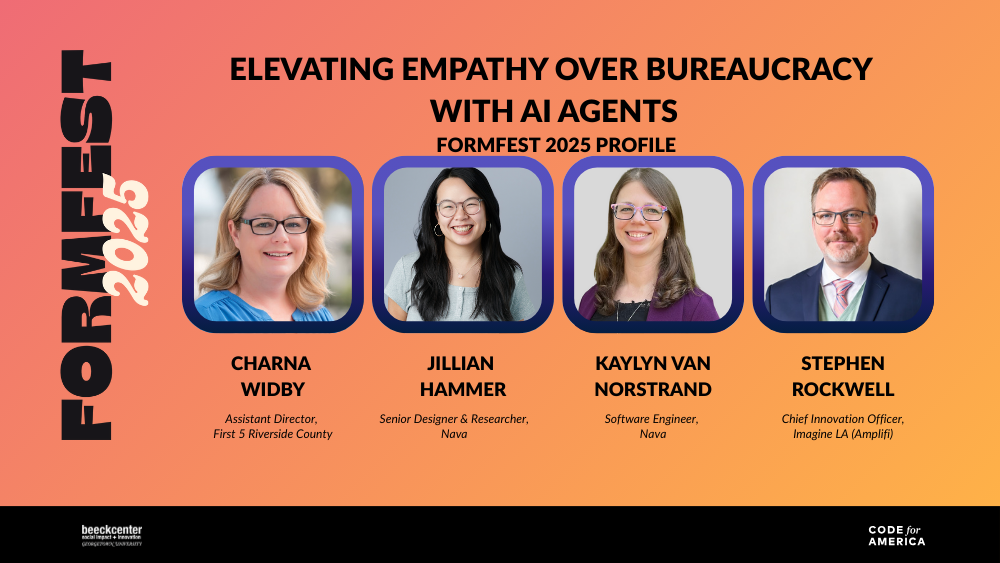
This FormFest profile highlights Riverside County’s pilot of AI-powered interviews that streamline benefit applications, reducing bureaucratic burden on families in crisis while freeing caseworkers to focus on human connection.
This internal glossary defines key terms and concepts related to automating enrollment proofs for public benefits programs to support shared understanding among product and policy teams.
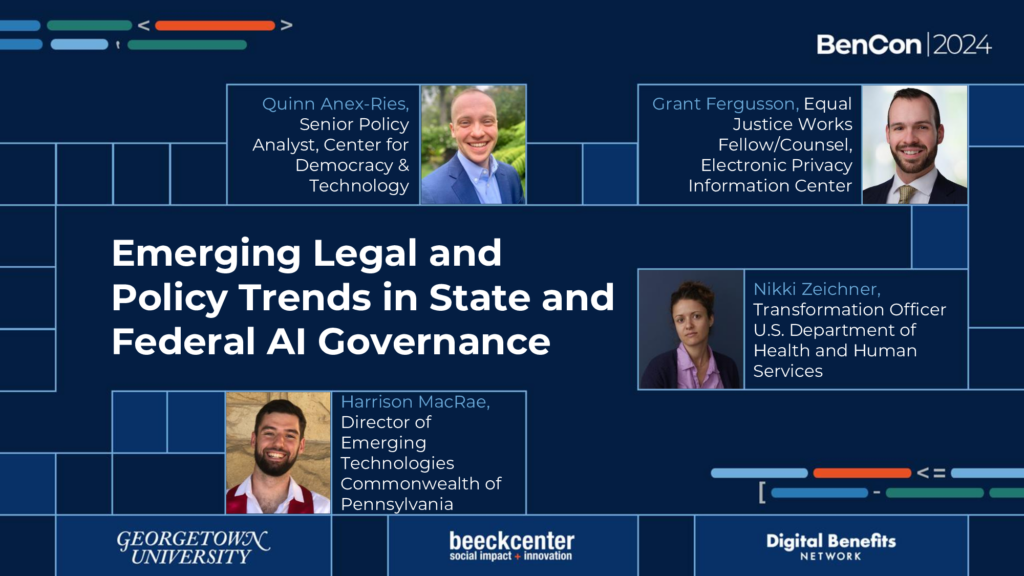
BenCon 2024 explored state and federal AI governance, highlighting the rapid increase in AI-related legislation and executive orders. Panelists emphasized the importance of experimentation, learning, and collaboration between government levels, teams, agencies, and external partners.
The primer–originally prepared for the Progressive Congressional Caucus’ Tech Algorithm Briefing–explores the trade-offs and debates about algorithms and accountability across several key ethical dimensions, including fairness and bias; opacity and transparency; and lack of standards for auditing.
This video shows you how to get started with using Generative AI tools, including Bard, Bing, and ChatGPT, in your work as public sector professionals.
This report explores technologies that have the potential to significantly affect employment and job quality in the public sector, the factors that drive choices about which technologies are adopted and how they are implemented, how technology will change the experience of public sector work, and what kinds of interventions can protect against potential downsides of technology use in the public sector. The report categories technologies into five overlapping categories including manual task automation, process automation, automated decision-making systems, integrated data systems, and electronic monitoring.
NIST has created a voluntary AI risk management framework, in partnership with public and private sectors, to promote trustworthy AI development and usage.
National Institute of Standards and Technology (NIST)
This academic paper examines how federal privacy laws restrict data collection needed for assessing racial disparities, creating a tradeoff between protecting individual privacy and enabling algorithmic fairness in government programs.
ACM Conference on Fairness, Accountability, and Transparency (ACM FAccT)