It is frequently assumed that when rules are implemented as code, a rules engine is necessary. However, it is possible for policy people and engineers to effectively work together to code logic that drives technological system without needing a mediating rules engine at all.
This playbook outlines the ways Community Action and human services agencies worked together to meet the pandemic challenge—what worked well, obstacles and difficulties, and lessons learned to inform the path forward, partnering to achieve a more equitable recovery. It also explains how communities have leveraged opportunities to partner on approaches that hold the promise of deeper, longer lasting changes for families—work shaped by families’ wishes and strengths and designed to advance both family-level and systems-level change.
American Public Human Services Association (APHSA)
Few large government software projects are successful, as current ecosystems in place at agencies do not support agile development practices. This guide provides instructions to federal agencies on how to effectively budget for, procure, and oversee software development projects.
Programs like Medicaid and SNAP are managed at the federal level, administered at the state level, and often executed at the local level. Because there are so many in-betweens, there is significant duplicated effort, demonstrating the need to simplify eligibility rules to facilitate easier implementation.
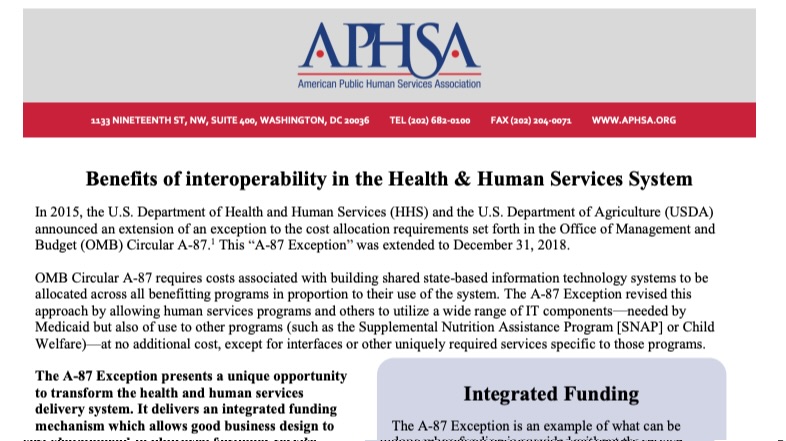
This report explains how the A-87 Exception enabled states to modernize and integrate health and human services systems, improving service delivery, efficiency, and data sharing across programs.
American Public Human Services Association (APHSA)
Initially created for and shared with staff at the Administration for Children and Families, this webinar provides an introduction to Universal Design, covering plain language, accessibility, user research, and Agile development.