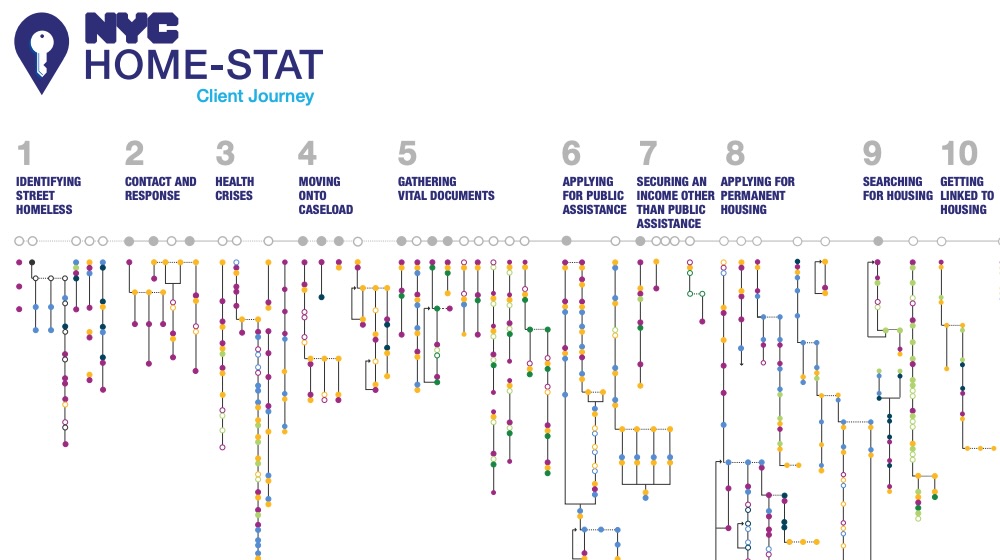
This overview journey map of street homeless outreach reflects the complexity of the service journey from first contact on street to placement in permanent housing.
In our research announcement on theories of change (ToC) for digital government, the Digital Service Network shared our belief that all Digital Service (DS) teams should work to develop a ToC.
In this updated primer, the DBN describes how identity proofing and authentication show up in public benefits applications and outlines equity and security concerns raised by common identity proofing and authentication methods.
In this updated primer, the DBN introduces the concept of digital identity, and provides brief snapshots of digital identity-related developments internationally and in the U.S.
In June 2020, the state implemented an innovative and entirely virtual vendor selection process to evaluate these solutions under the direction of the Colorado Digital Service (CDS).
Errors in administrative processes are costly and burdensome for clients but are understudied. Using U.S. Unemployment Insurance data, this study finds that while automation improves accuracy in simpler programs, it can increase errors in more complex ones.
In this brief, they present a definition of HCD that is applicable to the context of human services delivery, differentiate HCD from similar design and problem-solving approaches, and describe how HCD is being used in human services.
U.S. Department of Health and Human Services (HHS)
Government leaders discuss how to ensure seamless access to public benefits through breaking down silos, user-friendly digital identities, and privacy-focused security measures.
This article explores how AI and Rules as Code are turning law into automated systems, including how governance focused on transparency, explainability, and risk management can ensure these digital legal frameworks stay reliable and fair.
Presentation covering the findings of a research study analyzing the structural and budgetary layout of of eleven US-based Digital Service Teams (DSTs) at the municipal, county, and state levels.
This research study analyzes the structural and budgetary layout of eleven US-based Digital Service Teams (DSTs) at the municipal, county, and state levels. In doing so, it sets out to answer the research question: “How are digital service teams structured and funded?”