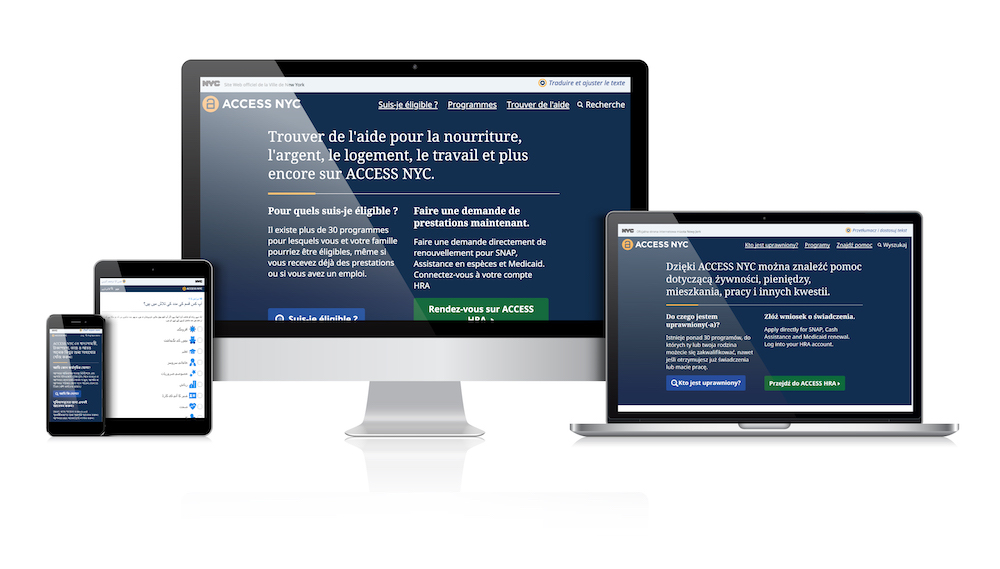
ACCESS NYC is an online public screening tool that residents can use to determine the City, State, and Federal health and human service benefit programs for which they are eligible.
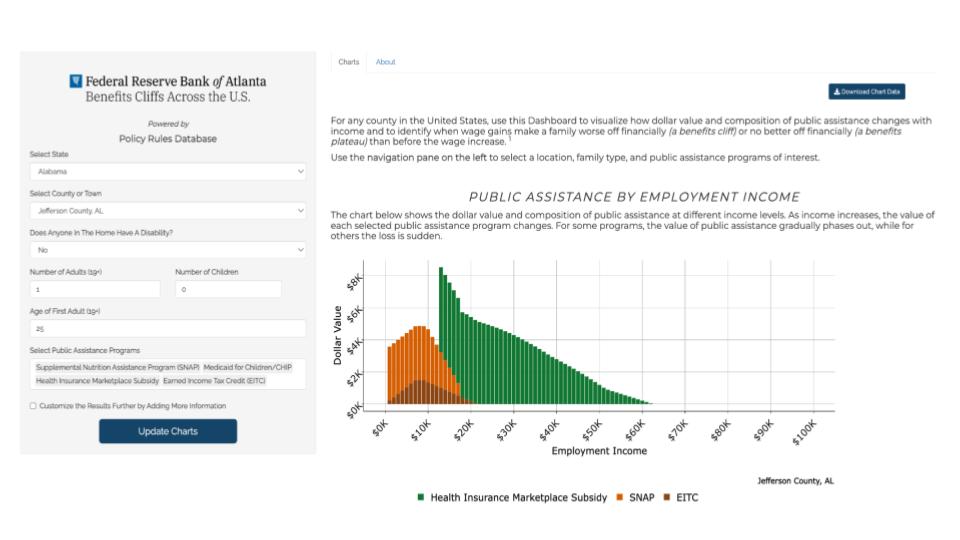
The Policy Rules Database (PRD), developed by the Federal Reserve Bank of Atlanta and the National Center for Children in Poverty, consolidates complex rules for major U.S. federal and state benefit programs and tax policies into a standardized, easy-to-use format. This database allows researchers to model public assistance impacts, simulate policy changes, and analyze benefits cliffs across various household scenarios using common rules and language across different programming platforms.
In this updated primer, the DBN describes how identity proofing and authentication show up in public benefits applications and outlines equity and security concerns raised by common identity proofing and authentication methods.
In this report, the U.S. Chamber of Commerce Foundation examines benefits cliffs – the loss of eligibility for public safety-net programs and benefits they provide as income rises above eligibility limits.
This budget request details ADES's FY2027 funding priorities—including developmental disability services, child care, IT modernization, and compliance with H.R. 1—and outlines projected fiscal impacts, caseload growth, and programmatic needs across the state
This brief provides a summary of potential federal funding sources and programs that can be used to support programs specifically targeted towards young families. While this list is not exhaustive, it highlights major sources that can serve as a starting point for braiding and blending of funding to create comprehensive programming to serve young families.
American Public Human Services Association (APHSA)
The Lost in the Labyrinth brief examines how fragmented early care and education (ECE) programs across the U.S. create challenges for families seeking services for young children.
This resource allows policymakers, employers, benefits providers, and researchers assess benefits performance for constituents and identify opportunities in market and policy innovation to ensure equitable benefits distribution.
This toolkit provides resources for training and technical assistance (T/TA) providers in the Child Care Technical Assistance Network (CCTAN) to help State, Territory, and Tribal CCDF Lead Agencies be prepared to conduct equity assessments.
The COVID Response Project was funded by the W.K. Kellogg Foundation to document the real-time impacts of the COVID-19 pandemic on state human services agencies and capture state perspectives on lessons learned to guide future federal policymaking and state implementation. The project was completed by the American Public Human Services Association (APHSA) in partnership with the U.S. Department of Health and Human Services, Administration for Children and Families (ACF), Office of Regional Operations. Insights from the report reflect information obtained through APHSA’s on-going support of state human services agencies’ COVID-19 response efforts as well as a series of in-depth interviews with executive leadership of the 14 state health and human services agencies in ACF’s Region 1 (New England) and Region 4 (Southeast) areas.
American Public Human Services Association (APHSA)
This report examines how states strategically approached managing and administering the historic influx of COVID-19 relief funds for child care and early childhood systems, focusing on governance structures, funding management systems, and data systems