Government agencies at all levels collect administrative data in the course of their day-to-day operations. While such information has been used to determine effectiveness through program evaluations for many years, program administrators view it increasingly as a valuable resource that can also be used to improve program performance. For example, administrative data from employment and public benefits programs such as Temporary Assistance for Needy Families (TANF) can offer insights into families’ unmet needs and ways to improve services.
This document, submitted in response to Executive Order 13985 on Advancing Racial Equity and Support for Underserved Communities, summarizes key aspects of DOL’s principles and approach to advancing equity. One of the five areas outlined includes administering and improving the federal-state Unemployment Insurance systems.
The toolkit provides strategies for state and local WIC agencies to enhance enrollment by utilizing data from Medicaid and SNAP for cross-program data matching and targeted outreach.
In Austin, there are over 2,000 individuals without a safe place to sleep. There are many reasons a person can become homeless, and these reasons range from the lack of affordable housing to the loss of family and community. In 2017, the Innovation Office secured a three-year $1.25m grant from Bloomberg Philanthropies to focus on the city's goal of ending homelessness. The grant funds an i-team to help the city identify the best ways for City Council, departments, and the community to collaborate towards a shared understanding of homelessness in Austin.
This report offers best practices for public agencies implementing digital identity verification, emphasizing privacy, equity, and security in the delivery of government services.
Better designs should never come at the cost of another person’s wellbeing. Informed consent is a fundamental part of an ethical research program, which respects participants and protects them from harm.
The Increasing Stimulus Payment Take-up in California report by the California Policy Lab examines barriers to accessing federal stimulus payments and provides strategies to increase take-up among eligible Californians, particularly low-income and non-filers.
This research summary presents findings from a randomized controlled trial demonstrating how mRelief’s simplified SNAP application significantly increases application rates among eligible individuals.
This strategic plan outlines Colorado's vision to enhance digital government by improving broadband access, simplifying government services, and leveraging data to create a more accessible, efficient, and responsive government for all residents.
Colorado Governor's Office of Information Technology (OIT)
This blog discusses the 988 Suicide and Crisis Lifeline, a nationwide initiative aimed at providing accessible, immediate support for individuals experiencing mental health crises through the easy-to-remember number 988.
Temporary Assistance for Needy Families (TANF) leaders, policymakers, and researchers all recognize the need for TANF agencies to use the data they collect to better understand how well their programs are working and how to improve them, given the impact on the families they serve. It is often difficult, however, for agencies already stretched to capacity to prioritize and execute data use and analytics. State TANF leaders are seeking roadmaps for how to transform their organizations and become data-driven.
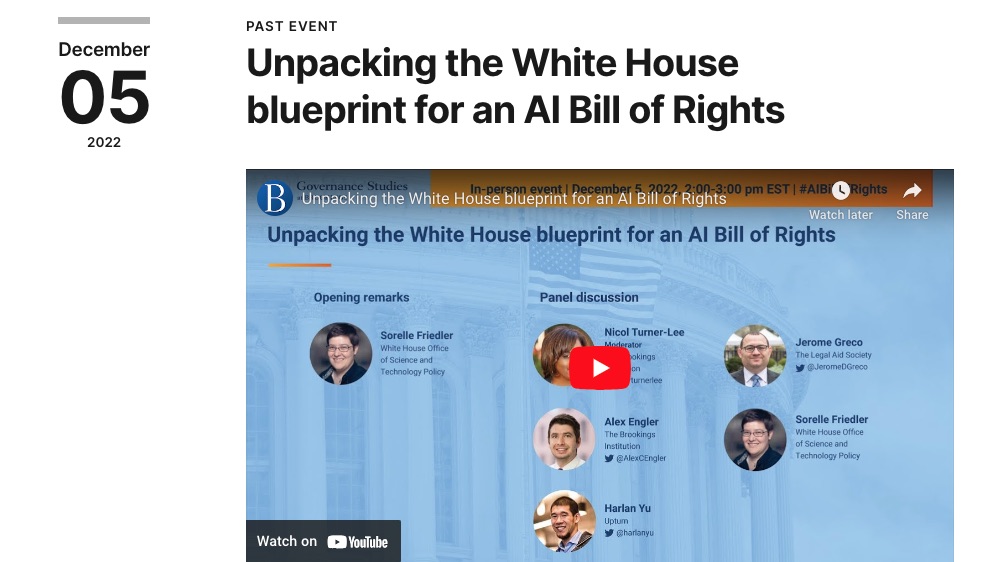
On December 5, 2022, an expert panel, including representatives from the White House, unpacked what’s included in the AI Bill of Rights, and explored how to operationalize such guidance among consumers, developers, and other users designing and implementing automated decisions.