This report explores the role that academic and corporate Research Ethics Committees play in evaluating AI and data science research for ethical issues, and also investigates the kinds of common challenges these bodies face.
The Electronic Privacy Information Center (EPIC) emphasizes the necessity of adopting broad regulatory definitions for automated decision-making systems (ADS) to ensure comprehensive oversight and protection against potential harms.
In early 2023, Wired magazine ran four pieces exploring the use of algorithms to identify fraud in public benefits and potential harms, deeply exploring cases from Europe.
This article examines how Chile’s SUSESO is balancing cost-focused procurement criteria with ethical AI concerns in its medical claims automation process.
The Digital Benefit Network's Digital Identity Community of Practice held a session to hear considerations from civil rights technologists and human-centered design practitioners on ways to ensure program security while simultaneously promoting equity, enabling accessibility, and minimizing bias.
The AI RMF Playbook offers organizations detailed, voluntary guidance for implementing the NIST AI Risk Management Framework to map, measure, manage, and govern AI risks effectively.
National Institute of Standards and Technology (NIST)
This paper explores how legacy procurement processes in U.S. cities shape the acquisition and governance of AI tools, based on interviews with local government employees.
This toolkit provides guidance to protect participant confidentiality in human services research and evaluation, including legal frameworks, risk assessment strategies, and best practices.
U.S. Department of Health and Human Services (HHS)
This report analyzes the growing use of generative AI, particularly large language models, in enabling and scaling fraudulent activities, exploring the evolving tactics, risks, and potential countermeasures.
This report investigates how D.C. government agencies use automated decision-making (ADM) systems and highlights their risks to privacy, fairness, and accountability in public services.
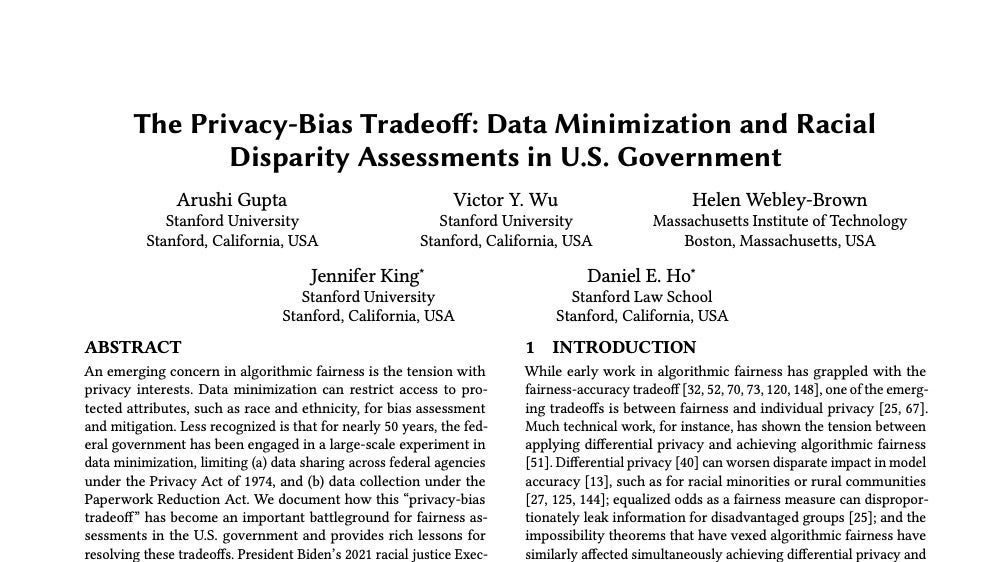
This academic paper examines how federal privacy laws restrict data collection needed for assessing racial disparities, creating a tradeoff between protecting individual privacy and enabling algorithmic fairness in government programs.
ACM Conference on Fairness, Accountability, and Transparency (ACM FAccT)