The Hawai‘i Department of Human Services (DHS), in partnership with the Hawai‘i Department of Health (DOH) and the Children’s Healthy Living Center of Excellence (CHL Center) at the University of Hawai‘i at Mānoa, is building foundational capacity to share and analyze administrative data across the SNAP (Supplemental Nutrition Assistance Program) and the Special Supplemental Nutrition Program for Women, Infants and Children (WIC). This groundwork will enable Hawai‘i to increase access to nutrition support programs, in alignment with Hawai‘i’s ‘Ohana Nui framework, which aims to dismantle intergenerational poverty.
American Public Human Services Association (APHSA)
Together, the Kansas Department for Children and Families (DCF) and Department of Health and Environment (KDHE) are working to design and build a sustainable process to improve cross-enrollment for families eligible for both the Supplemental Nutrition Assistance Program (SNAP) and the Special Supplemental Nutrition Program for Women, Infants, and Children (WIC). This report outlines how Kansas will integrate data matches between SNAP and WIC—as well as targeted outreach— within the ongoing business processes of the agencies to help streamline the experience of accessing nutrition supports for clients. These functions will contribute to the agencies’ shared goal of reducing rates of food insecurity in Kansas.
American Public Human Services Association (APHSA)
Coordinating SNAP & Nutrition Supports (CSNS) is a cohort program developed by the American Public Human Services Association (APHSA) and No Kid Hungry, a national campaign run by Share Our Strength.
American Public Human Services Association (APHSA)
This report highlights lessons learned from improving economic stability and well-being outcomes for young parent families, focusing on interagency collaboration, community engagement, data-driven improvement, and aligned services to guide future efforts.
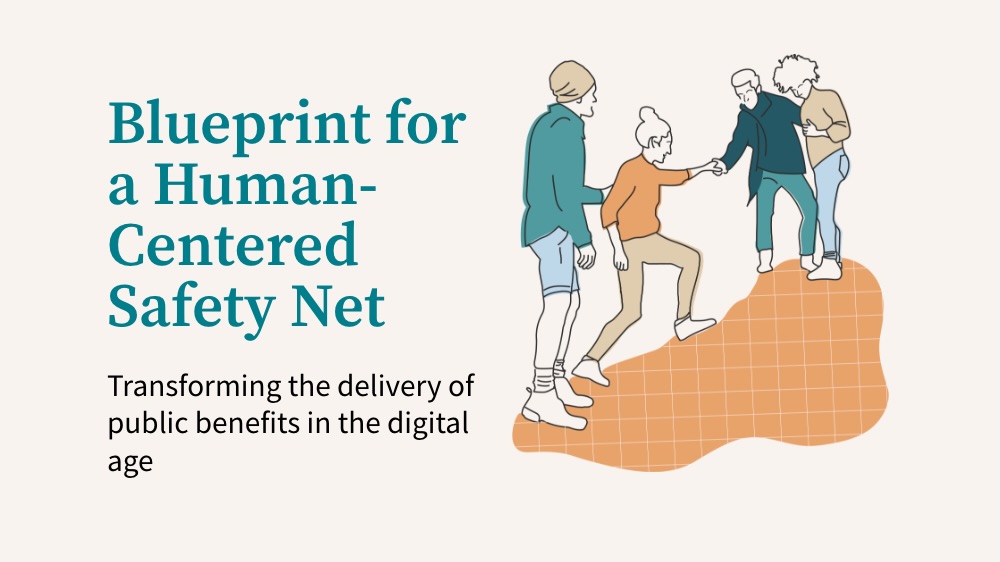
Describes the Principles of a Human-Centered Safety Net: Many Welcoming Doors, Easy to Understand, Clients Can Make Informed Decisions, Responsive to Changing Needs, Simple Actions
This article explores innovative strategies to improve access to public benefits by reducing administrative barriers and leveraging technology for a more user-friendly experience.
Code for America partnered with the CBPP, Civilla, and Nava to launch the Integrated Benefits Initiative, testing and piloting human-centered approaches to improve outcomes and learn what an optimal safety net could look like. This article describes key takeaways from short-term pilots implemented as part of this project.
This guide consolidates learning and spotlights principles, insights, and emerging practices to guide municipal leaders and public-private partnerships interested in designing basic income programs that are ethical, equitable, rigorous, informative, and consequential for local, state and national policymaking.
The goal of the brief is to encourage policy makers and employers to consider benefits cliffs as they look to create mandatory wage increases, with a look at a legislative action in NYC.
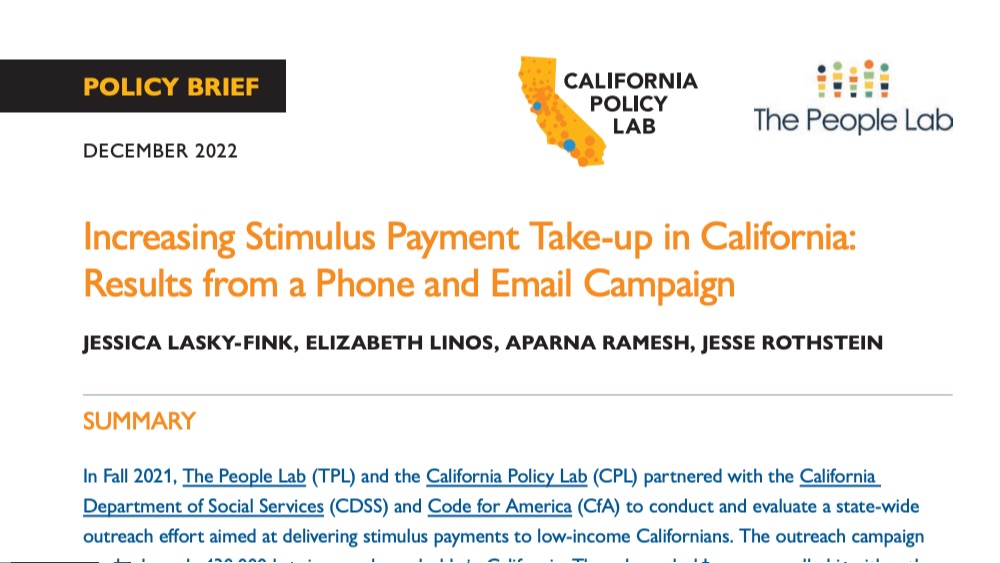
The Increasing Stimulus Payment Take-up in California report by the California Policy Lab examines barriers to accessing federal stimulus payments and provides strategies to increase take-up among eligible Californians, particularly low-income and non-filers.