Simplifying How Government Communicates with the Public: A Digital Government Network Spotlight
DGN Spotlights are short-form project profiles that feature exciting work happening across our network of digital government practitioners. Spotlights celebrate our members’ stories, lift up actionable takeaways for other practitioners, and put the resources and examples we host in the Digital Government Hub in context.
For many government agencies, communicating with the public remains a logistical challenge. Using mail or outdated contracts with vendors for constituent communications can delay the delivery of critical information. During emergencies or benefit renewals, these delays can mean the difference between a family receiving or losing vital support.
Recognizing the cross-cutting need to help agencies improve outreach, the Technology Transformation Services (TTS) at the U.S. General Services Administration (GSA) launched Notify.gov—a simple, shared text-messaging platform that lets agencies send messages directly to the people they serve. The open-source product was initially explored by 10x, TTS’s internal venture studio, and launched and scaled by the Public Benefits Studio, a TTS program focused on testing and scaling shared tools that make government benefits programs more responsive to beneficiaries’ needs. The system was built to be plug-and-play—an agency could start sending texts within minutes of setup—removing the typical procurement and integration barriers that often stall innovation.
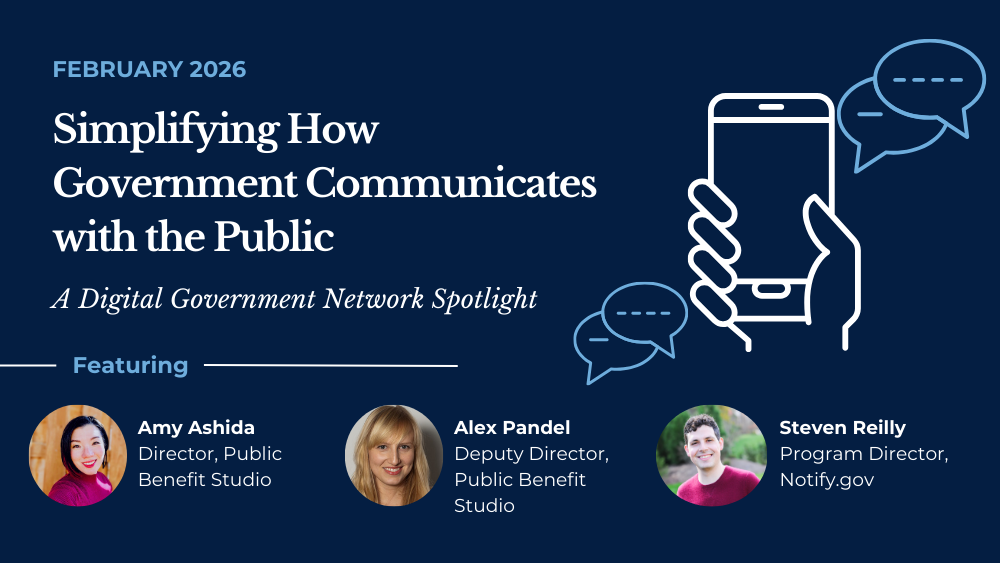
To learn more, the Digital Service Network (DSN) spoke with Amy Ashida, who served as the Public Benefit Studio’s director, and Alex Pandel, its deputy director. They shaped the early vision for Notify.gov’s implementation, built the team, secured leadership support, and oversaw its launch. Additionally, DSN spoke with Steven Reilly, who served first as the technical lead for Notify.gov and then Notify.gov’s overall program director in 2024.
Investing in Multi-Channel Benefits Outreach
Communication between public agencies and the people they serve has historically been fragmented, slow, and unreliable. Critical updates about eligibility, appointments, or application status frequently go unnoticed by recipients—not because of apathy, but because the communication channels themselves are broken. Agencies rely heavily on paper mail and outdated digital systems. Letters get lost, addresses are often outdated, and messages arrive too late to make a difference. These inefficiencies create ripple effects—eroding trust, increasing administrative burden, and straining already complex, resource-thin benefits programs.
When the Public Benefits Studio began exploring solutions to tackle communications challenges in 2022, they weren’t starting from scratch. Text messaging was already a proven intervention. Evidence from states, nonprofits, and behavioral science pilots had shown that simple SMS reminders could dramatically improve program participation, reduce churn, and increase follow-through. In other words, half the battle—proving that texting worked—was already won. The remaining challenge was building a tool that would let government agencies adopt it easily, safely, and at scale.
This insight shaped the team’s strategy. Instead of testing whether texting could improve communication, they focused on how to make it accessible within the unique constraints of government. The American Rescue Plan funding paved the way for prototyping shared, reusable digital infrastructure. Notify.gov—an open-source SMS platform developed and first implemented by the UK government—became an effort to make proven digital solutions widely available across agencies.
To test demand, the team conducted early outreach at conferences, speaking directly to public servants in the benefits space. The response was immediate and enthusiastic. Agencies wanted to text—they just didn’t know how to do it legally, securely, or affordably. Notify.gov promised to bridge that gap. As Ashida summarized, “The goal was to enable agencies who hadn’t had the opportunity to try text messaging yet to unlock the ability to experiment through a government-to-government partnership.”
Implementing Notify.gov
Forking Gov.UK Notify
To implement Notify.gov in the U.S., the Studio forked the UK’s well-established Gov.UK Notify platform, which is publicly available on GitHub. This allowed them to stand up a working prototype within months. “Forking the Gov.UK Notify codebase was a great way to reduce complexity and focus our efforts,” said Reilly. “It gave us a running start and made it possible to show value quickly.” This decision bought the team time to invest in outreach and partnership-building instead of basic infrastructure. But it also came with constraints. The UK platform had evolved over several years and wasn’t designed for easy reuse, meaning that adapting it for U.S. systems required deep customization.
“Forking the Gov.UK Notify codebase was a great way to reduce complexity and focus our efforts… It gave us a running start and made it possible to show value quickly.”
Steven Reilly Technical Lead, Notify.gov
Adapting Notify for the U.S. Federal Context
The decision to fork the UK’s Notify codebase gave the team a head start, but also meant diving into a complex, unfamiliar system. This kind of work is often referred to as “spelunking”—or familiarizing yourself with a vast, unknown codebase similar to exploring an old cave system. This careful work allowed the team to see what would break when they made changes to adapt the system.
While the British codebase was open source, it was not specifically designed for reuse. Much of the inherited code was specific to the UK’s policies and infrastructure. For example, the British system assumed all users operated in the same time zone, processed data using the UK’s fiscal year, and relied on hard-coded infrastructure that did not align with U.S. hosting or compliance requirements.
Every update risked disrupting some hidden dependency. Engineers spent significant time tracing relationships between components, pruning unnecessary features, and adapting the logic for U.S. use cases, such as diverse time zones. Other helpful features, like integrated agreements and billing, were not compatible with legal requirements in the U.S. While tedious, this deep dive was crucial to helping the team understand and refine the architecture more confidently over time.
Adapting the UK codebase became one of the most technically challenging aspects of the project. Reilly explained that making it compatible with Cloud.gov’s Platform-as-a-Service required careful refactoring. The team also swapped out the UK’s design elements for the U.S. Web Design System, aligning the interface with U.S. accessibility and branding standards.
From the start, the team made a strategic choice to keep their MVP narrowly focused on one gap: helping agencies that wanted to try texting but hadn’t been able to clear the technical or operational hurdles to procure a commercial tool. This general focus on minimalism reflected a broader design philosophy. “Notify wasn’t meant to be an everything-tool,” Ashida said. “It was about giving agencies a secure, fast, and low-friction way to try texting—nothing more, nothing less.”
“[Implementing Notify] was about giving agencies a secure, fast, and low-friction way to try texting—nothing more, nothing less.”
Amy Ashida Director, Public Benefit Studio
As part of this approach, they disabled features irrelevant to their MVP—like email and letter templates—and deleted unused dependencies to minimize maintenance risk. The team prioritized privacy from the start, redesigning storage logic so that the system would hold as little personally identifiable information as possible. For example, many potential features—like detailed engagement tracking—were excluded to protect user privacy. The goal was to find a balance in the tradeoff: offering enough reporting for agencies to evaluate success without compromising individuals’ information.
Establishing Initial Pilots and Partnerships
To turn the idea into reality, the team took a lightweight, collaborative approach. Early development emphasized getting something usable into partners’ hands quickly rather than building a fully polished system upfront. “We tried to move quickly to pilots,” Reilly said about the mindset. “We focused on making the application presentable and getting the one-year ATO [authority to operate] that would allow partners to access the system.”
TTS’s recently-formed Tech Law Division within GSA’s Office of General Counsel, launched under Administrator Robin Carnahan, was integral to this goal. The Tech Law group worked closely with the team to draft pilot agreements, using new authorities from the Federal Citizen Services Fund and devised pricing models and usage standards that would let Notify.gov scale beyond its initial pilots. Without lawyers who took time to understand the team’s goals and strike a careful balance between creativity and legal defensibility, the program might never have launched.
Early Notify.gov pilots intentionally reflected the diversity of public benefits programs. Federal, state, and local agencies tested Notify.gov to send reminders, alerts, and updates to participants—each with different needs and risk profiles. Some used internal pilots with staff as recipients to validate usability; others sent real messages to members of the public, tracking changes in response rates or processing times. Internally, the team balanced a mix of government leads and contractor support. “Each key role had a federal lead—product, technical, design, and partnerships—supported by contractors for execution,” said Ashida. “That structure worked well and set a model for future products.”
The team also connected Notify.gov’s work with government-wide efforts. Because the OMB efforts involved much outreach and coordination, it served as a key facet in helping Notify.gov get in front of potential partners. They collaborated with the Office of Management and Budget’s Life Experience initiatives to stand up pilots, such as Birth to Five and Financial Shock, where poor communication had been identified as a particular barrier to service delivery. Given the Life Experience teams’ active outreach with a vast network of partner agencies, this collaboration was pivotal in helping the Notify.gov team identify and secure pilot partnerships, and early results were promising. Agencies using Notify.gov found they could reach people faster, confirm receipt of applications, and resolve missing documentation in hours rather than weeks.
Testing and Learning
Notify.gov’s success depended not only on sound technology, but also on adoption. The team needed to prove that agencies would actually use and sustain a shared texting platform. “The biggest questions weren’t technical—they were operational,” Ashida said. “Would agencies sign up? Would they pay to use it?”
Within its first year, Notify.gov onboarded 13 partner agencies, collectively sending over 400,000 messages in more than 20 languages. Some agencies saw response times for client outreach drop from weeks to hours.
The team prioritized usability and accessibility, focusing on making the product easy to use and adopt. They maintained a demo environment with fake data, so users could explore the interface without risk. Live testing sessions captured feedback as participants navigated features.
Reilly noted that one early hypothesis was confirmed quickly: There was strong demand for a simple texting platform that didn’t require technical integration. As partners grew comfortable with the basics, their feedback evolved—they wanted more visibility into outcomes. This insight led the team to explore privacy-preserving ways for agencies to measure message effectiveness while maintaining their commitment to storing as little personal data as possible. Equally important was helping agencies craft clear and credible messages. The Notify.gov team provided guidance on writing effective texts: use plain language, avoid urgency, identify the sender, and sound human. “We encouraged trustworthy, personable communication over robotic alerts,” Ashida recalled.
Today, the code used for Notify.gov remains available and can be reused, and the service is resuming from where the team has left off. TTS continues to explore ways to integrate its capabilities into other shared services. Even in its current form, Notify.gov stands as a model for how rapid pilots can shift norms across government.
Lessons Learned
Proven digital solutions still demand local adaption. Notify.gov’s story shows that even when a solution has been validated elsewhere, translating it into a new context requires rethinking from the ground up. The team learned that scaling open source tools isn’t just about borrowing code—it’s about adapting ideas to fit distinct policies, infrastructure, and cultural expectations.
Digital solutions in government achieve long-term sustainability when they incite culture shifts. Notify.gov’s availability furthered the shift of normalizing text messaging as a legitimate, secure, effective, and efficient communication method for public agencies. Even as the platform pauses scaling for now, the shift towards programs incorporating text messaging as a critical way to meet residents where they are continues to grow. In that sense, Notify.gov achieved its purpose: it raised the baseline for what effective communication in government can look like.
Explore the resources
To see how this work was put into practice, explore the following assets in the Digital Government Hub:
A high-level primer that explains what it takes to stand up and operate an open-source, one-way government notification service for sending text messages and emails.
A practical guide for government teams on how to design, test, and run effective public text message campaigns for benefits and service communications.
A plain-language overview explaining how federal law regulates automated calls and text messages to the public, including when consent is required and who is exempt.
A case study documenting the creation, pilot, impact, and eventual sunset of a government text-messaging service used to improve how agencies communicate with the public.
An impact report summarizing how a small public-sector innovation team tested, built, and piloted shared digital services to reduce administrative burden in public benefits delivery.