FormFest 2025 Recap: Integrated Benefits Form Design from the Front Lines
An event recap from one of FormFest 2025’s breakout sessions featuring speakers from Code for America and Arizona’s Department of Economic Security (DES).
Integrated Benefits Form Design from the Front Lines
The Arizona Department of Economic Security (DES) partnered with Code for America to design an online integrated benefits application bringing together five programs: child care, nutrition, medical, cash, and energy assistance. The project pillars were client experience, program policy, and eligibility worker experience. This FormFest session focused on the crucial role eligibility workers played in the form design. Speakers detailed the ways they adapted everyday tools for collaboration and used artificial intelligence (AI) to gain efficiencies, well before a single line of code was written.
Main Points
- Code for America partnered with the Arizona Department of Economic Security to co-design an integrated benefits application for the Supplemental Nutrition Assistance Program (SNAP), Temporary Assistance for Needy Families (TANF), Medicaid, the Low Income Home Energy Assistance Program (LIHEAP), and child care assistance, centering the experiences of both clients and eligibility workers.
- The team used a non-linear design approach, where they developed content and wireframes in parallel and relied heavily on eligibility worker interviews to review questions, identify high-risk areas, and create realistic client profiles.
- Strong executive sponsorship, transparent prioritization, and phased rollouts helped ensure quality, reduce confusion, and align technology changes with real-world policy and workflow needs.
Lessons Learned
- Early and continuous involvement of eligibility workers improved clarity, accuracy, and usability of benefit applications while preventing backlogs and errors.
- Change management matters: Hands-on training, time to explore new tools, and low-effort resources like cheat sheets significantly support successful adoption.
- Sustainable modernization requires clear communication, shared roadmaps, quality assurance involvement from frontline staff, and ongoing feedback loops to adapt to policy and technology changes.
Actionable Takeaways
- Ask frontline staff for feedback early.
- Communicate changes to eligibility workers in a timely and organized manner.
- Give eligibility workers an opportunity to look through new benefit applications before rollout to better serve residents.
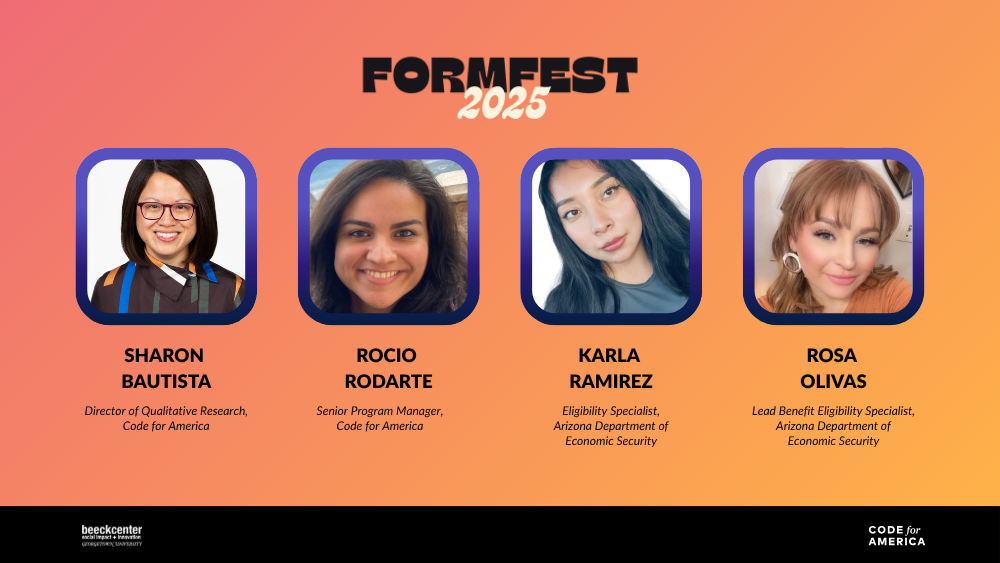
In this session, Code for America speakers Sharon Bautista and Rocio Rodarte along with the Arizona DES’ Karla Ramirez and Rosa Olivas discussed a joint project to co-design a new integrated benefits application for SNAP, TANF, Medicaid, LIHEAP, and child care assistance. As part of their broader modernization efforts, Arizona brought in Code for America to design and implement a new application for accessing benefits with a focus on client and eligibility worker experience, accessibility, and program policy. In order to create the new form, Code for America took a non-linear approach, working on content design while simultaneously building wireframes.
As part of the content design process, Code for America’s team prioritized using feedback from eligibility workers to conduct a question review of all five benefits applications. They built eligibility worker interview guides to understand how benefits applications and the process itself should be improved. Through these interviews, Code for America’s team built five different client profiles based on the highest-risk parts of the benefits application. By partnering with eligibility workers, Code for America was able to co-create a research plan with a clear goal that outlined specific expectations. They also closely worked with executive sponsors like Arizona’s DES, making sure to leave time to pilot the interview guides they developed and ensure eligibility workers understood their research goals.
From eligibility workers, they learned that a new benefits application should: (1) clarify question wording, (2) give eligibility workers time to learn a new client-facing application, (3) allow eligibility workers time to explore changes to forms, (4) provide in-person training for eligibility workers, and (5) offer low-effort, high-reward change management tools in the form of cheats sheets that provided an overview of new software tools for eligibility workers.
Key Form Design Principles:
- Start with client and caseworker needs.
- Practice transparent prioritization and share roadmaps with dates.
- Ensure that technology teams have direct lines to eligibility workers and vice versa.
- Let eligibility workers determine what are major or minor changes.
- Involve eligibility workers in quality assurance testing.
- Phase rollouts to focus on quality over quantity of new features.
This joint project with the DES and Code for America demonstrated that successful modernization depends on centering both client and eligibility worker experiences throughout the design and implementation process. By partnering closely with eligibility workers and leadership at the Arizona DES, the team ensured that form content, workflows, and training approaches reflected real-world needs, reducing confusion, preventing backlogs, and improving accuracy in eligibility determinations. The project underscored that clear wording, hands-on training, transparent communication, and phased rollouts are not just operational choices but essential change-management strategies. Ultimately, sustained collaboration, strong executive support, and continuous feedback loops enable agencies to adapt to policy and technology changes while delivering a more accessible, efficient, and client-focused benefits system.
See more from this session at FormFest 2025:
Watch the session recording from FormFest 2025.
Integrated Benefits Form Design from the Front Lines
See how Arizona centered eligibility workers in the design of an integrated benefits application, making it smoother for clients and staff.
About FormFest
FormFest is a free virtual event showcasing governments working to make services accessible to everyone through online forms. Discover best practices and tools that are shaping the future of form design and service delivery.