Digital Service Teams 101: A Guide for State and Local Governments
This guide is a practical introduction to Digital Service Teams (DSTs) for state and local governments. It is designed to help leaders interested in standing up new government DSTs understand what they are, why they exist, and how they are structured, staffed, funded, and more.
Government services should be accessible, responsive, secure, and easy to use. Digital Service Teams (DSTs) can play a critical role in building these types of services.
DSTs are in-house, multidisciplinary teams focused on improving government services through agile, user-centered, digital practices.
This guide is a practical introduction to DSTs for state and local governments: what they are, why they exist, and how to start one. Rather than prescribing a single approach, this guide offers contextualizing information, real-world examples, and an abundance of resources to help governments design and launch new DSTs in ways that fit their political, budgetary, and operational contexts.
The guide’s content is structured around the following core questions:
- What are government DSTs and why have leaders turned to them?
- What challenges do DSTs help address?
- How are effective DSTs built and sustained?
- If we are ready to start a DST, what’s next?
The Beeck Center for Social Impact + Innovation at Georgetown University supports state and local leaders in the formation and scaling of DSTs through its Digital Government Network (DGN), including the Chief Digital Service Officer Community of Practice (CDSO CoP), original applied research, and direct trainings and technical assistance.
What are government Digital Service Teams and why have leaders turned to them?
Defining Government DSTs
Government Digital Service Teams (DSTs) are in-house teams responsible for the digital transformation of essential services, such as benefits delivery or small business support. Specifically, government DSTs have:
- A mandate to create and improve, and/or help other government actors create and improve, public-facing online government experiences
- Expertise in, at minimum, software development, user-centered research and design, agile product management, and data-driven decision-making
DSTs are distinct from traditional modes of government information technology (IT) development in both philosophy and output. Following years of expensive and failed attempts to move government services online, DSTs emerged in the 2010s as a new model for software design and deployment.
Tracing the Origins of DSTs in U.S. State and Local Government
As the 1990s and early 2000s brought massive improvements in computer and broadband access, U.S. governments sought to capitalize on the potential efficiencies, cost-savings, and service improvements of moving services online.
But years of outsourcing IT to private contractors had left in-house government staff ill-equipped to assess—let alone lead—the challenge of building complex online services, or even to judge which vendors to hire. The growth of DSTs in U.S. state and local government in particular can be traced back to these early (often ineffective and sometimes disastrous) efforts to bring government service delivery into the internet era.
But failures were not the only origin of the DST movement. Explore the timeline tracing the origins of the DST movement back to the early 2000s.
The below timeline gives newcomers to this space a brief overview of a few major milestones that contributed to the emergence of DSTs at the state and local level in the U.S. It is not designed to be a comprehensive retelling of the emergence of digital service teams writ large, or the field of civic tech. Please reach out at digitalgovernmentnetwork@georgetown.edu with any thoughts about this timeline. For more expansive documentation of the history of digital services teams and civic tech, the resources below the timeline are fruitful starting places.
Go Deeper on the Hub
Timeline of Civic Tech
A blog post explaining how a data-driven civic tech timeline visualizes the growth, diversity, and evolution of the civic technology field, spanning 25 years from 1994-2018.

United States Digital Service Origins
This is an independent oral history archive documenting the founding and early development of the U.S. Digital Service (USDS) between 2009 and 2015.
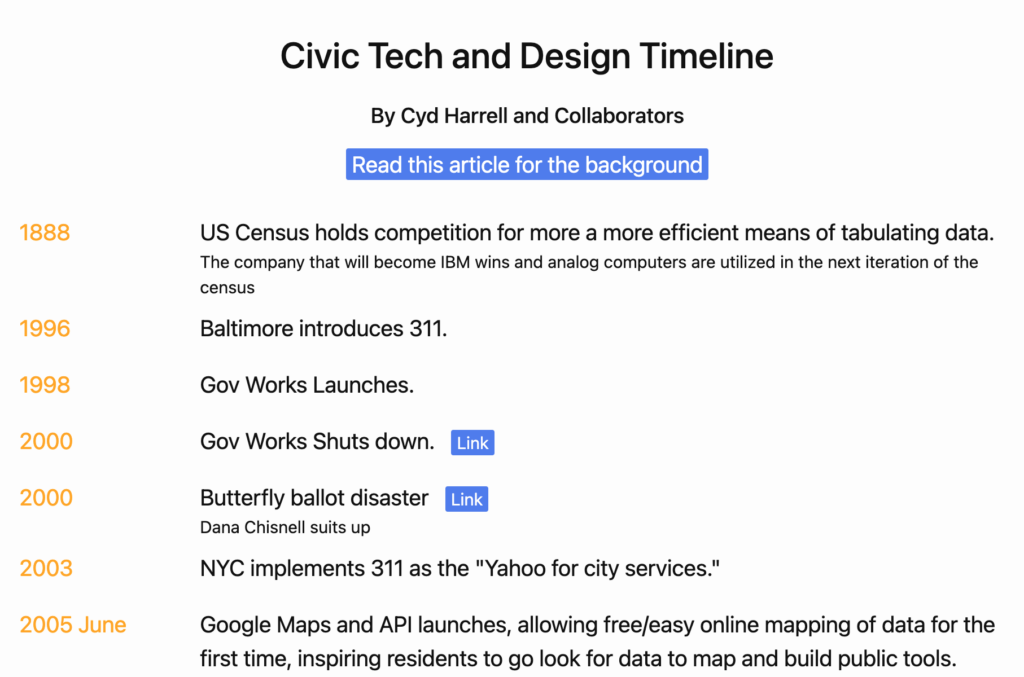
Civic Tech and Design Timeline
A timeline that maps key milestones, tools, and movements in the evolution of civic technology and design beginning in 1888.
DSTs vs. Other Government Teams
As a relatively new model for shaping government service delivery, it’s useful to distinguish DSTs from other common teams and functions in government. These distinctions help clarify DSTs’ role and promote better collaboration between DSTs and other government agencies and teams.
IT agencies focus on infrastructure, security, and enterprise systems, while DSTs focus more narrowly on public-facing service design and delivery. In many cases, DSTs are housed within IT agencies as one function of their work.
While both innovation teams and DSTs use human-centered and digital approaches to improve how government works, innovation teams typically operate across a broader range of operations and service delivery areas and are less laser-focused on digital delivery. In contrast, DSTs focus their efforts more narrowly on improvements to public-facing, online services.
Data teams analyze and report on things like program uptake and technology performance, and they support data infrastructure projects like cross-program data integration or open data programs. DSTs use data as an input to more direct service improvement efforts, and often collaborate with data teams to do so.
Communications teams focus on delivering information to the public through accessible language and content design, typically working on media campaigns, social media, and websites. While DSTs may employ content strategists or collaborate with communications teams, they go beyond content to (re)design services end-to-end.
Examples of DSTs in U.S. State and Local Government
While the core philosophy and methods of DSTs across governments are similar, the specifics of each team’s mandate, composition, and strategy are unique to its political, budgetary, and operational context.
This diversity of models, and their ongoing evolution, reflect an important reality: There is no single “right” way to build or sustain a DST. Below are a few team examples from around the U.S.
Go Deeper on the Hub
The Beeck Center for Social Impact + Innovation’s Digital Government Network maintains a Government Digital Service Team Tracker: a living database for those wanting to learn more about the locations, structures, mandates, and more of DSTs across the U.S.
What challenges do DSTs help address?
From benefits delivery to small business support, DSTs have a growing track record of helping governments move away from bureaucratic design patterns, siloed systems, and glitchy tech toward best-in-class services and technology products. Below are a few examples of how DSTs across the U.S. have improved government services.
Georgia’s Digital Services Team developed the Georgia Analytics Program to help state agencies make data-informed decisions about their digital properties. When agencies join the program, they gain access to a centralized analytics dashboard and tool for monitoring and assessing how users are engaging with public-facing websites, as well as ongoing analytics training. In its first year, 90 percent of participating agencies reported increased digital performance scores.
Pennsylvania’s Commonwealth Office of Digital Experience built a lookup tool for the Property Tax/Rent Rebate Program, which serves adults 65 and older, to make it easier for older adults and people with disabilities to find in-person application assistance. After launch, Pennsylvania’s Department of Revenue received double the number of applications compared to the same period in the previous year.
Colorado Digital Service implemented an entirely virtual vendor selection process for COVID-19 case investigation and contact tracing in June 2020. Using a human-centered approach focused on user needs and buy-in, a vendor was selected in 19 days and came in $15 million under budget.
South Bend, Indiana’s Innovation & Technology team modernized the experience of interacting with and working in City Hall. The team transformed the City Hall experience by implementing online appointment booking and SMS reminders, digital queuing, as well as a suite of self-service tools to reduce the need for in-person visits.
Seattle’s Digital Engagement team used a collaborative, iterative design process to reimagine how information about government benefits is displayed on the City’s website. The new Assistance and Discounts page gathers program information that had previously been scattered across over 7,000 webpages. The new page uses plain language and accessible design, and helps people quickly check program eligibility.
Boston Digital Service partnered with multiple city offices to launch a dedicated public notices hub on Boston.gov. The project relocated legally required public hearing information—previously buried in the city’s general online calendar and a corkboard on City Hall’s ground floor—to an easily locatable, mobile-friendly website.
Go Deeper on the Hub
Read more DST success stories in the Digital Government Network’s (DGN) Spotlight repository: a bank of short-form case studies that celebrate human-centered digital government service delivery, lift up actionable takeaways for other public servants, and put the resources and examples we host in the Digital Government Hub in context. From gender-inclusive forms to digital library cards, the DGN has showcased high-impact digital initiatives led by dozens of governments.
How are effective DSTs built and sustained?
Through years of research and engagement with DSTs across North America and beyond, the Digital Government Network has worked to bring to light the factors that position DSTs for success. Our engagement has demonstrated that sustainable, effective DSTs have:
- A clear mandate that empowers the team;
- Strategic placement within the organization;
- An experienced leader that brings strategic vision;
- A multidisciplinary team with user-centered and agile expertise; and
- Budget and resources to move quickly, autonomously, and sustainably.
Successful DSTs have a clear mandate that empowers the team and specifically defines their authority and purview. Clear mandates help DSTs:
- Set realistic expectations with agencies and leadership
- Prioritize work effectively
- Advocate for necessary resources
- Avoid being pulled into ad hoc or purely tactical requests that fail to drive a core strategy or vision
- Establish and maintain legitimacy and trust
State and local DSTs have been stood up through executive action, legislation, agency initiative, grant-funded pilots, and natural evolution. Each approach to establishing a team and defining its mandate has distinct advantages and tradeoffs.
Standing up a DST through executive action can enable fast startup and flexibility but makes it vulnerable to the winds of administrative change. Example: CODE PA executive order
Empowering a DST via legislative codification offers greater stability, funding opportunities, and durability across administrations. But the road to codification can be long and may constrain a team’s adaptability, depending on the scope and terms of the mandate. Example: California’s Office of Data and Innovation enabling legislation
Teams created through a specific agency initiative can be powerful when they grow out of a clear operational need and strong internal leadership. These teams may face limitations in authority, funding, and cross-agency influence unless explicitly empowered by executive leadership. Example: Austin Transportation and Public Works’ Data & Technology Services founding documentation
DSTs stood up as pilot efforts with grant-funded or term-limited teams benefit from lower barriers to entry and decreased risks of early experimentation, particularly in resource-constrained environments. They may struggle with sustainability, staff retention, and long-term impact if a long-term transition plan is not established early. Example: Baltimore’s Digital American Rescue Plan Act press release
DSTs occasionally evolve naturally as outgrowths of IT or innovation teams. These teams have the benefit of leveraging existing relationships and organizational infrastructure, though legacy expectations can unduly constrain these DSTs’ early identity and scope. Example: NYS Digital Service’s narrative of the team’s development
Go Deeper on the Hub
Toward Sound, Explicit Theories of Change for Digital Service Teams
The Digital Service Network published two essays to kick-start new (or super-charge existing) theories of change for government Digital Service teams.
Crafting a Theory of Change for Digital Transformation in Government
In our research announcement on theories of change (ToC) for digital government, the Digital Service Network shared our belief that all Digital Service (DS) teams should work to develop a ToC.
Wielding a Theory of Change for Digital Transformation in Government
This essay explores how a ToC is made explicit with various audiences.
DSTs can be centralized, serving an entire jurisdiction, or agency-specific. These models are not mutually exclusive: several state and local governments with centralized teams also boast agency-specific teams. Each model has advantages and limitations.
Centralized DSTs
Centralized DSTs support the priorities of a locality or state as a whole. To date, centralized teams are the more common team model. With their broad mandate and cross-functional positioning, centralized teams can advocate for more resources, enabling them to carry out large-scale digital initiatives across departments. But they often face friction when introducing new centralized tools or platforms at scale, which demands a high level of relationship-building and stakeholder management.
When centralized DSTs are housed in a mayor’s or governor’s office, they have a strong political mandate and visibility, greater flexibility and speed, and an increased ability to drive top-down cultural change. However, DSTs in executive offices are challenged by the perception of politicization, risk of discontinuity with changing administrations, and greater difficulty in receiving long-term assignments. Example: The Vermont Agency of Digital Services is housed within Vermont’s governor’s office.
When centralized DSTs are housed within the administration, such as a city administrator’s office (CAO), IT department, or budget office, they benefit from structural neutrality that builds agency trust and situates the team for long-term modernization work. On the other hand, they tend to have less political air cover and decreased visibility. Example: The Arizona Digital Solutions Office is housed within the Arizona Department of Administration.
A hybrid approach is also possible. For example, after operating as an independent agency, the New Jersey Office of Innovation transformed into the New Jersey Innovation Authority by legislation, unlocking opportunities for further sustainability and scale. As another example, Pennsylvania’s Commonwealth Office of Digital Experience dually reports to Pennsylvania’s Chief Information Officer and the Governor’s Director of Digital Strategy, unlocking benefits offered by both executive and administrative placements.
Agency-Specific DSTs
Agency-specific DSTs operate within and for particular government agencies to support that agency’s services and needs and have the advantage of being fully integrated with agency operations. These teams are rapidly growing in the ecosystem, as agencies look to capitalize on the benefits of these teams without waiting for a centralized team to emerge in their jurisdiction, or simply to invest in their own digital needs and capacities even if a centralized team does exist.
While agency-specific teams tend to amass fewer resources and therefore may have more limited impact or scale, they can act quickly and nimbly, effectively and efficiently driving initiatives at the narrower agency level. Example: Austin Data & Technology Services supports the city’s Transportation Public Works Department
Executive Champions
When considering placement for a DST, it’s important to note that successful teams tend to have one or more executive champions who:
- Provide air cover when work challenges existing norms
- Help resolve conflicts with other agencies
- Signal that user-centered, iterative digital delivery is valued
- Reinforce that the DST’s work is core to government operations, not a side project
Together with a clear, formal mandate, placing DSTs where they are likely to experience this kind of informal leadership support further enables these teams to move from pilot projects to durable institutions that work at scale.
DST leaders incite the technical shifts necessary for transforming services across a government organization. But the right leader for a DST isn’t just a technologist; they also understand policy, politics, administration, and management. They recognize that improving services with digital tools is about much more than technology—it’s about people and process.
Effective leaders of DSTs are:
- Visionary: They chart a clear, strategic path toward improved services that prioritizes the needs of residents while balancing operational realities.
- Technologically-savvy: They’ve led interdisciplinary teams that build user-centered digital products using modern technology practices.
- Collaborative: They understand the importance of having various forms of expertise on their team and build strong partnerships with staff across agencies to get things done.
Go Deeper on the Hub
Maryland Director of Digital Services
A public sector job posting for Maryland’s Director of Digital Services role, focused on building and leading user-centered digital systems for the state’s new paid family and medical leave program.
Columbus Ohio Director Digital Experience
A public sector job posting for Franklin County’s Director of Digital Experience role, focused on leading human-centered digital transformation and modernizing government service delivery platforms.
Digital Director, New York State
A public sector job posting for New York State’s Digital Director role, focused on building a modern digital services team and improving online experiences for residents through user-centered strategy and execution.
Digital Services Director
This is a job description for the role of Digital Services Director from the Commonwealth of Pennsylvania.
Digital Services Manager, Portland Oregon
A public sector job posting for the City of Portland’s Digital Services Manager role, focused on leading digital transformation and improving resident-facing services through user-centered product management.
Hennepin County Director, Digital Experience
A public sector job posting for Hennepin County’s Director of Digital Experience role, focused on leading enterprise digital strategy and improving how residents interact with county services online.
People working for a DST have experience with building popular, high-traffic digital services through user-centered research and agile development methods. But just like its leader, high-impact DSTs need more than just technical skills—they also need expertise with program design and administration, policy development, and more.
A DST that is just getting started can typically be stood up with four to six key roles; mature DSTs tend to be much larger. Below are examples of the types of roles that new DSTs tend to recruit. Depending on the organization, some of these roles may require new job descriptions and external hires, while some are already found in abundance and may only need minor job description updates or role-based upskilling.
- Product Manager: Leads a cross-functional team to ensure digital services are designed and implemented in a way that is agile, collaborative, and centers user needs alongside organizational goals. Sets user-centered goals for services and keeps work on track with a focus on delivery. Translates between executive, program, and technical stakeholders. (Example job description)
- User Experience (UX) Researcher: Plans, designs, and carries out research activities to build deep understanding of the people that use government services. Provides data and evidence to build a service that works well for all users, including those with disabilities. (Example job description)
- UX / Service Designer: Designs the experience for government services based on the evidence of user needs and organizational goals. Documents end-to-end service journeys and helps imagine new pathways. Creates accessible services and a consistent user experience. (Example job description)
- Software Engineer: Mocks up, builds, and/or maintains the software code that keeps digital services running. Continually improves services with new tools and techniques and advises on technical feasibility. (Example job description)
- Data Analyst: Turns numbers into insights to understand and improve how services are performing. Provides quantitative and qualitative data from web analytics, budgetary data, user feedback, and more to clarify needs. (Example job description)
- Program / Policy Analyst: Conducts research and analysis to understand relevant policy issues. Ensures services meet policy requirements and business needs, and are aligned with organizational goals. (Example job description)
Hiring and Staffing Considerations
Bringing in top-tier digital service talent in the public sector is an ever-present challenge for new and maturing DSTs. Successful, sustainable DSTs in state and local government deploy numerous strategies to hire and keep talent with digital delivery expertise, including:
- Investing in job reclassifications. Job reclassification is often the most high-impact arena to reshape a government’s ability to hire the right staff for a DST, but the process can be slow. Successful digital service leaders work closely with HR partners—and take some of the work into their own hands—to modernize job classifications, craft clear role definitions, and create flexible, targeted hiring strategies.
- Tapping into unconventional hiring pathways. DSTs have used internships, fellowships, and direct hiring authorities to move faster and reach nontraditional candidates. Partnering with local work training-organizations has also led to new hiring pathways. Another approach among some DSTs, like the Colorado Digital Service, is to use the “tour of duty” model, attracting mission-driven top talent for brief runs of service.
- Looking to upskilling first. States like California have conducted research revealing that few digital service delivery roles can be filled by only recruiting outside talent. Many governments have successfully trained their existing workforce to take on new DST roles or incorporate DST methods into their existing roles, like service design, product ownership, or agile project management.
- Outsourcing thoughtfully. DSTs embedded as in-house teams are often preferable to contractors when feasible. But for a number of reasons—from capacity limitations to expertise gaps—contractors still play a key role in digital delivery work today. DSTs use agile, user-centered strategies to scope and manage vendor contracts, keeping users at the fore and costs in line.
Go Deeper on the Hub

Visit the Talent + Hiring topic page for more resources. Government talent is the foundation of strong government service delivery, so hiring, retaining, and up-skilling the government workforce is critical.
Governments use a variety of approaches to fund and resource DSTs. The right model and level of resourcing depends on the team’s placement within government, the scope of its mandate, and the financial structure of the jurisdiction.
Funding Models
Two common funding models are general fund appropriations and cost-recovery, though in practice DSTs may operate using a hybrid of these and other funding mechanisms.
General fund appropriations are the most stable funding mechanism. In this model, the DST receives a dedicated budget allocation through the government’s annual budget process. This approach provides predictability and enables the team to plan multi-year initiatives, recruit permanent staff, and invest in internal capacity. However, teams funded this way must often demonstrate their value during each budget cycle and may face pressure to prioritize highly visible projects over foundational work.
Cost-recovery (or chargeback) models fund DST work through payments from partner agencies that request services. Under this approach, agencies “purchase” the DST’s time or expertise for specific projects. Cost-recovery models can create strong incentives for collaboration and ensure that DST work is aligned with agency priorities. However, they may also make it harder for DSTs to pursue proactive or cross-agency initiatives, since the team’s work becomes dependent on agencies’ ability and willingness to pay.
Some DSTs also supplement these primary funding mechanisms with project-based funding, grants, or philanthropic support, particularly during early stages. While these sources can help launch new teams or support experimentation, they rarely provide a sufficient long-term funding base on their own.
In practice, DSTs often have hybrid funding models, such as maintaining a core general-fund budget to support staff while using cost-recovery or project-based funding for specific initiatives.
“Right-Sizing” a DST Budget
DSTs work best when equipped with the resources to support a diverse, high-expertise staff and complex technical projects. Establishing a realistic budget from the outset helps ensure that the team can move beyond small pilots and deliver sustained impact.
Governments often find that an early-stage DST requires a core annual budget roughly comparable to a small agency program or initiative, rather than a large IT program. While exact costs vary by geography and compensation structures, an early-stage DST budget typically includes:
- Staffing for a small, cross-functional team
- Software and collaboration tools
- Modest contracting support for specialized needs
Staffing is typically the largest cost category. DSTs rely on highly skilled professionals and competitive salaries and benefits are essential. Investing in professional development from the start helps teams retain talent and stay current with evolving digital practices.
Most early-stage DSTs begin as small, highly specialized teams with four to six core staff members and expand as their impact and demand grow. This generally includes a leader and the six roles discussed above: chief digital service officer (or equivalent); product manager; user researcher; service designer; software engineer; and program or policy lead; and data analyst.
Importantly, impact is not driven solely by team size. Small, well-positioned teams with strong executive support and clear mandates often deliver outsized results by focusing on high-impact service improvements and helping agencies adopt modern delivery practices themselves.
Tools represent a smaller but essential portion of a DST’s budget. Modern digital service work often requires specialized hardware, collaborative development platforms, design and prototyping software, and communication tools that enable cross-functional teams to work efficiently.
Vendors and contractors can provide additional capacity and specialized expertise, particularly for large-scale or technically complex projects. DSTs that effectively engage contractors retain strong internal product leadership and technical oversight, ensuring that external work aligns with user needs and long-term internal capacity.
Successful DSTs grow incrementally over time. As DSTs grow in scope—supporting multiple concurrent projects, building shared platforms, or embedding staff within agencies—their budgets expand accordingly. Over time, successful DSTs grow their staff numbers, formalize sustainable funding structures, and mature their centralized capacities and service offerings.
We’re ready to start a DST. What’s next?
Leaders preparing to launch a DST should begin with a few critical steps:
- Clarify purpose and scope. What services or problems will the DST focus on first? Will it operate centrally or within a specific agency?
- Establish authority and support. Define a clear mandate (executive order, legislation, or pilot). Identify executive champions to back the work.
- Start small and targeted. Launch with a lean, high-impact team (four to six roles). Prioritize a small number of visible, high-value projects.
- Plan for sustainability early. Identify and plan for pathways to scale staff, budget, and impact over time.
- Engage with the Digital Government Network. Leverage the Beeck Center’s no-cost resources, peer-to-peer connections, original research, and direct technical assistance to put promising DST practices from peer governments into action.
Get in Touch
Are you ready to start a new DST in your jurisdiction? Do you have resources or examples we should add to this guide?
Reach out at digitalgovernmentnetwork@georgetown.edu. We look forward to hearing from you!