Building Broadband Access Through Youth Leadership in Raleigh: A Digital Service Network Spotlight
DGN Spotlights are short-form project profiles that feature exciting work happening across our network of digital government practitioners. Spotlights celebrate our members’ stories, lift up actionable takeaways for other practitioners, and put the resources + examples we host in the Digital Government Hub in context.
Across the United States, cities have invested heavily in broadband expansion, aiming to reduce a digital divide that disproportionately impacts low-income and aging populations. When the City of Raleigh made this work a priority with their 2020 Strategic Plan, they learned a crucial lesson: broadband infrastructure is only one part of the story.
Raleigh, like many fast-growing cities, faces a widening digital divide. According to an analysis from N.C. Broadband, nearly 95 percent of residents have access to high-speed internet, but only about 80 percent subscribe to it.
The cross-departmental team tasked with addressing this adoption gap set out to learn what barriers were keeping residents from taking advantage of existing broadband infrastructure. The result was not just a new approach to expanding internet use, but a new framework for engaging residents and the city’s youth in developing public services.
To learn more, the Beeck Center’s Digital Service Network (DSN) spoke with Raleigh’s Digital Impact Program Manager Yanira Campos, and the Office of Strategy and Innovation’s Strategy and Innovation Manager Cristina Leos.
Designing a Human-Centered Approach to Broadband Access
When Leos joined the City of Raleigh’s Office of Strategy and Innovation in 2022, the city, like many across the country, was reckoning with just how critical online services had become during the COVID-19 pandemic. It was clear that access to the internet and technology was now essential to delivering public services. The City’s 2020 Strategic Plan identified this access as a priority, and Leos joined a highly collaborative, cross-departmental team to lead the work.
When the team—led by the Office of Strategy and Innovation and including representatives from Parks, Recreation, and Cultural Resources, Housing and Neighborhoods, Information Technology, and Engineering Services—began to assess the state of internet access and use in their city, they quickly realized their working assumptions did not align with residents’ lived experiences. “We had a lot of assumptions that to bridge the digital divide, we just needed to install more broadband,” said Leos. But when they reviewed the data, they saw that existing broadband infrastructure was already reaching the vast majority of households in the city.
To uncover what was really stopping residents from taking advantage of it, Leos and her team leaned into a human-centered approach. “We were in a point of transition. So we focused on bringing this human-centered lens and asking questions like: What do we know about people who need access to the internet? Have we talked to them? What do we know about what the barriers really are?”
To support these efforts, the team partnered with U.S. Digital Response on a qualitative study with residents. The interviews revealed a more complicated story than a lack of technical infrastructure. Residents spoke about four key barriers to connectivity: affordability, poor digital literacy, limited plan awareness, and difficulty accessing customer support. “Even though the infrastructure was there, and technically they had access to a broadband provider, these things were keeping them from being able to actually use it,” Leos explained.
These insights led the city to shift from investment in infrastructure to services that expand residents’ ability to engage with technology independently.
Leveraging and Growing Youth-Led Programs
Yanira Campos is a part of the Department of Community Engagement, program manager for the City of Raleigh’s Digital Impact programs. As part of her role, Campos manages the Raleigh Digital Connectors (RDC) and Raleigh Digital Ambassadors (RDA). RDC is a youth digital leadership program designed to teach digital literacy skills to high school students.
The program has run consistently since its founding a decade ago, but had never been deeply integrated into a broader city strategy. With their research findings, the team saw an opportunity to leverage an established but underutilized asset. Of her team’s thought process, Leos recalled: “The answer was not to change or add something, the answer was: ‘We have a great program already, let’s just enhance it. We need to invest more in this.”
[We were] in a point of transition. So we focused on bringing this human-centered lens and asking questions like: What do we know about people who need access to the internet? Have we talked to them? What do we know about what the barriers really are?”
Cristina Leos Strategy and Innovation Manager, Office of Strategy and Innovation
The team set out to strengthen RDC and its sister program, RDA, through three goals:
Increase access to internet-enabled devices in underserved neighborhoods
Expand device access and digital literacy for low-income and aging residents
Build partnerships with community-based organizations and private providers to sustain digital support programs
As a first step, Campos worked with student feedback and current Raleigh Digital Connectors to rebuild the RDC curriculum. She said that the program’s original goal—teaching digital skills to high schoolers—had evolved in line with the changing needs and realities of the young people it served.
The new curriculum, she told us, aimed to “help students understand what the digital divide means, how it impacts the community, and ultimately made them see themselves as agents of change.” This shift also echoed in student feedback, which highlighted that service was a priority. “They wanted to be able to talk to people… that was a passion of theirs.” Campos said. Her redesigned curriculum now centers students as changemakers, framing youth not just as participants in a city program, but as contributors helping other residents build digital skills.
Expanded community partnerships have proven instrumental in helping the city meet its goals for increased device access and digital literacy. RDC and RDA now work with the Kramden Institute, a local organization that refurbishes devices and offers technical assistance to co-lead computer distribution events. Campos and Leos both acknowledge that although such initiatives may not combat the underlying affordability crisis, they do help residents get the technology they need when they need it. “Just yesterday, we distributed 23 computers at Raleigh Housing Authority, and I could see smiles from the residents and the students serving. It was such a great day all-around,” Campos said.
“Just yesterday, we distributed 23 computers at Raleigh Housing Authority, and I could see smiles from the residents and the students serving them. It was such a great day all-around.”
Yanira Campos Program Manager, Digital Impact
Signature offerings now include Advice About Your Device, a recurring event held at community centers around the city, where Raleigh Digital Ambassadors provide residents with everything from iPhones to Kindles to blood pressure monitors. The drop-in sessions occur three times a month, serving one to 10 residents at a time. On average, community residents spend 90 minutes receiving support from students. Attendees come from many backgrounds, and some prefer languages other than English—but students are prepared to assist them. Other partnerships, including with the Raleigh Housing Authority and Wake County Public Schools, continue to expand the program’s reach.
Support for this growth came from the American Rescue Plan Act and additional city grants, including $185,000 for Raleigh Digital Connectors and $300,000 through the state’s Digital Champions Grant for Raleigh Digital Ambassadors. These funds allowed the team to pilot new initiatives, including new digital literacy and expanded mobile device distribution events. RDC now trains cohorts of 15 high school students each semester, meeting twice weekly at the Raleigh Pathway Center. Graduates of RDC can continue into RDA, an extension program for RDC alumni who wish to continue their professional development and community engagement work.
With each device delivered and each hour spent troubleshooting with a neighbor, Raleigh’s youth are helping the city close digital literacy and adoption gaps that infrastructure alone could not solve. Today, RDC and RDA serve as key components of the city’s strategy to expand digital skills and internet use. They are youth-led, rooted in community service, and shaped by the lived experiences of the residents they support.
Lessons Learned
Change doesn’t always mean starting from scratch. Instead of launching a new initiative from the ground up, the City of Raleigh took an inventory of existing teams and efforts. By investing in RDC, they were leveraging a decade’s worth of institutional knowledge and building on existing program infrastructure. This approach not only saved the city money and time, but showed that services can continuously evolve to meet a city’s changing needs.
Rethink assumptions. Centering the lived experience of residents revealed the true culprits of low broadband adoption in Raleigh. By adjusting their approach and emphasis to be more human-centered, the City of Raleigh redirected time, funding, and energy toward interventions that matched residents’ actual needs.
Centering youth leadership multiplies a city’s impact. Positioning these students as community educators has vastly expanded the city’s capacity to provide one-on-one digital support to residents, while plugging young people into crucial professional development and civic engagement opportunities. This training likely has long-term outcomes as well: Civically-minded young people are likely to turn into civically-minded adults.
Explore the resources
To see how this work was put into practice, explore the following assets in the Digital Government Hub:
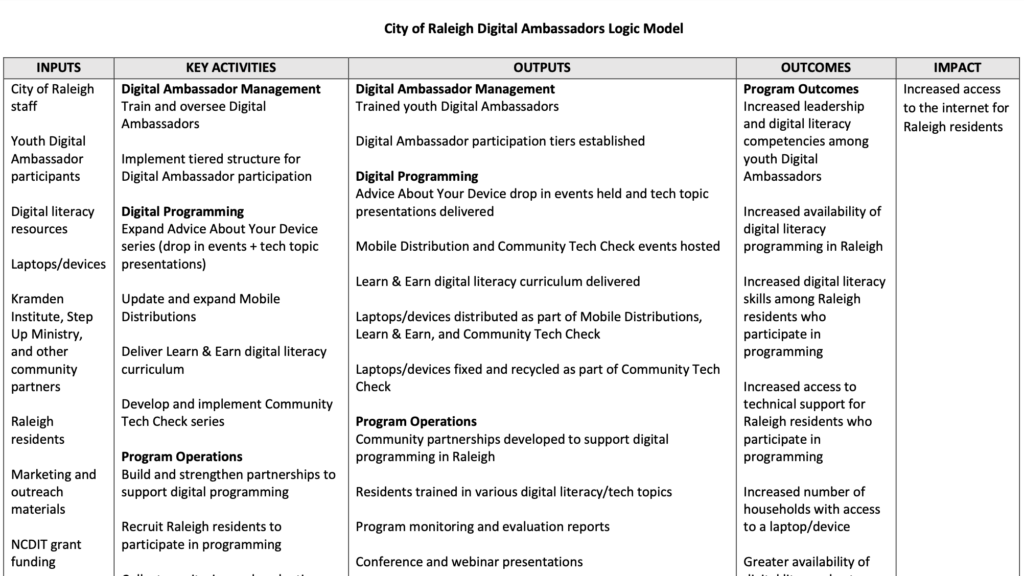
This logic model outlines a digital inclusion program designed to expand digital literacy, device access, and technical support for residents through youth leadership and community partnerships.
This project overview presentation outlines a digital equity initiative focused on evaluating and addressing the digital divide through expanded broadband access, devices, and digital literacy programs.