Digital service (DS) teams across the public sector are working to improve how services are delivered to residents. These teams exist at all levels of government and are iteratively using data, technology, and human-centered design to reframe how residents interact with government.
Code for America discusses the importance of a people-centered, digital-first safety net. Tools of technology, policy, and good implementation can advance a bold vision that will allow the nation to push through the end of the COVID-19 crisis.
Jennifer Pahlka, Deputy CTO in President Obama’s Administration and author, shares her new book, Recoding America on how government must be equipped for digital delivery in order to meet ambitious policy goals. This video was recorded at the Digital Benefits Conference (BenCon) at Georgetown University on June 14, 2023.
SNAP Waivers and Adaptations During the COVID-19 Pandemic: A Survey of State Agency Perspectives in 2020 is a study conducted by the Johns Hopkins Institute for Health and Social Policy (IHSP) based at Johns Hopkins Bloomberg School of Public Health and the American Public Human Services Association (APHSA). This research seeks to understand perspectives from state SNAP administrators on the successes, challenges, and lessons learned from waivers and flexibilities used to preserve equitable access to SNAP during the COVID-19 pandemic. Based on state agency survey responses, this report summarizes key findings from the first calendar year of pandemic response and provides policy considerations for the future of SNAP. This research was supported by Healthy Eating Research, a national program of the Robert Wood Johnson Foundation.
Johns Hopkins Institute for Health and Social Policy
In this webinar, a panel of experts discuss what states can do right now to improve EBT security, how to use data to analyze theft patterns, and how EBT payment technology needs to evolve to ensure efficiency, security, and dignity for beneficiaries.
This toolkit provides guidance for state and local WIC agencies on implementing digital tools to enhance participant engagement and streamline program operations.
This nine-minute video, produced after the completion of the TANF Data Collaborative (TDC) Pilot, features staff members from the California, Colorado, Minnesota, and Virginia TANF agencies reflecting on their challenges, accomplishments, and general experiences during the pilot. In particular, they describe their research questions and discuss building data capacity, integrating datasets, networking with other states, increasing collaboration between state and county agencies, learning new technical skills, and the benefits of being able to draw from diverse skillsets, all within the context of the TDC Pilot.
Through the ACCESS project, key collaborators have shared insights into current and future opportunities for alignment within their agencies, including potential enablers for and barriers to alignment activities.
American Public Human Services Association (APHSA)
Though the rhetoric of “waste, fraud, and abuse” is ubiquitous when it comes to welfare programs, low-income households receive little relief from benefits programs. Most efforts to make public benefits systems more “efficient” actually just waste time and money in practice. They instead serve to stigmatize low-income families and chip away at the little assistance that remains available to them.
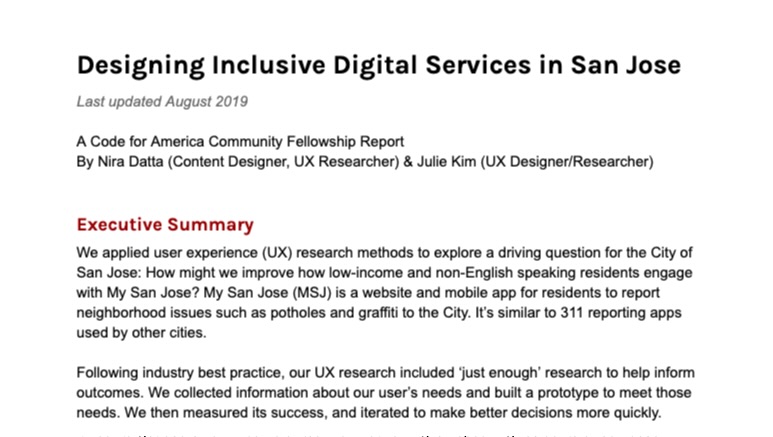
Applying UX research methods, the City of San Jose worked to improve how low-income and non-English speaking residents engaged with My San Jose, a website and mobile app for residents to report neighborhood issues to cities. They used a Spanish and Vietnamese translator to conduct interviews with target users, then detailed major findings and corresponding recommendations in this report.