Technology enables governments to engage in “pilot” projects to see where they are headed and course-correct along the way, as opposed to evaluating the results over the course of multiple years. Delivery-driven government utilizes technology and “pilot” projects to see institutions and processes through the eyes of users, allowing for more effective service delivery.
This primer is written for a non-technical audience to increase understanding of the terminology, applications, and difficulties of evaluating facial recognition technologies.
This report examines how states strategically approached managing and administering the historic influx of COVID-19 relief funds for child care and early childhood systems, focusing on governance structures, funding management systems, and data systems
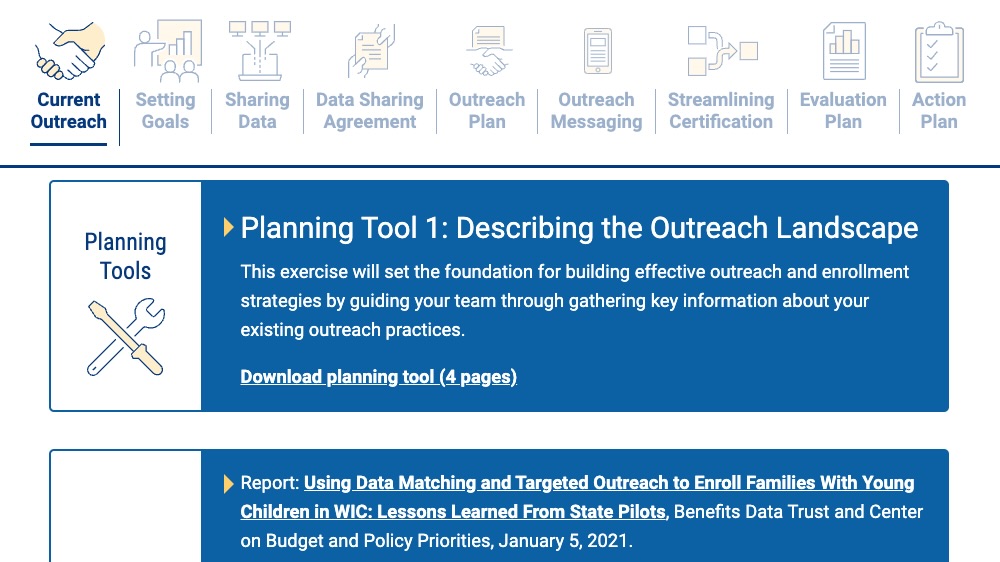
The toolkit provides strategies for state and local WIC agencies to enhance enrollment by utilizing data from Medicaid and SNAP for cross-program data matching and targeted outreach.
At Rules as Code Demo Day Seth Hartig from the National Center for Children in Poverty (NCCP) and Bank Street College demoed the Policy Rules Database (PRD), a collaborative effort between the Federal Reserve Bank of Atlanta and the NCCP. The primary purpose of the PRD is to simplify the interpretation of all programs by creating a common structure and a common terminology. The repository allows for research on public assistance programs and tax policies, and helps users model benefits cliffs on career pathways. The PRD is supported by a technical manual with pseudocode that helps guide integration and usage in other platforms.
This mainstage session from FormFest 2024 included conversations about form design, accessibility, user experience, and data collection to show how good forms can build trust and confidence in government.
This session from FormFest 2024 focuses on accessibility, featuring British Columbia’s work to improve legal form usability and tips from the Wisconsin Department of Public Instruction on making forms more accessible overall.
This session from FormFest 2024 features the South Carolina Early Childhood Advisory Council’s work developing a single portal to integrate applications for publicly funded programs and services, and the office of Federal Student Aid’s work on the FAFSA form.
Sheev Davé, Product Manager at Notify.gov (GSA), provides an overview of what makes an effective multilingual translation through the principles of designing tools that have the ability to have conversations, meeting communities where they are, use of plain language and prioritize tricky topics, key life events and using trusted delivery sources.