This report explores Michigan’s implementation of the Pandemic Electronic Benefit Transfer (P-EBT) program. Drawing on interviews from individuals within the Michigan Department of Health and Human Services and input from SNAP participants via surveys distributed using the Fresh EBT app, this report provides insights into the strategies that enabled Michigan to roll out an entirely new program quickly and effectively.
This FormFest profile highlights Rachael Zuppke and Molly Graham’s work to redesign Michigan’s civil court forms using human-centered design, making them more accessible for people who must represent themselves in critical cases like eviction, family law, and guardianship.
This resource highlights strategies for integrating benefits renewals and correspondence, potentially reducing administrative burdens for both clients and caseworkers.
This case study highlights Michigan’s integrated, data-driven approach to reducing food insecurity through cross-agency collaboration, referral tracking, and targeted outreach.
American Public Human Services Association (APHSA)
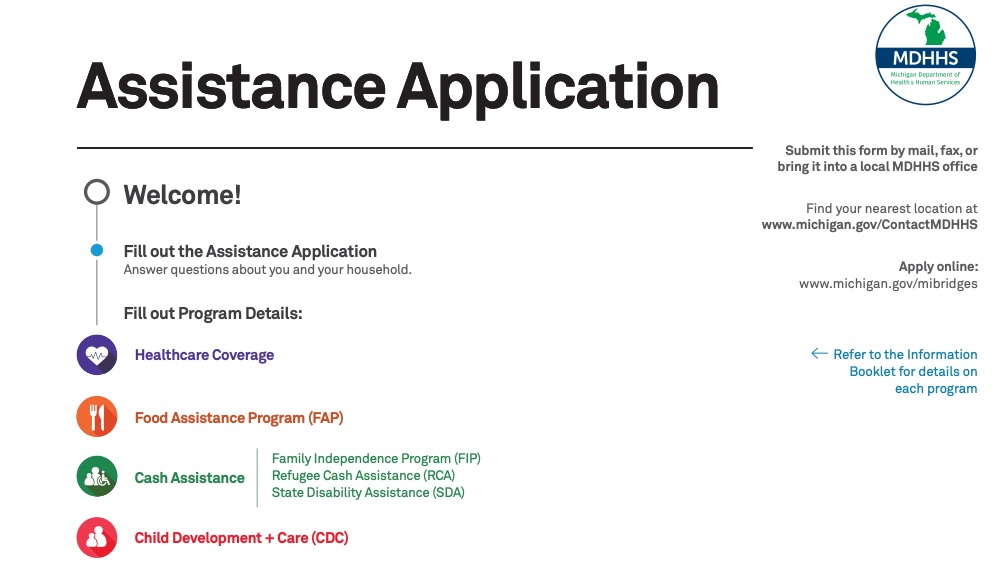
This resource outlines strategies for cross-enrollment outreach, which can break down silos between programs and reach applicants who may be eligible for under-enrolled benefits programs.
This report documents four experiments exploring if AI can be used to expedite the translation of SNAP and Medicaid policies into software code for implementation in public benefits eligibility and enrollment systems under a Rules as Code approach.
The Michigan Department of Health and Human Services, together with the Food Bank Council of Michigan and the Michigan Department of Education developed a comprehensive Food Insecurity Map and a closed-loop referral system for nutrition and economic supports.
American Public Human Services Association (APHSA)
Code for America partnered with the CBPP, Civilla, and Nava to launch the Integrated Benefits Initiative, testing and piloting human-centered approaches to improve outcomes and learn what an optimal safety net could look like. This article describes key takeaways from short-term pilots implemented as part of this project.