The report beings by briefly describing the challenge that disabled workers face in accessing UI and the benefits of reforming the system to better serve these workers. The report then presents a list of considerations for UI reform in the areas of administrative process and technology improvements as well as considerations for policy change.
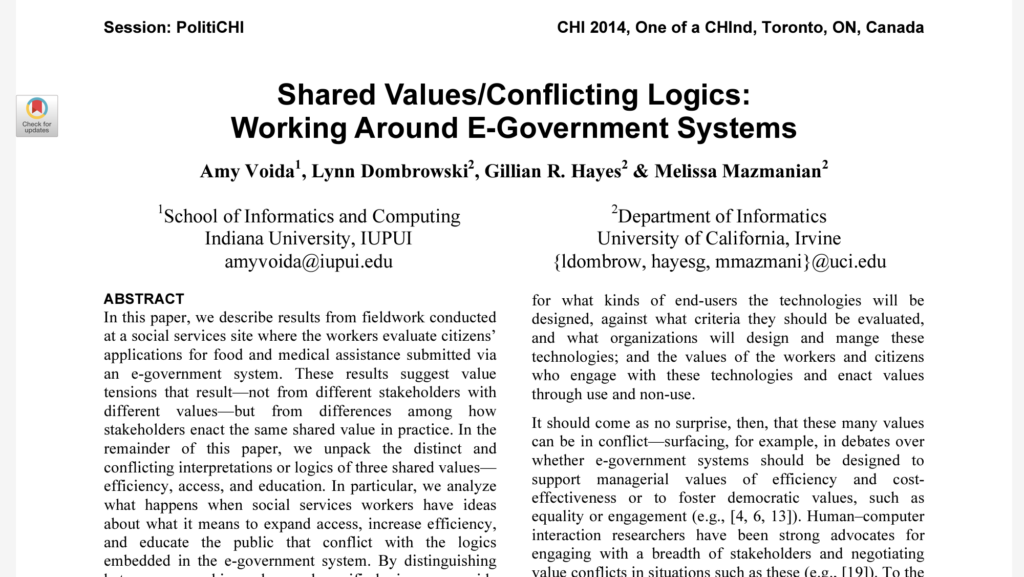
This paper describes results from fieldwork conducted at a social services site where the workers evaluate citizens' applications for food and medical assistance submitted via an e-government system. These results suggest value tensions that result - not from different stakeholders with different values - but from differences among how stakeholders enact the same shared value in practice.
CHI '14: Proceedings of the SIGCHI Conference on Human Factors in Computing Systems
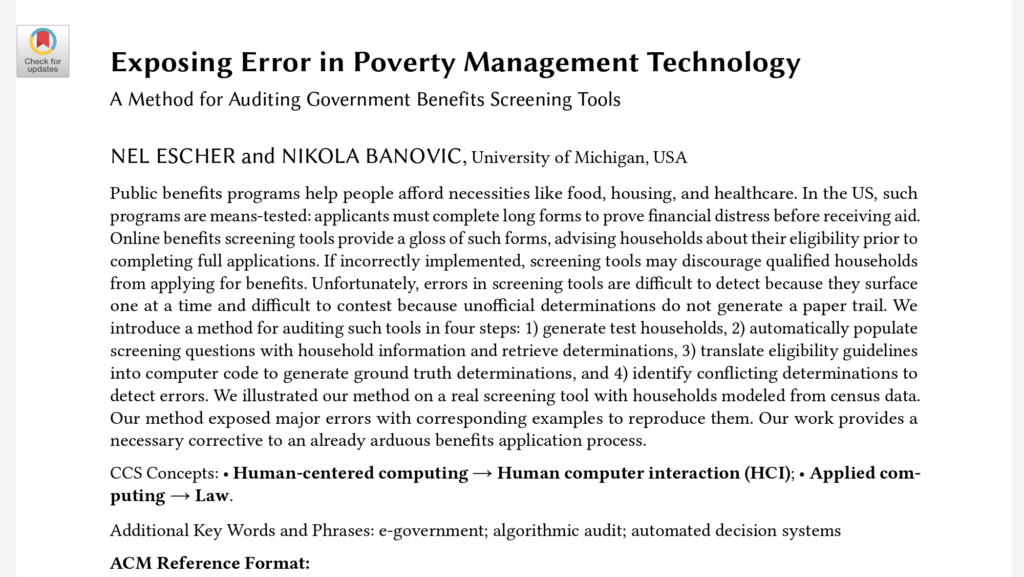
This paper introduces a method for auditing benefits eligibility screening tools in four steps: 1) generate test households, 2) automatically populate screening questions with household information and retrieve determinations, 3) translate eligibility guidelines into computer code to generate ground truth determinations, and 4) identify conflicting determinations to detect errors.
This paper introduces the problem of semi-automatically building decision models from eligibility policies for social services, and presents an initial emerging approach to shorten the route from policy documents to executable, interpretable and standardised decision models using AI, NLP and Knowledge Graphs. There is enormous potential of AI to assist government agencies and policy experts in scaling the production of both human-readable and machine executable policy rules, while improving transparency, interpretability, traceability and accountability of the decision making.
Washington Technology Solutions (WaTech) launched a three-year (2024-2026) strategic plan centered around three key goals: optimize service delivery for customers, cultivate an flexible and innovative workplace, and establish WaTech's role as a statewide technology leader.
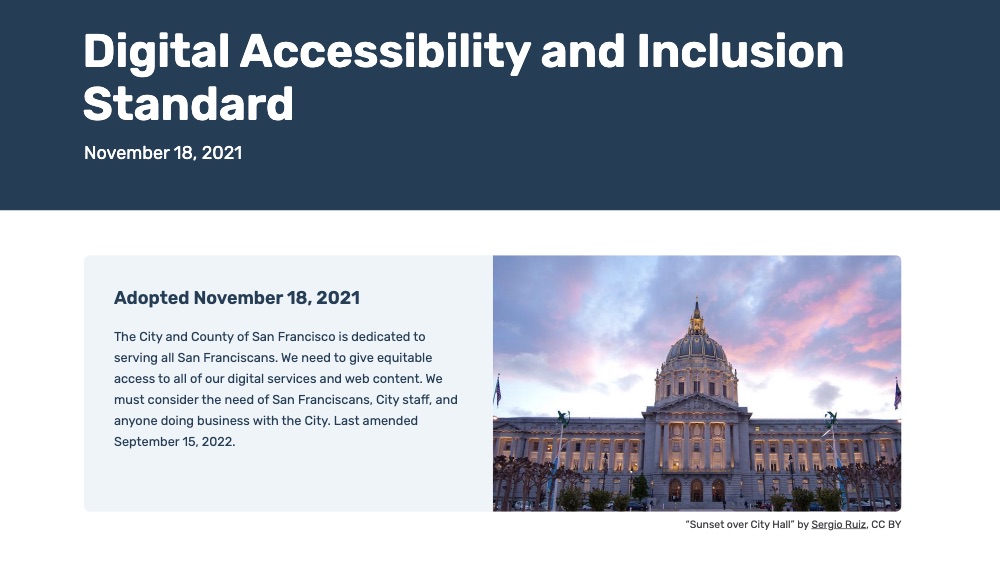
City and County of San Francisco's Digital Accessibility and Inclusion Standard which ensures equitable access to all of digital services and web content for San Franciscans.
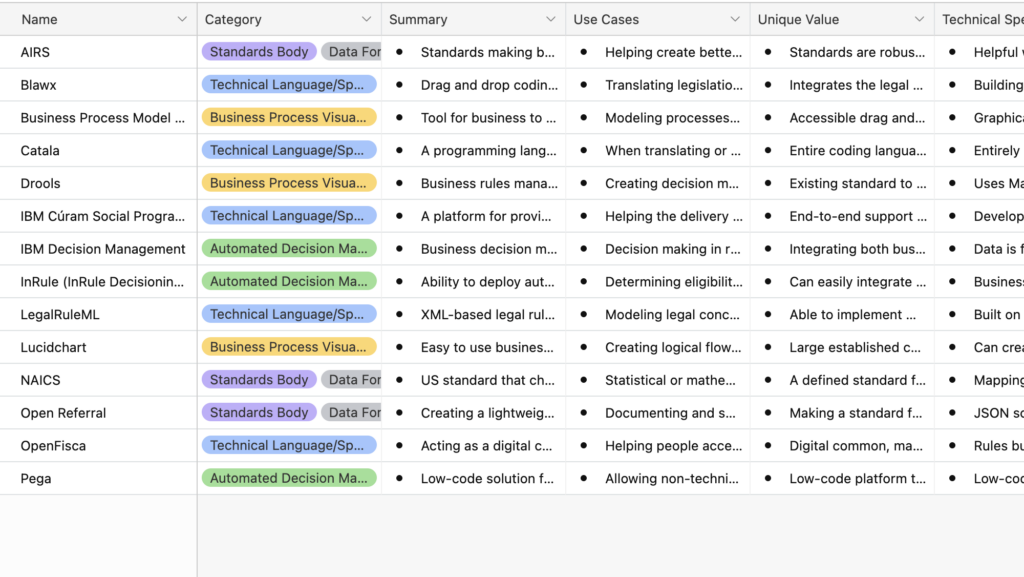
There are frameworks available that could inform the standardization of communicating rules as code for U.S. public benefits programs. The Airtable communicates the differences between the frameworks and tools. Each entry is tagged with different categories that identify the type of framework or tool it is.