A framework that helps policy and digital service teams interpret legislation by identifying user needs, intent, and implementation challenges to support more effective, human-centered government service delivery.
This publication summarizes a body of research about how state benefits administering agencies build and maintain integrated eligibility and enrollment (IEE) systems. It is an easy to reference guide for state administrators, legislators, advocates, and delivery partners.
“Interoperability” refers to systems’ ability to interact with each other to share data so that a customer is connected with as many benefits as possible in an efficient way. The Affordable Care Act (ACA) was originally intended to be interoperable, but this has not occurred yet. Promoting interoperability in the ACA is imperative, as it would help alleviate food insecurity through automatic benefits enrollment.
This report examines how the U.S. federal government can enhance the efficiency and equity of benefit delivery by simplifying eligibility rules and using a Rules as Code approach for digital systems.
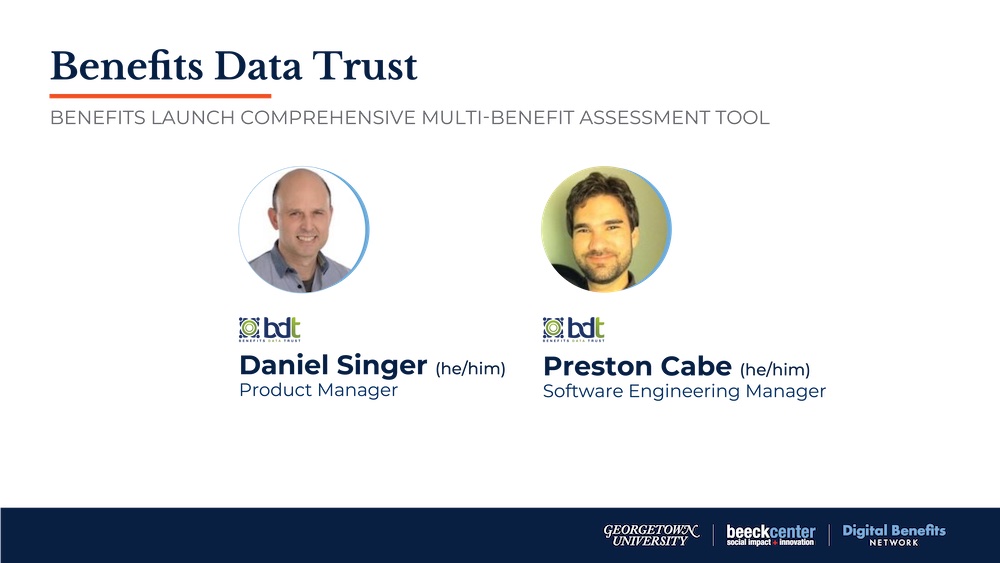
We continued Rules as Code Demo Day with Daniel Singer and Preston Cabe from Benefits Data Trust. Benefits Data Trust provides benefit outreach and application assistance services in seven states. Using Benefits Launch, their in-house interview and rules engine, they support two hundred contact center employees as they screen and apply thousands of clients each year. They also offer a self-service screener, Benefits Launch Express. Additionally, they offer an eligibility API to integrate with other services.
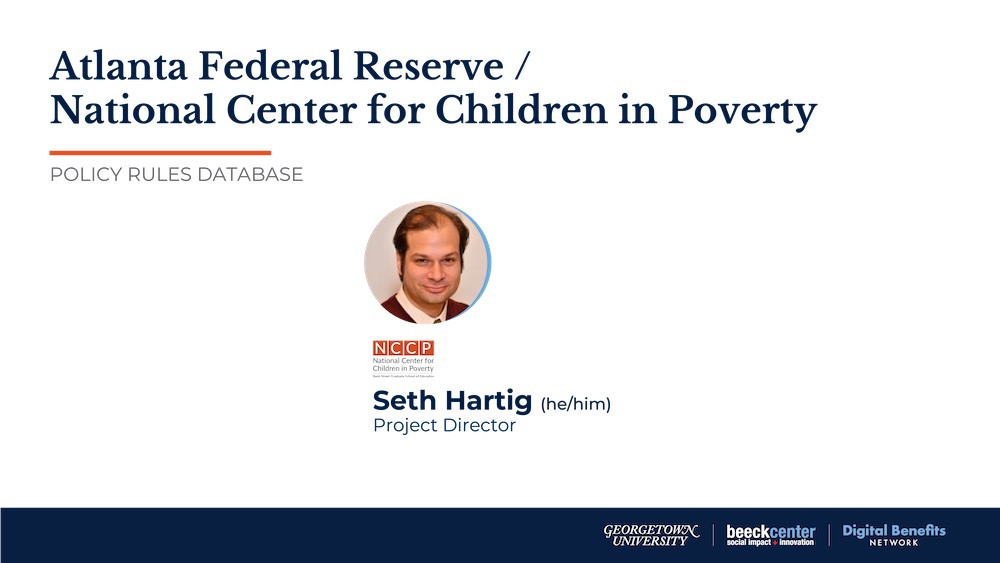
At Rules as Code Demo Day Seth Hartig from the National Center for Children in Poverty (NCCP) and Bank Street College demoed the Policy Rules Database (PRD), a collaborative effort between the Federal Reserve Bank of Atlanta and the NCCP. The primary purpose of the PRD is to simplify the interpretation of all programs by creating a common structure and a common terminology. The repository allows for research on public assistance programs and tax policies, and helps users model benefits cliffs on career pathways. The PRD is supported by a technical manual with pseudocode that helps guide integration and usage in other platforms.
Digitizing public benefits policy will make the biggest impact for administrators and Americans, but only if it happens at the highest level of government.
The first half of Rules as Code Demo Day was wrapped up with Thomas Guillet who has contributed to Open Fisca France and beta.gouv. He demoed the code for Mes Aides—or My Benefits—which is France’s social benefit simulator that leverages open source rule models for over 600 benefits while keeping the displayed complexity to its minimum.
It is frequently assumed that when rules are implemented as code, a rules engine is necessary. However, it is possible for policy people and engineers to effectively work together to code logic that drives technological system without needing a mediating rules engine at all.