AI Agents for Streamlining Safety Net Applications
Low-income families face complex, time-consuming processes to access critical public benefits, resulting in $228 billion in unclaimed assistance in 2022 alone. Many caseworkers spend significant time on repetitive, manual application tasks, rather than directly supporting clients. This FormFest session explored how generative artificial intelligence (AI) can transform service delivery by automating key form-related workflows—with human oversight—to free up caseworker time, improve application accuracy, and accelerate benefit access.
Main Points
This project aims to build an intelligent assistant that reduces administrative burdens on social workers by pre-filling benefit applications, flagging missing information, and supporting multi-program submissions, ultimately helping families receive the benefits they are entitled to.
The AI system prioritizes safety, consent, and data protection and focuses on supporting staff rather than replacing roles; ongoing evaluation examines accuracy, consistency, human interaction quality, and appropriate oversight.
Lessons Learned
Trust and in-person support are essential; workers struggle with duplicative data entry and complex family cases. Transparency, workflow integration, and clear communication are crucial for adoption and change management.
Actionable Takeaways
Understand workflows before automating, expect iteration due to rapidly evolving AI, maintain user-centered design and communication, and keep the focus on the core mission—streamlining access to services and preserving client dignity.
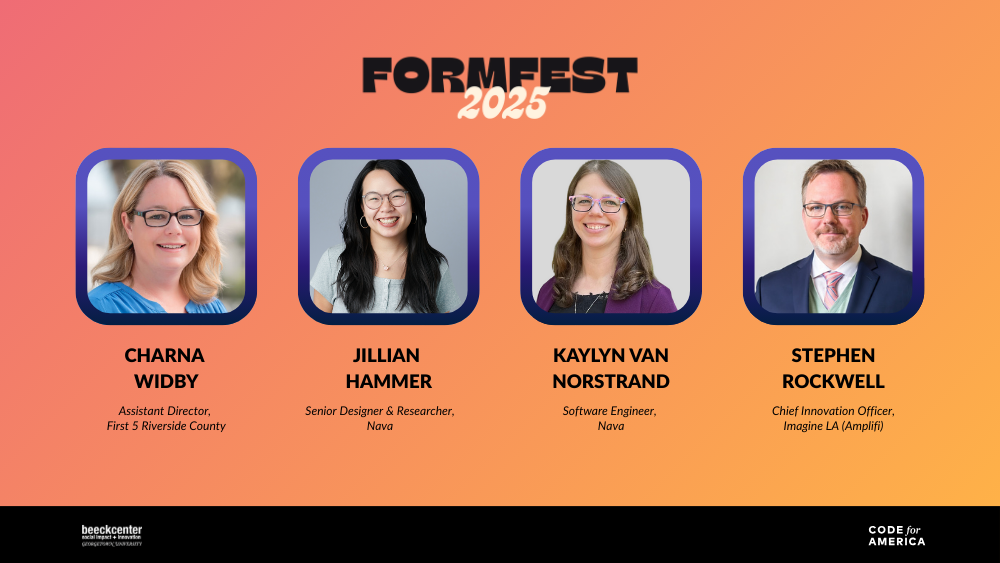
Panelists Charna Widby, Kaylyn van Norstrand, Stephen Rockwell, and discussion leader Jillian Hammer shared a pilot program created by Benefit Navigator, Nava Labs, and First 5 Riverside to develop an AI agent to assist with the form filling process to access government benefits. Often, households do not receive all of the government benefits they are eligible for as a result of administrative challenges. Social workers are overwhelmed by a large caseload and backlog, making it challenging for them to take time to fill out forms thoroughly for each case. Through this project, Widby, van Norstrand, Rockwell, and Hammer hope to create an intelligent assistant that helps caseworkers quickly complete benefit applications for families. It does this by listening to their needs, analyzing available data, and pre-filling forms on behalf of households. The AI agent can flag missing information, prepare applications for approval, and monitor application status.
Trust is hard. It’s hard for governments to trust things outside of their comfort zone.”
Charna Widby Assistant Director, First 5 Riverside County
As they continue to develop this agent, Widby, van Norstrand, Rockwell, and Hammer highlight how government partners, households, and social workers are deeply integrated in the development process. Widby said that they will never lose sight of their “guiding north star” in this process: centering government partners and social workers. Widby shared the transparency they maintained throughout the development process helped government stakeholders feel more at ease. Ultimately, their focus is on making the form-filling process easier for social workers and not to eliminate the role of caseworkers as a whole.
In an environment where the technology they use changes every day, there is always a level of experimentation when creating the solution—especially given the newness of the software, according to Rockwell. The team’s experience reflects this reality: they emphasized that building an AI assistant is not just a technical exercise, but an ongoing process of learning alongside users, refining workflows, and adapting to rapidly evolving tools. Throughout discovery and design, they centered trust, transparency, and dignity, focusing not on the technology itself but on improving how families access essential benefits. By grounding innovation in real needs, clear communication, and thoughtful safeguards, they are creating a system that supports social workers, respects clients, and remains flexible enough to grow as the technology continues to evolve.
See more from this session at FormFest 2025:
Watch the session recording and more from FormFest 2025.
This FormFest profile highlights Riverside County’s pilot of AI-powered interviews that streamline benefit applications, reducing bureaucratic burden on families in crisis while freeing caseworkers to focus on human connection.
Explore how generative AI is changing public benefits by automating application tasks, boosting accuracy, and freeing up caseworker time.
About FormFest
FormFest is a free virtual event showcasing governments working to make services accessible to everyone through online forms. Discover best practices and tools that are shaping the future of form design and service delivery.