Remote identify proofing is the process federal agencies and other entities use to verify that the individuals who apply online for benefits and services are who they claim to be. If the applicant responds correctly to personal questions, their identity is considered to be verified. However, data stolen in recent breaches could be used fraudulently to respond to knowledge-based verification questions. Alternative methods are available that provide stronger security, but these methods may have limitations in cost, convenience, technological maturity, and they may not be viable for all segments of the public.
The Technology Code of Practice is a set of government guidelines for designing, building, and buying digital services and technology to ensure they are efficient, accessible, and cost-effective in the UK.
These guidelines provide UK government organizations with best practices for responsibly and effectively procuring artificial intelligence (AI) systems.
This brief provides research recommendations to improve programs serving LGBT youth, focusing on homelessness and sexual health education services funded by the U.S. Department of Health and Human Services.
U.S. Department of Health and Human Services (HHS)
This brief outlines research recommendations to better understand and improve income support and employment services for low-income and at-risk LGBT populations.
U.S. Department of Health and Human Services (HHS)
Monthly SNAP participation data for the United States and every state, from October 1988 through the latest month published by USDA Food and Nutrition Service (generally a 3-month lag).
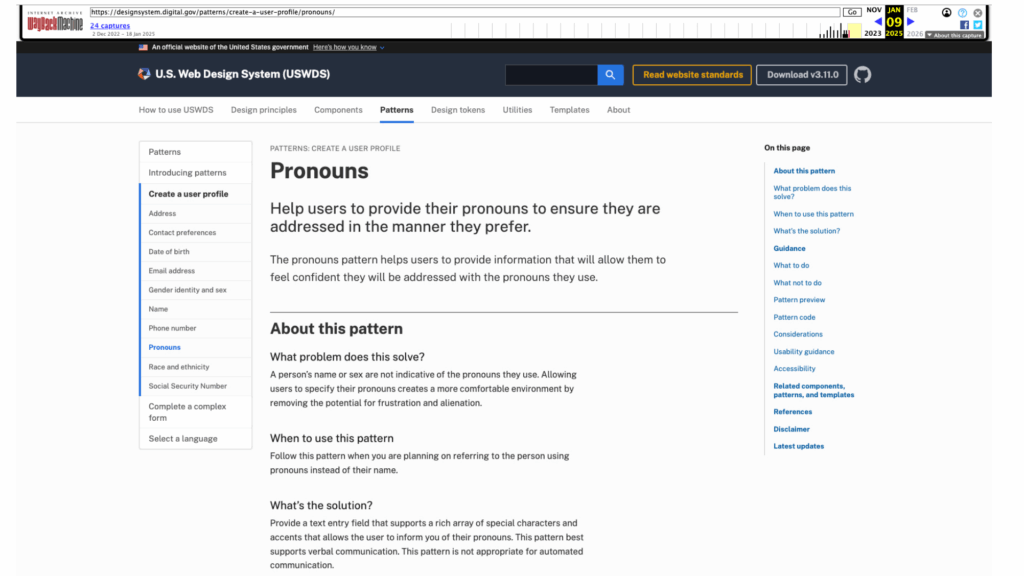
This page provides a U.S. Web Design System pattern for collecting pronoun information in user profiles in a way that respects identity, supports data standards, and promotes inclusion.
A guiding framework for designing, building, buying, and maintaining digital government services in Nova Scotia that emphasizes trust, inclusivity, sustainability, and public value.
Guidance outlining how Australian government agencies can train staff on artificial intelligence, covering key concepts, responsible use, and alignment with national AI ethics and policy frameworks.
An overview of direct cash programs and innovations in the U.S., exploring how unconditional cash transfers promote economic stability, mobility, and well-being.
This page reports on key metrics assessing how well federal websites are performing against standards for accessibility, mobile usability, search, feedback, design consistency, analytics, and security.
This brief explores the relationship between economic hardship and child welfare involvement, examining how direct cash transfers (DCTs) can reduce child maltreatment and strengthen family stability.