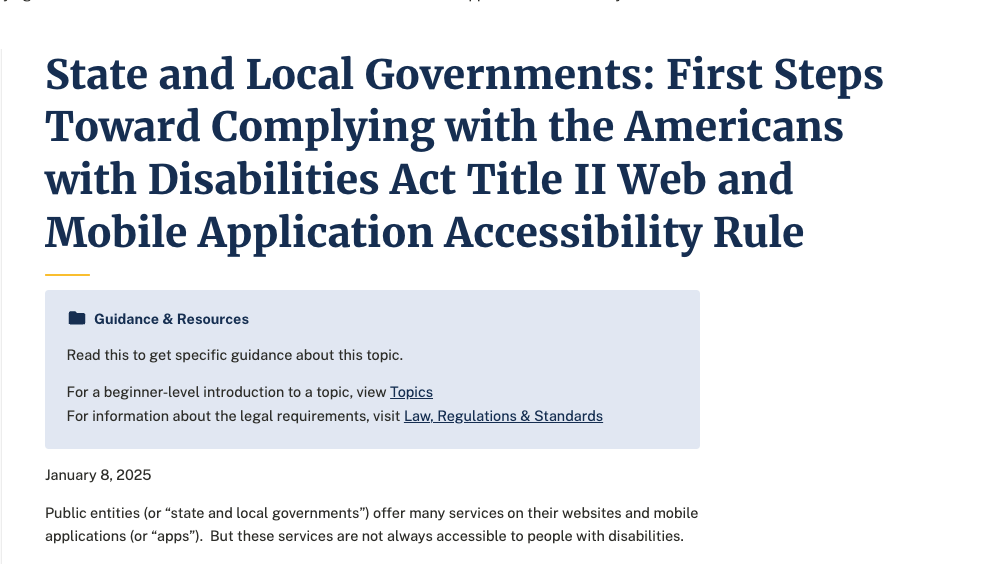
A guidance resource for state and local governments outlining first-step actions to prepare for compliance with the new web and mobile accessibility rule under Americans with Disabilities Act (ADA).
This site contains resources explaining the 2025 Working Families Tax Cut Act (WFTC) — formally Public Law 119-21, which changes eligibility, financing, and community-engagement requirements for Medicaid and Children’s Health Insurance Program (CHIP).
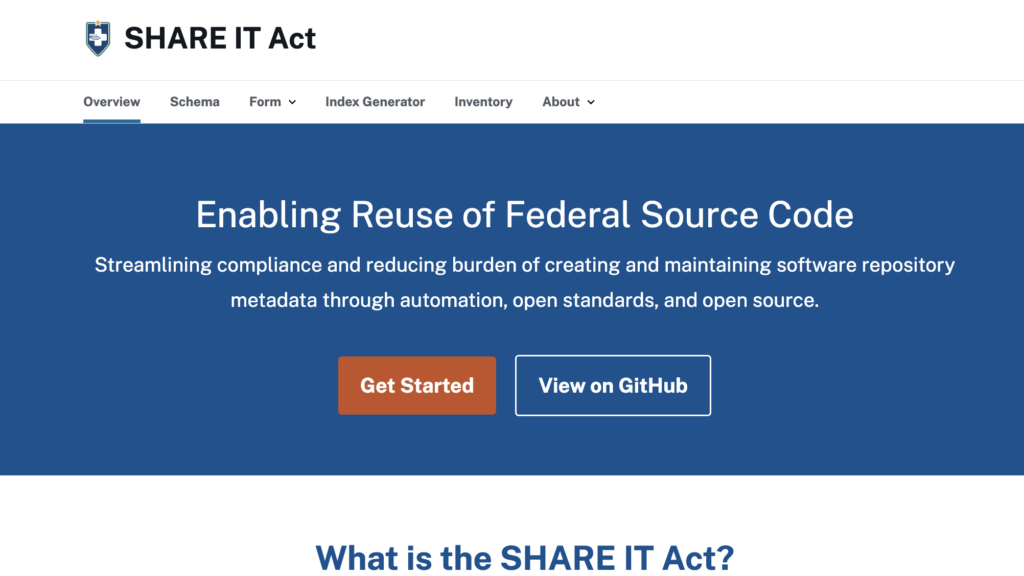
A public web guide designed to help federal agencies understand and implement the SHARE IT Act’s code-sharing requirements, with documentation, tools, and procedural resources for compliance.
U.S. Department of Health and Human Services (HHS)
This guidance provides detail on activities to be conducted by designated High-Impact Service Providers (HISPs) under the Executive Order on Customer Experience.
The report evaluates the feasibility, costs, taxpayer interest, and operational challenges of implementing an IRS-run free direct e-file tax return system, as required by the Inflation Reduction Act.
This toolkit is designed to support government agencies in evaluating the effectiveness of their public participation and community engagement (PPCE) activities.
This report outlines the U.S. Department of Labor’s comprehensive action plan to strengthen the unemployment insurance (UI) system by addressing chronic underfunding and proposing legislative reforms to support long-term modernization and resilience.
This "Styles" section introduces design tokens that encode brand and design decisions for basic style elements like colors, typography, and spacing, ensuring consistency across Government of Canada digital services.
This blog explains how to provide culturally and linguistically appropriate services to individuals who have experienced trafficking, emphasizing the importance of cultural competence and the CLAS Standards.
U.S. Department of Health and Human Services (HHS)
This blog discusses a resource developed by the Digital Service at the Centers for Medicare & Medicaid Services (CMS) to assist individuals in navigating mental health, drug, or alcohol issues and connecting with appropriate support services.
U.S. Department of Health and Human Services (HHS)
Monthly SNAP participation data for the United States and every state, from October 1988 through the latest month published by USDA Food and Nutrition Service (generally a 3-month lag).