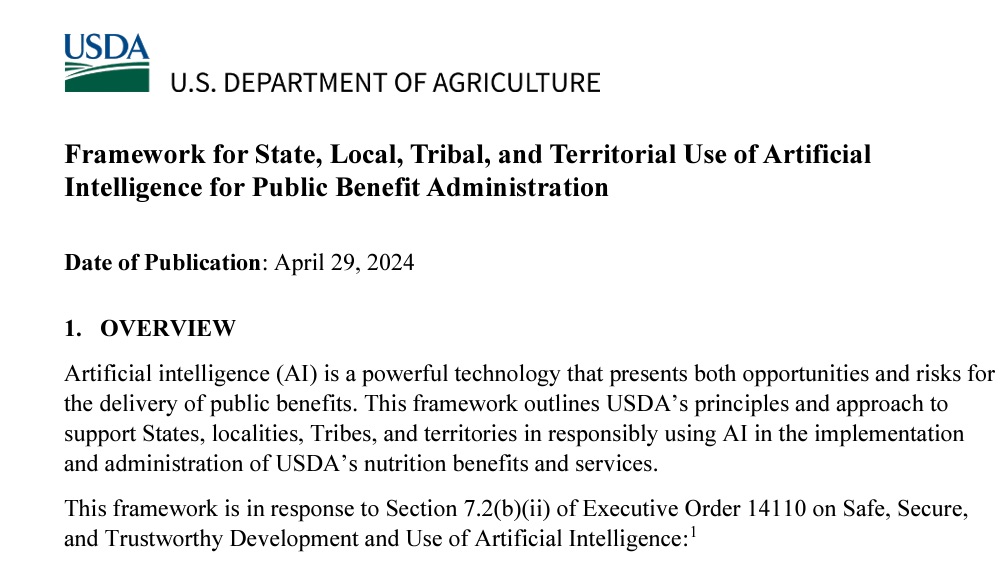
This framework outlines USDA’s principles and approach to support States, localities, Tribes, and territories in responsibly using AI in the implementation and administration of USDA’s nutrition benefits and services. This framework is in response to Section 7.2(b)(ii) of Executive Order 14110 on Safe, Secure, and Trustworthy Development and Use of Artificial Intelligence.
AI resources for public professionals on responsible AI use, including a course showcasing real-world applications of generative AI in public sector organizations.
A report assessing City of San José's AI governance practices against the NIST AI Risk Management Framework, identifying gaps, and outlining recommendations to strengthen AI oversight and accountability.
Guidance outlining how Australian government agencies can train staff on artificial intelligence, covering key concepts, responsible use, and alignment with national AI ethics and policy frameworks.
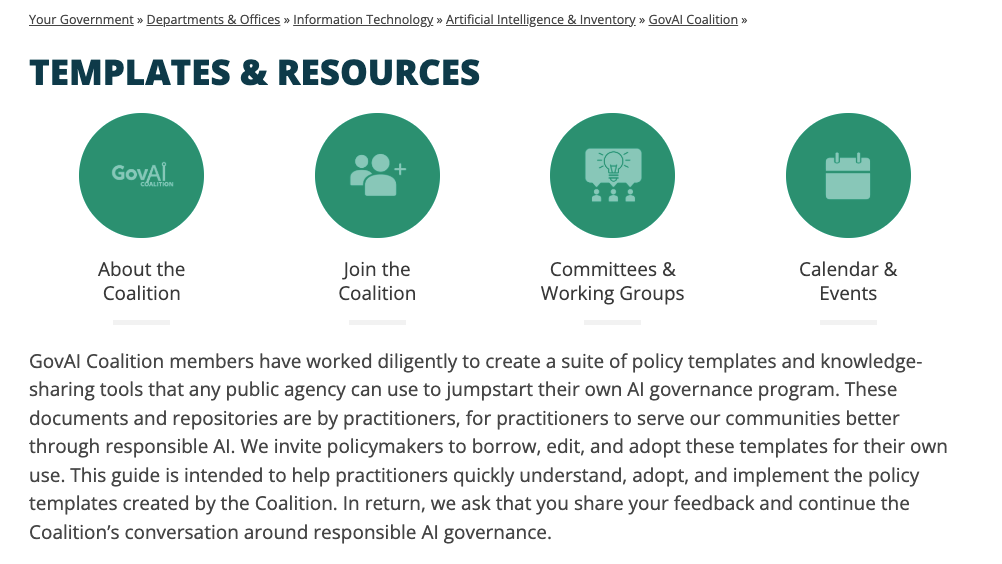
A publicly-available suite of policy templates and knowledge-sharing tools offered by the GovAI Coalition (via the City of San José) to help public agencies launch or refine responsible AI governance programs.
An in-depth report that examines how states use automated eligibility algorithms for home and community-based services (HCBS) under Medicaid and assesses their implications for access and fairness.
A unified taxonomy and tooling suite that consolidates AI risks across frameworks and links them to datasets, benchmarks, and mitigation strategies to support practical AI governance.
A critical landscape report examining how the AI industry concentrates corporate power, reshapes public institutions, and advances economic and political interests that undermine democracy, labor, and shared prosperity.
An academic research paper introducing SHADES, a multilingual benchmark designed to evaluate how large language models (LLMs) generate and reinforce stereotypes across different languages and cultural contexts.
A policy paper from the OECD examining how emerging technologies such as artificial intelligence, blockchain, and virtual reality can help governments address challenges in civic participation and strengthen democratic engagement.
Organisation for Economic Co-operation and Development (OECD)
A practical, step-by-step guide for government agencies to design, implement, and evaluate community engagement efforts around the use of artificial intelligence.
This report documents four experiments exploring if AI can be used to expedite the translation of SNAP and Medicaid policies into software code for implementation in public benefits eligibility and enrollment systems under a Rules as Code approach.